
We read your photo as:
Argue for or against the adoption of multilingualism in teaching, learning, and assessment in linguistically diverse countries.
ScanSolve AI Answer
Step-by-step solution
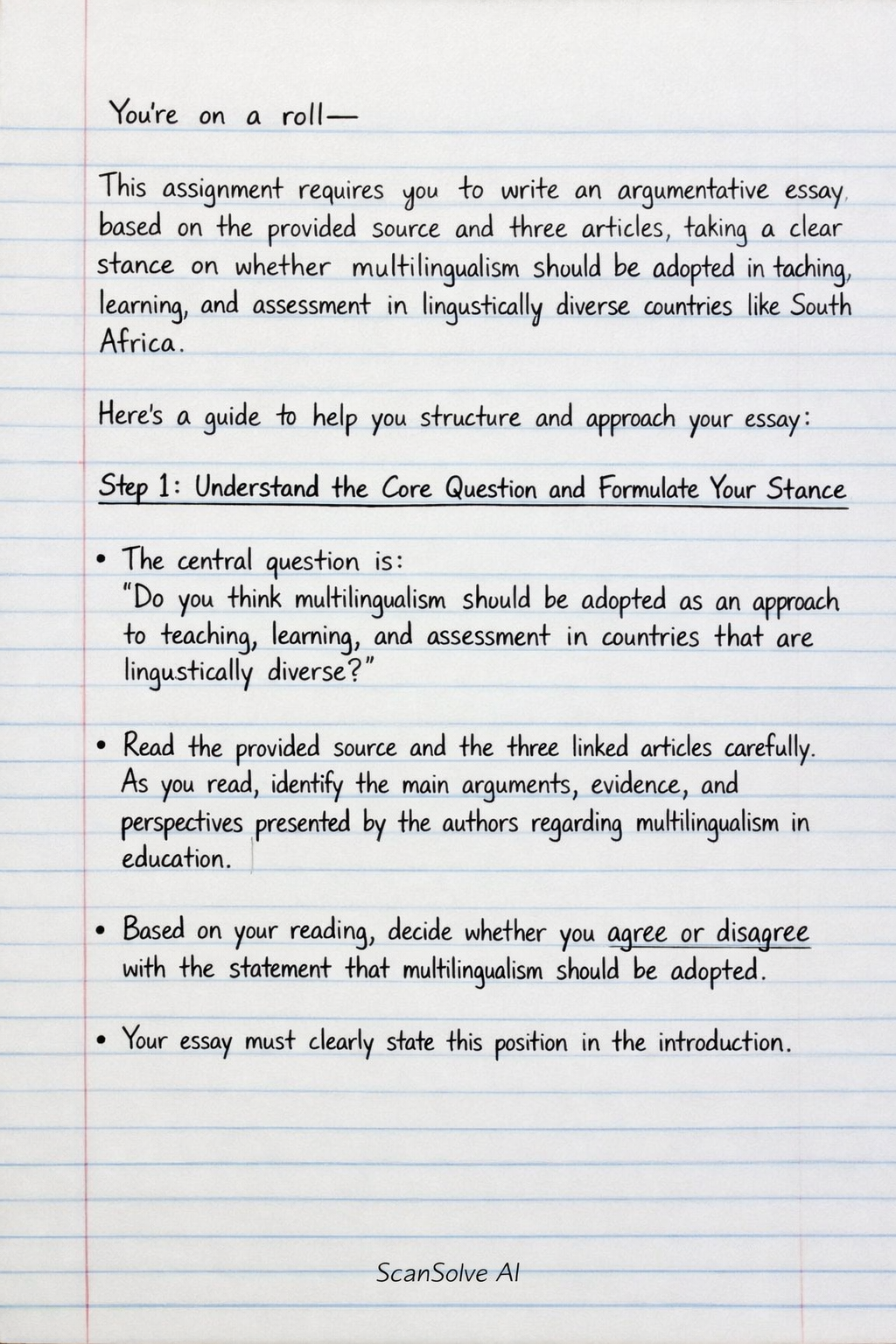
5 stepsThis assignment requires you to write an argumentative essay based on the provided source and three articles, taking a clear stance on whether multilingualism should be adopted in teaching, learning, and assessment in linguistically diverse countries like South Africa.
Here's a guide to help you structure and approach your essay:
Understand the Core Question and Formulate Your Stance
The central question is: "Do you think multilingualism should be adopted as an approach to teaching, learning, and assessment in countries that are linguistically diverse?"
- Read the provided source and the three linked articles carefully. As you read, identify the main arguments, evidence, and perspectives presented by the authors regarding multilingualism in education.
- Based on your reading, decide whether you agree or disagree with the statement that multilingualism should be adopted. Your essay must clearly state this position in the introduction.
Plan Your Essay Structure
An argumentative essay typically follows this structure:
- Introduction:
- Hook: Start with a general statement about language diversity in education.
- Background: Briefly introduce the context of multilingualism in diverse countries, referencing the provided source (Ndlangamandla & Chaka, 2023).
- Thesis Statement: Clearly state your stance (agree or disagree) on the adoption of multilingualism in teaching, learning, and assessment.
- Body Paragraphs (Three): Each paragraph will present one of your well-supported arguments.
- Topic Sentence: State your argument clearly.
- Explanation: Elaborate on your argument.
- Evidence: Support your argument with specific details, examples, or quotes from the three provided articles. Remember to cite correctly.
- Link back to thesis: Explain how this argument supports your overall stance.
- Conclusion:
- Restate Thesis: Rephrase your main argument in new words.
- Summarize Main Points: Briefly recap your three key arguments.
- Concluding Thought: Offer a final thought on the broader implications or future outlook of multilingualism in education.
- Introduction:
Develop Your Three Well-Supported Arguments
Your arguments should directly support your chosen stance and be backed by evidence from the articles.
- If you agree (for adopting multilingualism), your arguments might focus on:
- Cognitive benefits: How learning in multiple languages enhances cognitive development and critical thinking.
- Improved comprehension and academic performance: How using mother tongue or multiple languages can help students better understand complex concepts, especially in early grades.
- Cultural identity and inclusivity: How multilingual education affirms students' identities, promotes cultural heritage, and creates a more inclusive learning environment.
- Effective assessment: How assessing students in their strongest language can provide a more accurate measure of their knowledge and abilities.
- If you disagree or take a nuanced stance (against widespread adoption or highlighting challenges), your arguments might focus on:
- Practical implementation challenges: Difficulties in teacher training, resource development (textbooks, materials) for numerous languages, and curriculum design.
- Standardization and quality control: Challenges in maintaining consistent educational standards across many languages and ensuring quality instruction.
- Economic and social mobility: Concerns that focusing on local languages might hinder proficiency in a dominant language (like English), potentially limiting access to higher education or global job markets.
- Complexity of assessment: The logistical and methodological difficulties of developing fair and reliable assessments across a multitude of languages.
- If you agree (for adopting multilingualism), your arguments might focus on:
Integrate and Cite Sources
- You must cite only from the three provided articles (Link 1, Link 2, Link 3) and the initial source (Ndlangamandla & Chaka, 2023).
- For each argument, use direct quotes or paraphrase ideas from these articles to provide evidence. Ensure you correctly attribute the information to the authors.
Review and Refine
- Check for clarity, coherence, and logical flow of your arguments.
- Ensure your language is formal and academic.
- Proofread for grammar, spelling, and punctuation errors.
- Consult the marking rubric (on the next page of your document) to ensure your essay meets all the assessment criteria.
Still stuck on this one?
Ask a follow-up, and the answer starts from this question.
More English Questions
Handwritten Step-by-Step Solution
Get this as a handwritten image on WhatsApp — like a tutor wrote it for you.
Try on WhatsApp