
We read your photo as:
As an Early grade educator, present four (4) determinants of a child's first language acquisition and four arguments for using L1 as the medium of instruction.
ScanSolve AI Answer
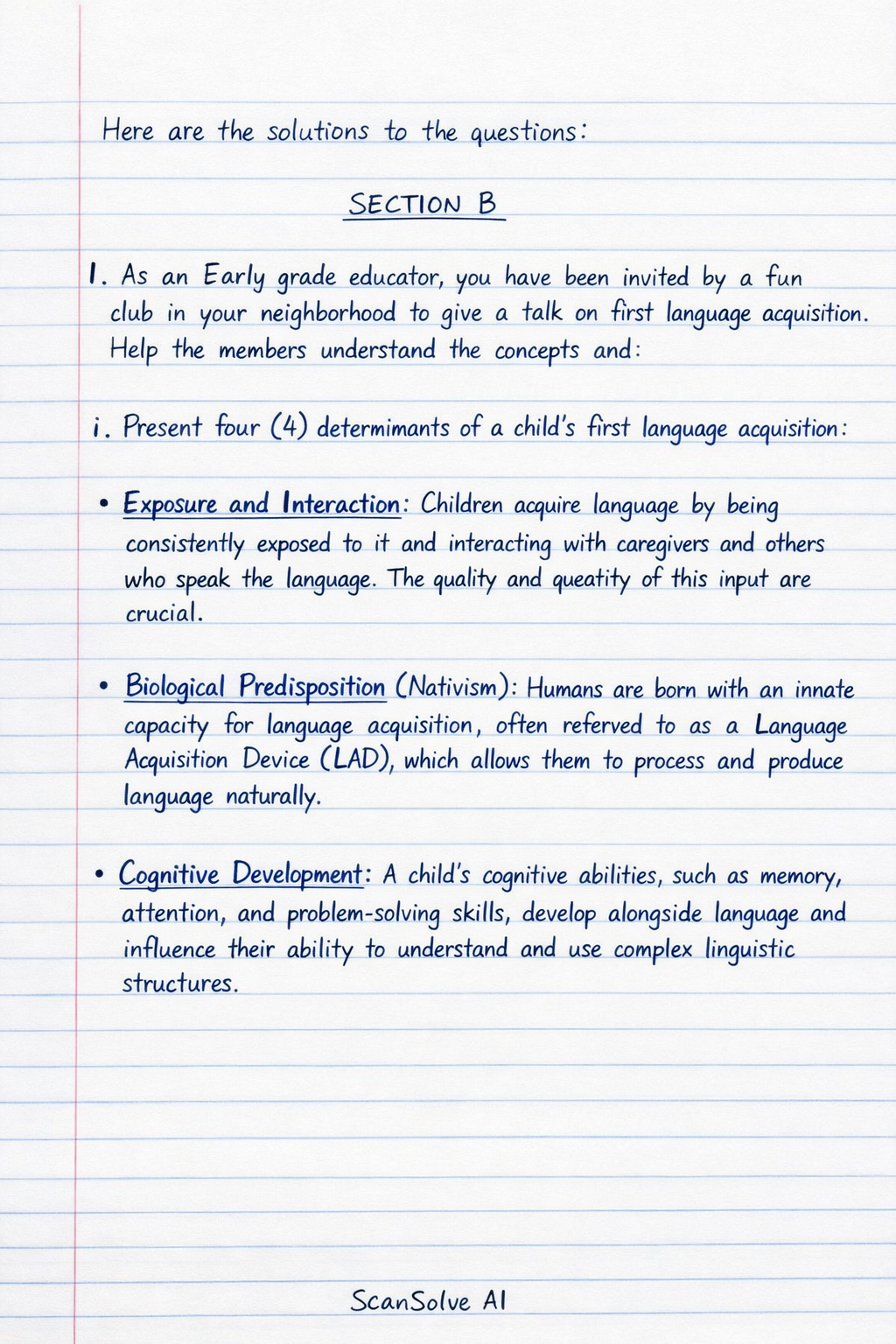
Here are the solutions to the questions:
SECTION B
1. As an Early grade educator, you have been invited by a fun club in your neighborhood to give a talk on first language acquisition. Help the members understand the concepts and:
-
i. Present four (4) determinants of a child's first language acquisition.
- Exposure and Interaction: Children acquire language by being consistently exposed to it and interacting with caregivers and others who speak the language. The quality and quantity of this input are crucial.
- Biological Predisposition (Nativism): Humans are born with an innate capacity for language acquisition, often referred to as a Language Acquisition Device (LAD), which allows them to process and produce language naturally.
- Cognitive Development: A child's cognitive abilities, such as memory, attention, and problem-solving skills, develop alongside language and influence their ability to understand and use complex linguistic structures.
- Motivation and Need: Children are motivated to acquire language to communicate their needs, desires, and thoughts, fostering social connections and enabling them to interact with their environment.
-
ii. Highlight four arguments in favour of the use of L1 as medium of instruction.
- Enhanced Comprehension: Students understand concepts more easily and deeply when taught in their first language (L1), as they don't have to simultaneously decode new language and new content.
- Stronger Cognitive Foundation: Learning in L1 helps develop stronger cognitive skills, critical thinking, and problem-solving abilities, which can then be transferred to learning in a second language.
- Cultural Identity and Self-Esteem: Using L1 in education validates a child's cultural background and language, fostering a positive self-image and encouraging active participation in learning.
- Improved Academic Performance: Research consistently shows that students who receive initial instruction in their L1 tend to perform better academically, including in the acquisition of a second language, compared to those immersed immediately in a second language.
2. State and explain five (5) components of an effective literacy programme.
- Phonological Awareness: The ability to recognize and manipulate the sound structure of spoken language, including rhyming, alliteration, and segmenting words into syllables and individual sounds (phonemes).
- Phonics: The understanding of the relationship between letters and sounds (grapheme-phoneme correspondence) to decode words. This involves systematic instruction in letter sounds and blending them to read words.
- Fluency: The ability to read text accurately, quickly, and with appropriate expression. Fluent readers can focus on comprehension rather than struggling with word recognition.
- Vocabulary: A strong understanding of word meanings is essential for comprehension. Effective programs include direct instruction of new words, teaching word-learning strategies, and encouraging wide reading.
- Comprehension: The ability to understand and interpret what is read. This involves teaching strategies such as making predictions, asking questions, summarizing, and identifying main ideas.
3. In a tabular form, outline five (5) major differences between language acquisition and language learning.
| Feature | Language Acquisition | Language Learning |
|---|---|---|
| Process | Subconscious, natural, implicit | Conscious, deliberate, explicit |
| Age | Typically occurs in childhood (first language) | Can occur at any age, often in formal settings |
| Environment | Informal, natural communication, immersion | Formal instruction, classroom setting |
| Focus | Meaning and communication | Rules, grammar, vocabulary |
| Error Tolerance | High tolerance for errors, seen as part of process | Low tolerance for errors, often corrected directly |
4. Discuss five (5) major challenges confronting language policy implementation in Ghana.
- Multilingualism and Diversity: Ghana has over 80 indigenous languages, making it challenging to select and implement a national language policy that adequately addresses the linguistic diversity without marginalizing certain groups.
- Resource Constraints: Implementing a language policy, especially one promoting indigenous languages, requires significant resources for developing teaching materials, training teachers, and conducting research, which are often scarce.
- Teacher Training and Capacity: Many teachers lack adequate training in teaching indigenous languages or in using them effectively as a medium of instruction, leading to inconsistent implementation and poor outcomes.
- Parental and Societal Attitudes: There can be a strong preference among parents and the wider society for English, viewing it as the language of opportunity and upward mobility, which can undermine efforts to promote indigenous languages in education.
- Lack of Standardized Orthographies and Materials: For some indigenous languages, there is a lack of standardized writing systems, comprehensive textbooks, and supplementary reading materials, hindering their effective use in formal education.
5. Identify two features for each of the following stages in literacy acquisition.
-
i. Emergent Literacy
- Pretending to read and write: Children engage in activities like "reading" picture books from memory or scribbling to represent writing.
- Developing print awareness: Understanding that print carries meaning, recognizing logos, and knowing how to hold a book and turn pages.
-
ii. Alphabetic Fluency
- Systematic decoding: Applying phonics knowledge to sound out unfamiliar words letter by letter or by common letter patterns.
- Increasing sight word recognition: Rapidly recognizing a growing number of high-frequency words without needing to decode them.
-
iii. Words and Patterns
- Analyzing word structure: Recognizing common word families, prefixes, suffixes, and root words to decode and understand new vocabulary.
- Reading with greater automaticity: Reading more smoothly and with fewer hesitations, allowing for better focus on comprehension.
-
iv. Intermediate Reading
- Reading for information and understanding: Shifting from "learning to read" to "reading to learn," extracting main ideas and details from more complex texts.
- Developing comprehension strategies: Actively using strategies like summarizing, inferring, and monitoring understanding while reading.
-
v. Advanced Reading
- Critical analysis and evaluation: Reading texts with a critical eye, evaluating arguments, identifying bias, and synthesizing information from multiple sources.
- Reading across disciplines: Applying advanced reading skills to understand specialized vocabulary and complex structures in various academic subjects.
Still stuck on this one?
Ask a follow-up, and the answer starts from this question.
More Psychology Questions
Handwritten Step-by-Step Solution
Get this as a handwritten image on WhatsApp — like a tutor wrote it for you.
Try on WhatsApp