This biology question covers important biological concepts and processes. The step-by-step explanation below helps you understand the underlying mechanisms and reasoning.
What are diploblastic animals?
Biology

ScanSolve AI Answer
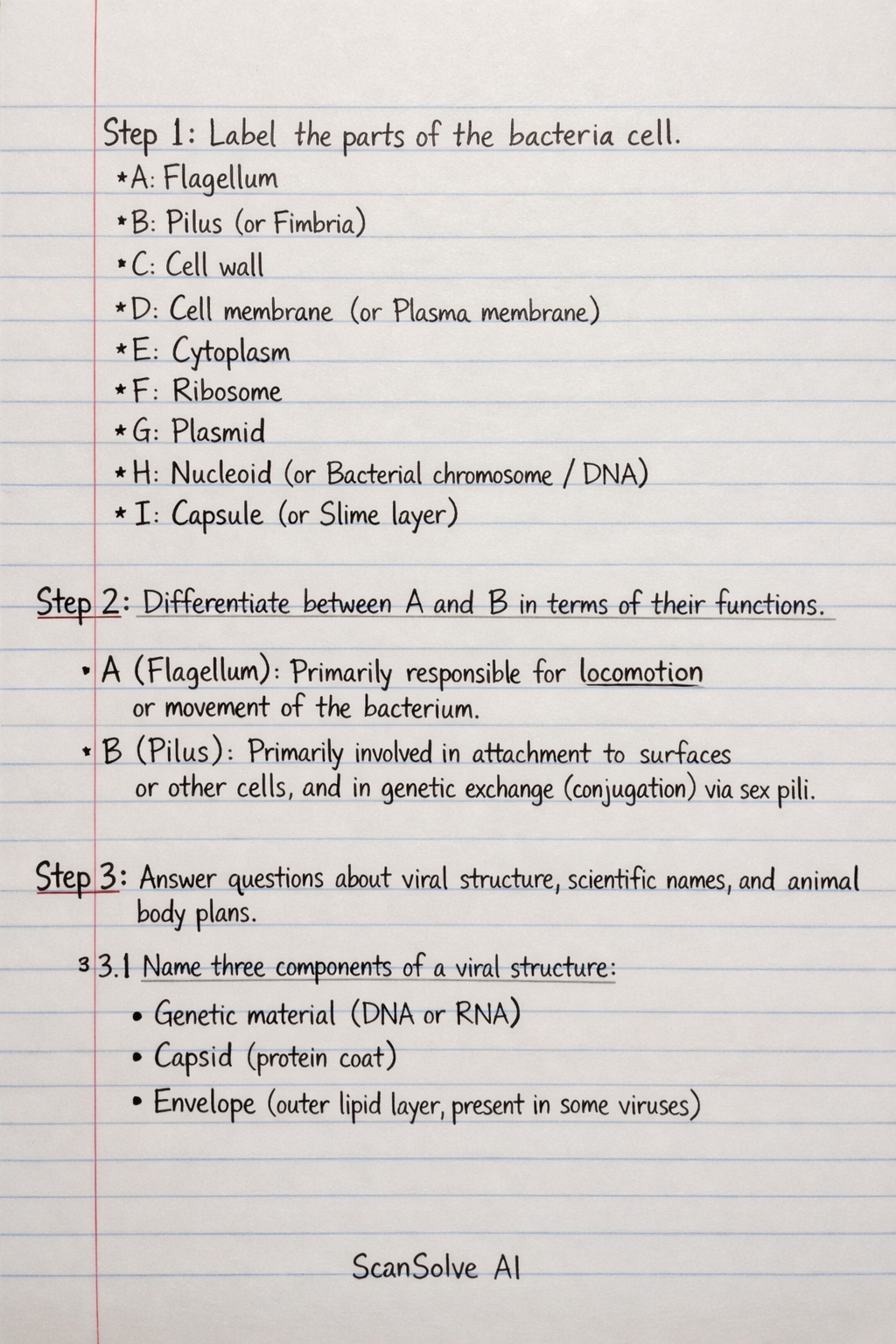
Step 1: Label the parts of the bacteria cell.
- A: Flagellum
- B: Pilus (or Fimbria)
- C: Cell wall
- D: Cell membrane (or Plasma membrane)
- E: Cytoplasm
- F: Ribosome
- G: Plasmid
- H: Nucleoid (or Bacterial chromosome/DNA)
- I: Capsule (or Slime layer)
Step 2: Differentiate between A and B in terms of their functions.
- A (Flagellum): Primarily responsible for locomotion or movement of the bacterium.
- B (Pilus): Primarily involved in attachment to surfaces or other cells, and in genetic exchange (conjugation) via sex pili.
Step 3: Answer questions about viral structure, scientific names, and animal body plans.
-
3.1 Name three components of a viral structure.
- Genetic material (DNA or RNA)
- Capsid (protein coat)
- Envelope (outer lipid layer, present in some viruses)
-
3.2 Mention three rules of writing scientific names.
- The name consists of two parts: the genus and the species.
- The genus name is always capitalized, and the species name is always written in lowercase.
- The entire scientific name is italicized when typed or underlined when handwritten.
-
3.3 What are diploblastic animals?
- Diploblastic animals are those whose embryos have two primary germ layers: the ectoderm and the endoderm.
-
3.4 What are triploblastic animals?
- Triploblastic animals are those whose embryos have three primary germ layers: the ectoderm, mesoderm, and endoderm.
-
3.5 Provide one word.
- 3.5.1 Parts of the body have become specialized so that only two planes can divide the body into similar halves.
- Bilateral symmetry
- 3.5.2 The body has the general form of a wheel or cylinder, and similar structures are regularly arranged as spokes from a central axis.
- Radial symmetry
- 3.5.3 Body forms that do not have body cavities.
- Acoelomate
- 3.5.1 Parts of the body have become specialized so that only two planes can divide the body into similar halves.
Was this helpful?
Need help with your own homework?
Get instant step-by-step solutions to any question. Free to start.
Ask Your Question
Handwritten Step-by-Step Solution
Get this as a handwritten image on WhatsApp — like a tutor wrote it for you.
Try on WhatsAppMore Biology Questions
QFeature Prokaryotic Eukaryotic Nucleus No true nucleus True nucleus Nuclear membrane Absent Present…QWhy do we drink waterQIn a food chain study, learners discussed energy transfer. State two ways energy is lost.QHow many chromosomes were present in the cell at the beginning of meiosis?QName the organelle that is found in plant cells only, where the nucleic acid named in QUESTION 1.4.1…
Still have questions?
ScanSolve AI Answer
Step 1: Label the parts of the bacteria cell. A: Flagellum* B: Pilus* (or Fimbria) C: Cell wall* D: Cell membrane* (or Plasma membrane) E: Cytoplasm* F: Ribosome* G: Plasmid* H: Nucleoid* (or Bacterial chromosome/DNA) I: Capsule* (or Slime layer) Step 2: Differentiate between A and B in terms of their functions. A (Flagellum): Primarily responsible for locomotion* or movement of the bacterium. B (Pilus): Primarily involved in attachment* to surfaces or other cells, and in genetic exchange (conjugation) via sex pili. Step 3: Answer questions about viral structure, scientific names, and animal body plans. 3.1 Name three components of a viral structure. Genetic material* (DNA or RNA) Capsid* (protein coat) Envelope* (outer lipid layer, present in some viruses) 3.2 Mention three rules of writing scientific names. The name consists of two parts: the genus and the species*. The genus name is always capitalized, and the species name* is always written in lowercase. The entire scientific name is italicized when typed or underlined* when handwritten. 3.3 What are diploblastic animals? Diploblastic animals are those whose embryos have two primary germ layers: the ectoderm and the endoderm*. 3.4 What are triploblastic animals? Triploblastic animals are those whose embryos have three primary germ layers: the ectoderm, mesoderm, and endoderm*. 3.5 Provide one word. 3.5.1 Parts of the body have become specialized so that only two planes can divide the body into similar halves. Bilateral symmetry* 3.5.2 The body has the general form of a wheel or cylinder, and similar structures are regularly arranged as spokes from a central axis. Radial symmetry* 3.5.3 Body forms that do not have body cavities. Acoelomate*