

This languages problem is solved step by step below, with detailed explanations to help you understand the method and arrive at the correct answer.
ScanSolve AI Answer
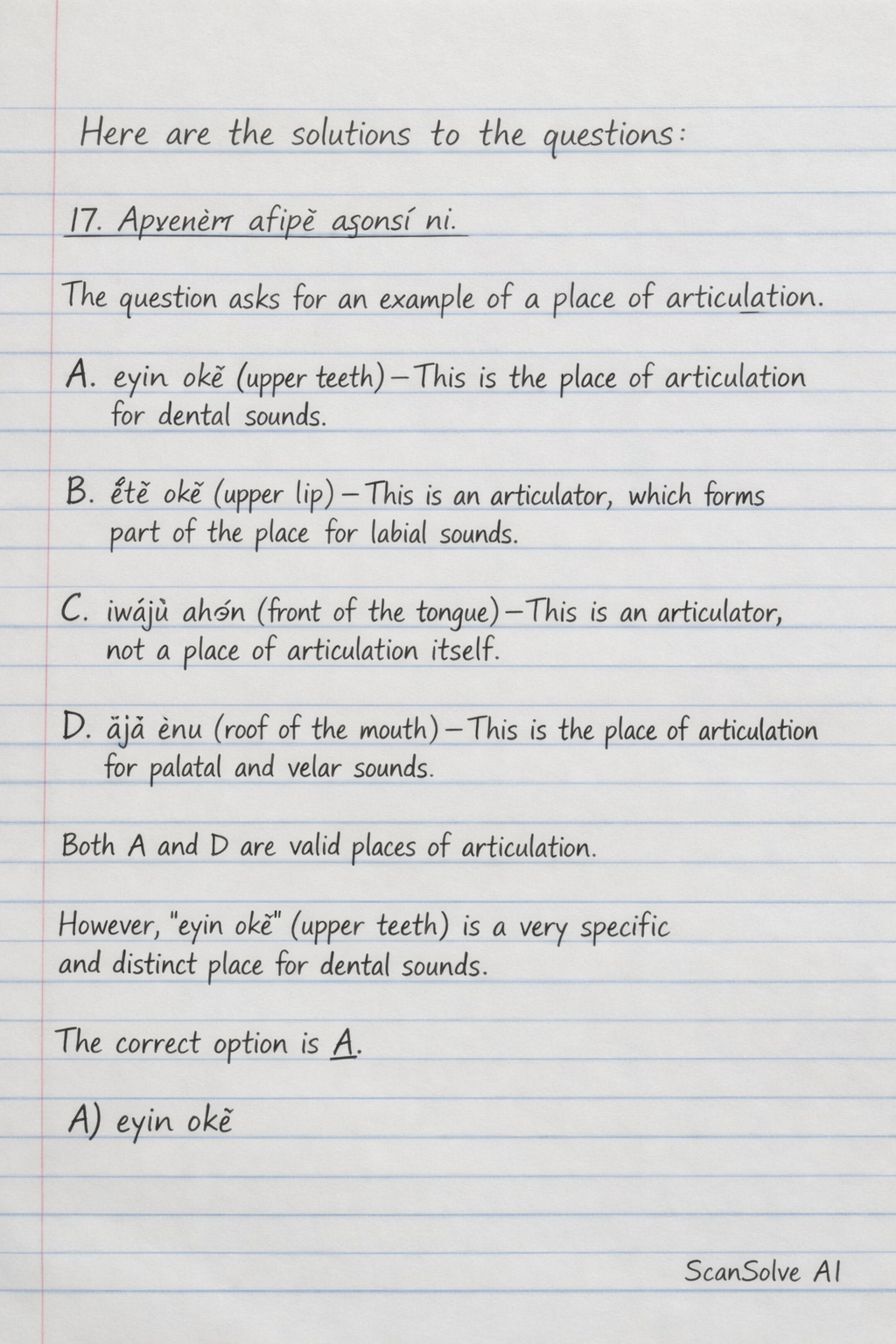
Here are the solutions to the questions: 17. Apẹẹrẹ afipẹ asọnsi ni The question asks for an example of a place of articulation. A. eyin okè (upper teeth) - This is the place of articulation for dental sounds. B. ètè okè (upper lip) - This is an articulator, which forms part of the place for labial sounds. C. iwájú ahọ́n (front of the tongue) - This is an articulator, not a place of articulation itself. D. àjà ẹnu (roof of the mouth) - This is the place of articulation for palatal and velar sounds. Both A and D are valid places of articulation. However, "eyin okè" (upper teeth) is a very specific and distinct place for dental sounds. The correct option is A. A) eyin okè 18. Nínú ìhùn sílẹ́bù èdè Yorùbá, 'F' nínú 'Talángbá' ni The question is about the syllable structure of "Talángbá". The letter 'F' is a typo as it does not appear in the word. Assuming the question asks to identify a syllable or a significant component of the syllable structure from the options. The word "Talángbá" can be syllabified as Ta-lán-gbá. A. n. - This is a consonant, specifically the coda in the syllable "lán". While 'n' can be a syllabic nasal in Yoruba, it is not presented as such here. B. l. - This is a consonant, the onset of the syllable "lán". C. n. - Same as A. D. gbá. - This is a complete CV (consonant-vowel) syllable. Among the options, "gbá" is the only complete syllable. The correct option is D. D) gbá 19. "Dárádárá" di "dáadáa" nípasẹ̀ The question asks about the phonological process by which "Dárádárá" transforms into "dáadáa". This transformation involves the reduction or contraction of the word, specifically the deletion of the middle "rá" syllable. A. ìkánpò (assimilation) - Sounds becoming more alike. B. ìpajẹ (elision/deletion) - Omission of a sound or syllable. C. àrànmọ́ (epenthesis/insertion) - Addition of a sound or syllable. D. ìyọ́pò (metathesis) - Reordering of sounds. The process of removing a syllable is known as deletion or elision. The correct option is B. B) ìpajẹ 20. Èwo ni ọ̀rọ̀ àyálò àfọjúyà? The question asks "Which is an obvious/conspicuous loanword?". All the options are loanwords from English. "Àfọjúyà" implies a word whose foreign origin is clearly evident. A. Pìà (from "pear") B. Sọ́jà (from "soldier") C. Tẹ́bù (from "table") D. Pàsítò (from "pastor") All these words are common and clearly identifiable as loanwords in Yoruba. However, "Sọ́jà" (soldier) is a very prominent example of a loanword, often cited in discussions of Yoruba phonology and vocabulary due to its clear English origin and widespread use. The correct option is B. B) Sọ́jà Send me the next one 📸