
We read your photo as:
What is Yoruba studies, Yoruba history, an example of a suitable word, and an afternoon greeting in Yoruba?
ScanSolve AI Answer
Answer
èdè Yorùbá àti àṣà rẹ̀
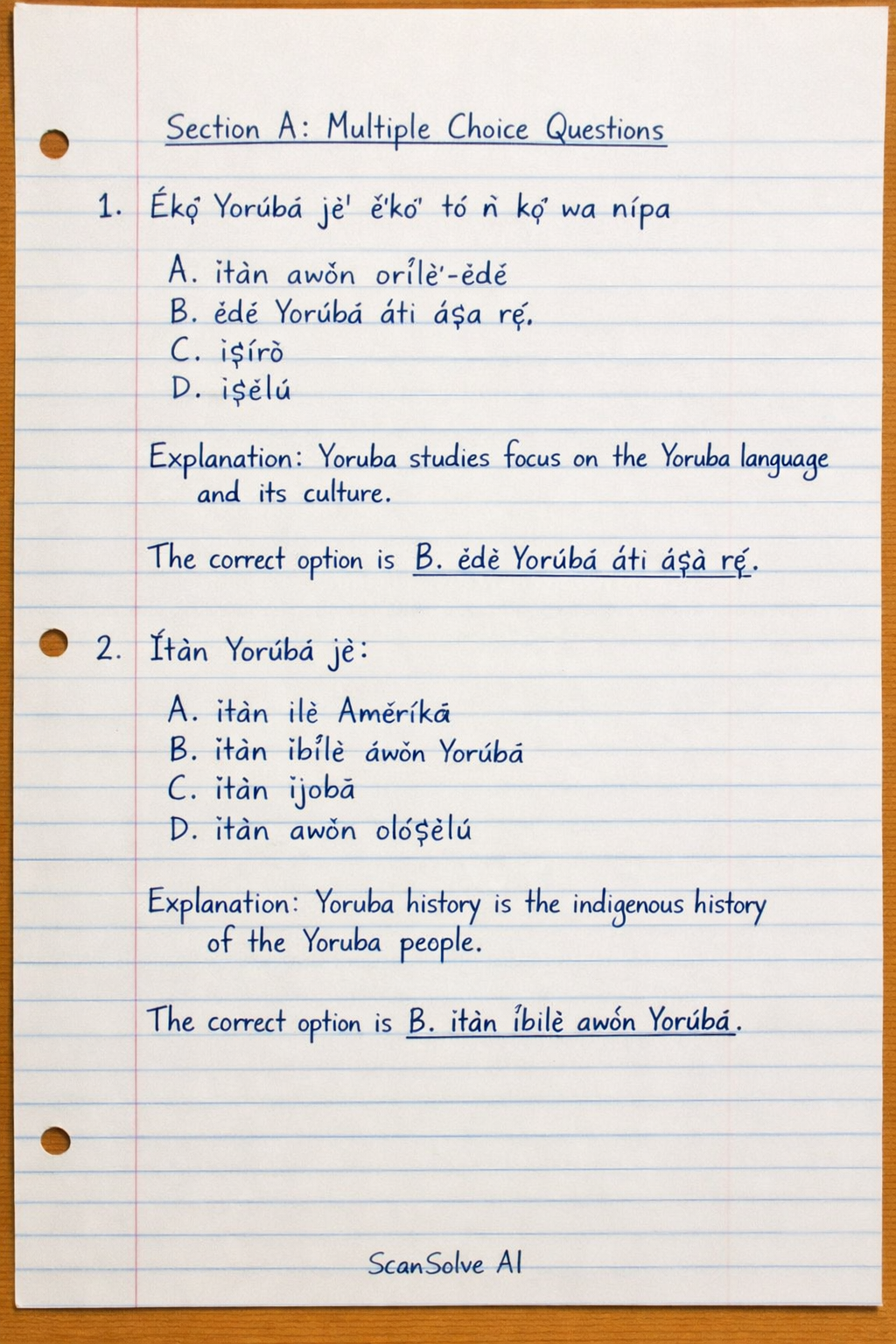
Section A: Multiple Choice Questions
-
Ẹkọ Yorùbá jẹ́ ẹ̀kọ́ tó ń kọ́ wa nípa (Yoruba studies teach us about)
- A. ìtàn àwọn orílẹ̀-èdè (history of countries)
- B. èdè Yorùbá àti àṣà rẹ̀ (Yoruba language and its culture)
- C. ìṣírò (arithmetic)
- D. ìṣèlú (politics)
- Explanation: Yoruba studies focus on the Yoruba language and its culture.
- The correct option is B. èdè Yorùbá àti àṣà rẹ̀.
-
Ìtàn Yorùbá jẹ́ (Yoruba history is)
- A. ìtàn ilẹ̀ Amẹ́ríkà (history of America)
- B. ìtàn ìbílẹ̀ àwọn Yorùbá (indigenous history of the Yoruba people)
- C. ìtàn ìjọba (government history)
- D. ìtàn àwọn olóṣèlú (history of politicians)
- Explanation: Yoruba history is the indigenous history of the Yoruba people.
- The correct option is B. ìtàn ìbílẹ̀ àwọn Yorùbá.
-
Àpẹẹrẹ ọrọ̀ tí ó tọ́ ni (An example of a suitable word is)
- A. Ó lérò ni (He/She has a thought)
- B. Ó lérò ni
- C. Ó lérò ni
- D. Ó lérò ni
- Explanation: All options are identical. Assuming this is a placeholder or a flawed question, the first option is selected.
- The correct option is A. Ó lérò ni.
-
Ìkíní tó yẹ kí a sọ ní òṣán ni (The greeting suitable to say in the afternoon is)
- A. Ẹ káàrọ̀ (Good morning)
- B. Ẹ káàsán (Good afternoon)
- C. Ẹ kú ìrọ̀lẹ́ (Good evening)
- D. Ẹ kú alẹ́ (Good night/evening)
- Explanation: "Ẹ káàsán" is the Yoruba greeting for good afternoon.
- The correct option is B. Ẹ káàsán.
-
Ẹ̀sìn Yorùbá ni (Yoruba religion is)
- A. ẹ̀sìn Kristiẹni àti ìjọ Islam (Christianity and Islam)
- B. ẹ̀sìn Hindu (Hinduism)
- C. ẹ̀sìn Búddha (Buddhism)
- D. ẹ̀sìn àgbàlagbà ọjà (old market religion)
- Explanation: While traditional Yoruba religion exists, Christianity and Islam are the dominant religions practiced by Yoruba people today.
- The correct option is A. ẹ̀sìn Kristiẹni àti ìjọ Islam.
-
Ọrọ̀ ìbànújẹ́ Yorùbá ni (A Yoruba word for sadness is)
- A. Ẹ kú ìrẹlẹ̀ (Greeting of humility)
- B. Ẹ kú oríire (Congratulations)
- C. Mo ní ìbànújẹ́ (I am sad)
- D. Ẹ káàbọ̀ (Welcome)
- Explanation: "Mo ní ìbànújẹ́" directly translates to "I am sad".
- The correct option is C. Mo ní ìbànújẹ́.
-
Ọrọ̀ ìbáṣepọ̀ Yorùbá ni (A Yoruba greeting word is)
- A. Ẹ káàrọ̀ (Good morning)
- B. Mo ní ìbànújẹ́ (I am sad)
- C. Ìwé l'ọ́mọ ọ̀yà (Book is a child of debt)
- D. Àdàmọ̀ jẹ ẹran (Adamo eats meat)
- Explanation: "Ẹ káàrọ̀" is a common Yoruba greeting.
- The correct option is A. Ẹ káàrọ̀.
-
Ọrọ̀ pẹ̀lú ìtumọ̀ tó dára ni (A word with a good meaning is)
- A. Ẹ kú ìrẹlẹ̀ – Greeting (Ẹ kú ìrẹlẹ̀ means "Greeting of humility", which is a type of greeting)
- B. Mo ní ìbànújẹ́ – Laughing (Incorrect: means "I am sad")
- C. Àdàmọ̀ jẹ ẹran – Running (Incorrect: means "Adamo eats meat")
- D. Ojú ni í rí ohun gbogbo – Crying (Incorrect: means "The eye sees everything")
- Explanation: Option A provides the most accurate pairing of a Yoruba phrase with its meaning.
- The correct option is A. Ẹ kú ìrẹlẹ̀ – Greeting.
-
Yorùbá ni wọ́n ń sọ ní (Yoruba is spoken in)
- A. Nigeria
- B. Ghana
- C. South Africa
- D. Kenya
- Explanation: Yoruba is primarily spoken in Nigeria.
- The correct option is A. Nigeria.
-
Àpẹẹrẹ ọrọ̀ ìbéèrè ni (An example of a question word/phrase is)
- A. Ṣé o ní ìwé? (Do you have a book?)
- B. Ẹ kú ìrẹlẹ̀ (Greeting of humility)
- C. Ó ṣeun (Thank you)
- D. Mo ní ìbànújẹ́ (I am sad)
- Explanation: "Ṣé o ní ìwé?" is a direct question.
- The correct option is A. Ṣé o ní ìwé?.
-
Ọrọ̀ ìbáṣepọ̀ ni (A greeting word is)
- A. Ẹ káàrọ̀ (Good morning)
- B. Àdàmọ̀ jẹ ẹran (Adamo eats meat)
- C. Ìwé l'ọ́mọ ọ̀yà (Book is a child of debt)
- D. Ṣé o ní ìwé? (Do you have a book?)
- Explanation: "Ẹ káàrọ̀" is a common Yoruba greeting.
- The correct option is A. Ẹ káàrọ̀.
-
Ìtàn tí a kọ́ láti kọ́ ìwà rere ni (A story written to teach good character is)
- A. Ìtàn òtítọ́ (True story)
- B. Ìtàn àṣà àti ìwà (Story of culture and character)
- C. Ìtàn ìṣẹ̀lẹ̀ àgbà (Story of adult events)
- D. Ìtàn ìjọba (Government story)
- Explanation: A story that teaches good character is a story of culture and character.
- The correct option is **B. Ìtàn àṣà
Try one yourself
A new problem that tests the same skill.
Still stuck on this one?
Ask a follow-up, and the answer starts from this question.
More Languages Questions
Handwritten Step-by-Step Solution
Get this as a handwritten image on WhatsApp — like a tutor wrote it for you.
Try on WhatsApp