

This law problem is solved step by step below, with detailed explanations to help you understand the method and arrive at the correct answer.
ScanSolve AI Answer
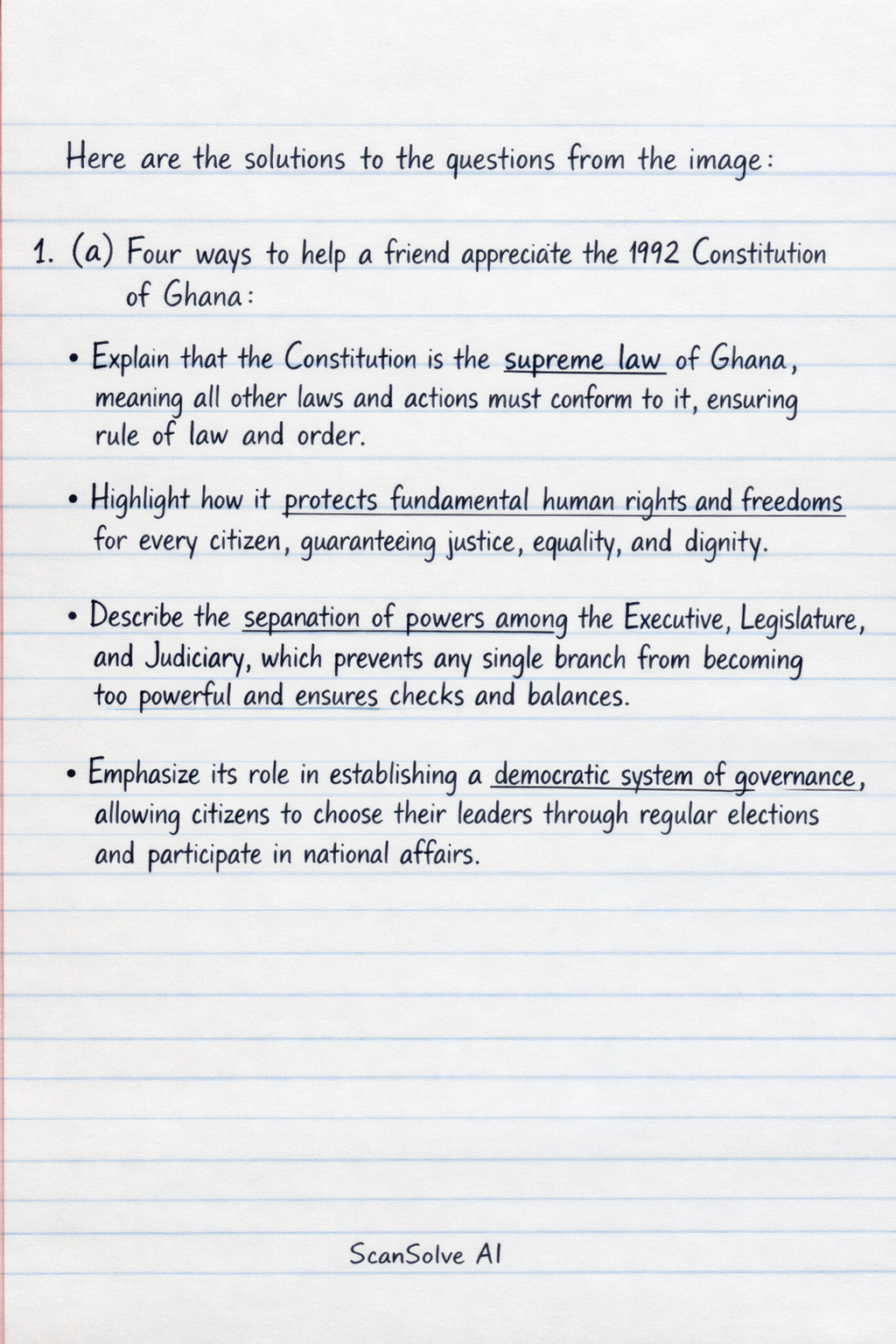
Here are the solutions to the questions from the image: 1. (a) Four ways to help a friend appreciate the 1992 Constitution of Ghana: • Explain that the Constitution is the supreme law of Ghana, meaning all other laws and actions must conform to it, ensuring rule of law and order. • Highlight how it protects fundamental human rights and freedoms for every citizen, guaranteeing justice, equality, and dignity. • Describe the separation of powers among the Executive, Legislature, and Judiciary, which prevents any single branch from becoming too powerful and ensures checks and balances. • Emphasize its role in establishing a democratic system of governance, allowing citizens to choose their leaders through regular elections and participate in national affairs. 1. (b) Four ways of acquiring citizenship in Ghana: • By Birth: A person born in Ghana on or after 24th September 1992, or a person born outside Ghana whose parent(s) are Ghanaian citizens. • By Registration: A foreign spouse of a Ghanaian citizen can apply for citizenship after a specified period of residence. • By Naturalization: A person who has resided in Ghana for a continuous period (usually five years or more) and meets other criteria like good character and ability to contribute to Ghana. • By Adoption: A child adopted by a Ghanaian citizen can acquire Ghanaian citizenship. 2. (a) Four ways to calm down youth tension and prevent conflicts in a district (addressed to the District Chief Executive): • Promote Dialogue and Engagement: Establish youth forums and platforms for open discussion to allow young people to voice their concerns and participate in local governance. • Create Economic Opportunities: Implement skills training programs, entrepreneurship initiatives, and job creation schemes to reduce youth unemployment and idleness. • Strengthen Community Leadership: Engage traditional leaders, religious bodies, and respected community elders to mediate disputes and foster unity among youth groups. • Organize Peace Education: Conduct workshops and campaigns on conflict resolution, tolerance, and civic responsibility to equip youth with peaceful means of addressing grievances. 2. (b) Four main points on how peace and security can lead to development in Ghana: • Attracts Investment: A stable and secure environment encourages both local and foreign investors, leading to the establishment of businesses, job creation, and economic growth. • Enables Resource Allocation: Without the need to spend heavily on conflict management, government resources can be directed towards essential development sectors like education, healthcare, and infrastructure. • Promotes Social Cohesion: Peace fosters trust and cooperation among diverse ethnic and religious groups, allowing for collective efforts towards national development goals. • Ensures Stability for Governance: A secure nation allows for effective policy implementation, long-term planning, and consistent governance, which are crucial for sustainable development. SECTION III: SOCIAL AND ECONOMIC DEVELOPMENT (Answer any one question only from this section) 3. (a) Four challenges mostly associated with human resource development: • Inadequate Funding: Insufficient investment in education, training, and skill development programs by both government and private sectors. • Brain Drain: The emigration of skilled professionals (e.g., doctors, engineers, teachers) to other countries, leading to a loss of critical expertise and human capital. • Mismatch between Skills and Industry Needs: Educational curricula often do not align with the current demands of the job market, resulting in graduates lacking relevant skills. • Poor Quality of Education and Training: Substandard educational facilities, outdated teaching methods, and a lack of qualified instructors hinder the development of a competent workforce. 3. (b) Four ways in which your government can use the tourism industry to drive development in Ghana: • Infrastructure Development: Invest in improving roads, airports, hotels, and other facilities to support tourism, which also benefits local communities and other economic sectors. • Job Creation: Promote tourism to create direct and indirect employment opportunities for locals in hospitality, transport, arts, and crafts, reducing unemployment. • Foreign Exchange Earnings: Attract international tourists whose spending brings in foreign currency, boosting the national economy and improving the balance of payments. • Preservation of Culture and Environment: Use tourism revenue and interest to fund the preservation of cultural heritage sites, traditional practices, and natural ecosystems, which are valuable national assets. 3. (c) (a) As an individual, in what four ways can you contribute to the development of your community? • Active Participation in Community Projects: Volunteer time and skills for local initiatives such as clean-up exercises, school renovations, or health awareness campaigns. • Paying Taxes and Levies: Fulfill civic duties by paying taxes and local levies, which provide funds for public services and infrastructure development in the community. • Adhering to Laws and Regulations: Maintain peace and order, respect community rules, and report criminal activities to create a safe and conducive environment for development. • Promoting Education and Skill Development: Encourage children to attend school, mentor younger community members, or share personal skills to empower others. 3. (c) (b) In your view, state four factors you will consider in the community decision-making process. • Community Needs and Priorities: Identify the most pressing issues and what the community truly requires for improvement, based on direct input from residents. • Resource Availability: Assess the financial, human, and material resources that can be realistically mobilized to implement a particular decision or project. • Stakeholder Engagement and Participation: Ensure that all relevant groups, including marginalized populations, have a voice and are actively involved in the decision-making process. • Sustainability and Long-Term Impact: Evaluate whether the decision will have lasting positive effects and if it is environmentally, socially, and economically viable for the community in the long run.