

This law problem is solved step by step below, with detailed explanations to help you understand the method and arrive at the correct answer.
ScanSolve AI Answer
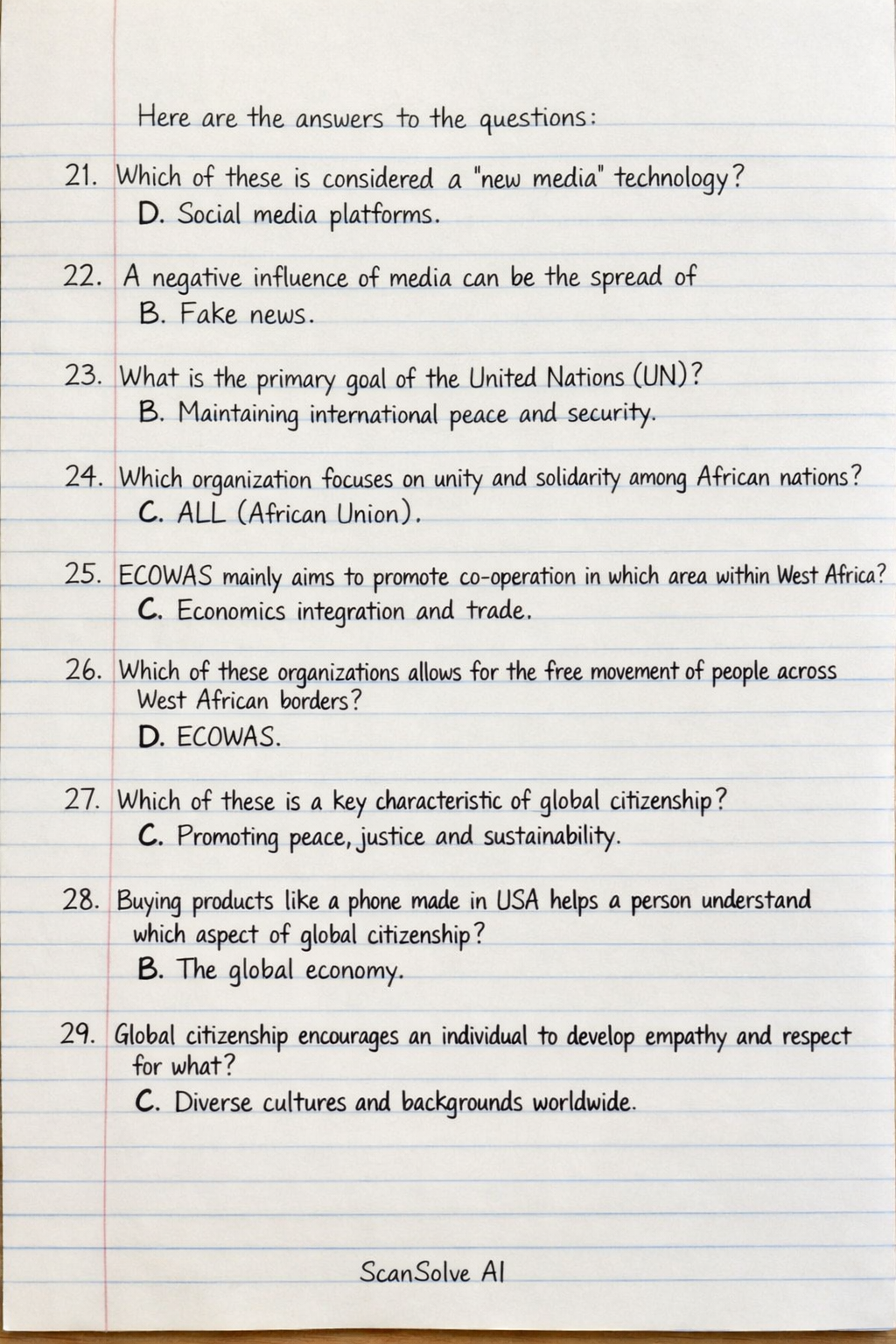
Here are the answers to the questions: 21. Which of these is considered a 'new media' technology? D. Social media platforms* 22. A negative influence of media can be the spread of B. Fake news* 23. What is the primary goal of the United Nations (UN)? B. Maintaining international peace and security* 24. Which organization focuses on unity and solidarity among African nations? C. ALL (African union)* 25. ECOWAS mainly aims to promote co-operation in which area within West Africa? C. Economics integration and trade* 26. Which of these organizations allows for the free movement of people across West African borders? D. ECOWAS* 27. Which of these is a key characteristic of global citizenship? C. Promoting peace, justice and sustainability* 28. Buying products like a phone made in USA helps a person understand which aspect of global citizenship? B. The global economy* 29. Global citizenship encourages an individual to develop empathy and respect for what? C. Diverse cultures and backgrounds worldwide* 30. Which action demonstrates a good example of global citizenship in daily life? D. Supporting local community initiatives or volunteering* THEORY (SECTION B) Answer five (5) questions 1. Why are International Organizations Important? International organizations* are important because they facilitate cooperation among nations on global issues, promote peace and security, foster economic development, and protect human rights. They provide a platform for countries to address challenges that transcend national borders, such as climate change, pandemics, and conflicts, through collective action and diplomacy. 2. What is an example of an International Organization? An example of an International Organization is the United Nations (UN)*. 3. What is the Role of Media in the Society? The media plays a crucial role in society by informing the public about current events, educating citizens on various issues, and serving as a watchdog to hold those in power accountable. It also provides entertainment and helps in the socialization* process by transmitting cultural values and norms. 4. Why are Election Important? Elections* are important because they are the primary means by which citizens in a democracy choose their representatives and hold them accountable. They ensure that governments derive their legitimacy from the consent of the governed, allow for peaceful transitions of power, and provide an avenue for citizens to express their preferences and influence public policy. 5. What is Human Right Abuse? Human rights abuse* refers to the violation or infringement of the fundamental rights and freedoms to which all individuals are inherently entitled. This can include actions by state or non-state actors that deny a person their civil, political, economic, social, or cultural rights, such as torture, arbitrary detention, discrimination, or denial of access to education or healthcare. 6. What is a Social Problem? A social problem* is a condition or behavior that is considered undesirable by a significant portion of society and for which there is a collective desire to change it. These problems often stem from societal structures, institutions, or cultural norms and can include issues like poverty, crime, unemployment, inequality, and discrimination. 7. What is a Crime? A crime* is an act or omission that is prohibited by law and punishable by the state. It is a violation of legal rules established to protect society and maintain order. Crimes range from minor offenses (misdemeanors) to serious offenses (felonies) and typically involve an intent to commit harm or a reckless disregard for the law.