

This law problem is solved step by step below, with detailed explanations to help you understand the method and arrive at the correct answer.
ScanSolve AI Answer
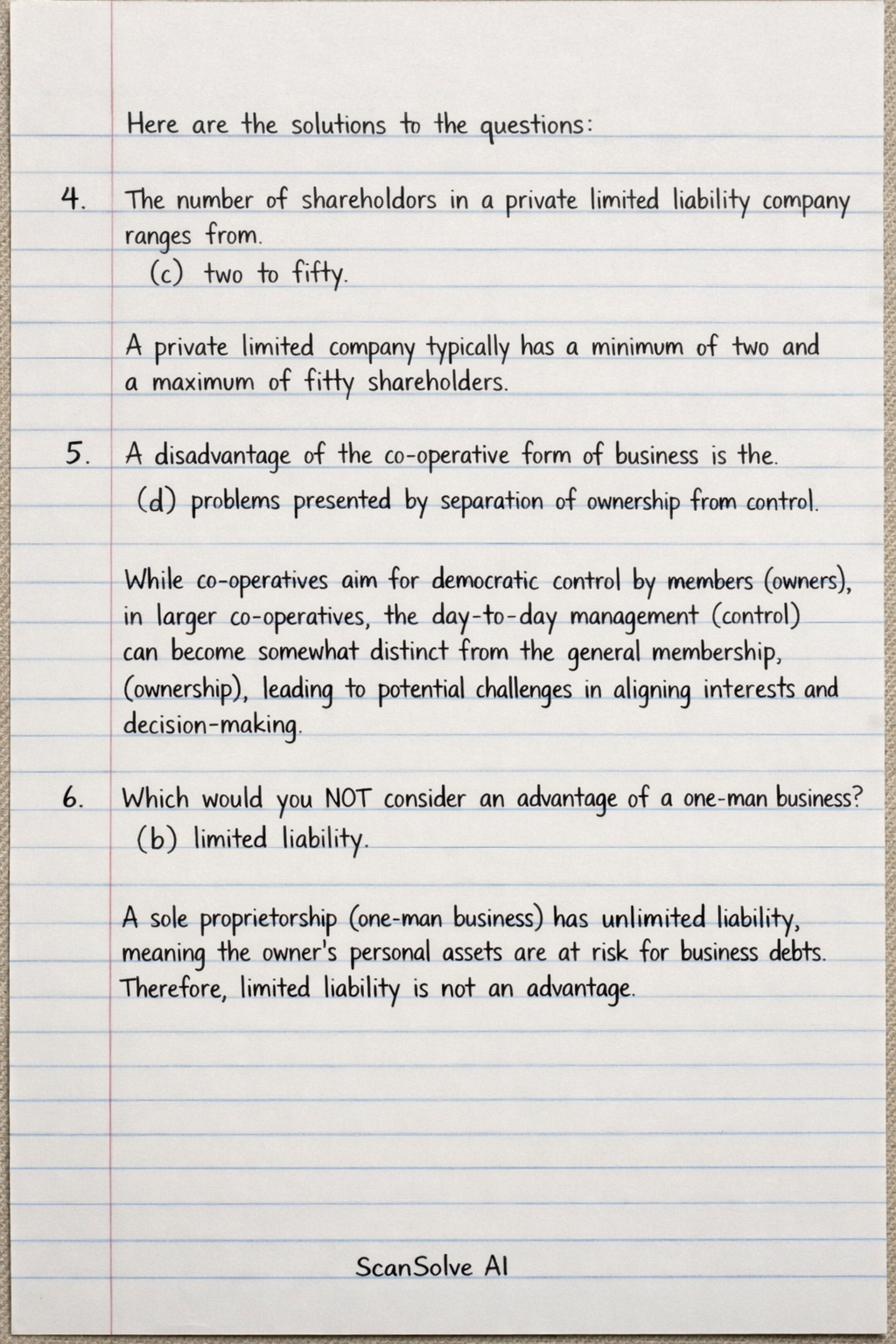
Here are the solutions to the questions: 4. The number of shareholders in a private limited liability company ranges from (c) two to fifty A private limited company typically has a minimum of two and a maximum of fifty shareholders. 5. A disadvantage of the co-operative form of business is the (d) problems presented by separation of ownership from control While co-operatives aim for democratic control by members (owners), in larger co-operatives, the day-to-day management (control) can become somewhat distinct from the general membership (ownership), leading to potential challenges in aligning interests and decision-making. 6. Which would you NOT consider an advantage of a one-man business? (b) limited liability A sole proprietorship (one-man business) has unlimited liability, meaning the owner's personal assets are at risk for business debts. Therefore, limited liability is not an advantage. 7. A limited liability company is owned by (c) shareholders Shareholders are the individuals or entities who own a limited liability company by holding its shares. 8. A typical corporate form of business organization is owned by (b) shareholders Corporations are legally distinct entities owned by their shareholders. 9. The advantage of the sole proprietorship is as follows: (c) control and supervision is under one man A sole proprietor has complete control over all business decisions, allowing for quick and direct management. 10. Which of the following is not a form of Business Organization? (a) cartel A cartel is an agreement between competing firms to control prices or restrict output, not a type of business organization itself. Partnership, joint stock (company), and sole proprietorship are forms of business organization. 11. In a sole proprietorship, the decisions are made by the (d) owner The sole proprietor is the single owner and has full authority to make all business decisions. 12. Most firms are financed by share capital. The shares which do not carry any fixed rate of dividend are known as (c) ordinary shares Ordinary shares (also known as common stock) typically do not have a fixed dividend rate; dividends are declared by the board of directors based on company profits. 13. Unlimited liability mean (d) a firm must pay its debts from business as well as private funds Unlimited liability means that the owner's personal assets are not separate from the business and can be used to settle business debts. 14. In a limited liability company, the greatest risk is borne by (c) ordinary shareholders Ordinary shareholders bear the greatest risk because they are residual claimants, meaning they are paid last after all other creditors and preference shareholders, and their investment value fluctuates most with the company's performance. 15. Who controls a limited company? (d) the board of directors The board of directors is elected by shareholders to oversee the management and strategic direction of a limited company. 16. A corporation can obtain funds by issuing bonds. A bond is a form of debt which falls due to repayment after: (b) 10 or more years Bonds are typically long-term debt instruments, often issued with maturities of 10 years or more. 17. A firm is said to be a public Joint Stock Company when it (b) is operated as a public corporation A public Joint Stock Company (or Public Limited Company) is one whose shares are offered to the general public and are typically traded on a stock exchange. That's 2 down. 3 left today — send the next one.