

This law problem is solved step by step below, with detailed explanations to help you understand the method and arrive at the correct answer.
ScanSolve AI Answer
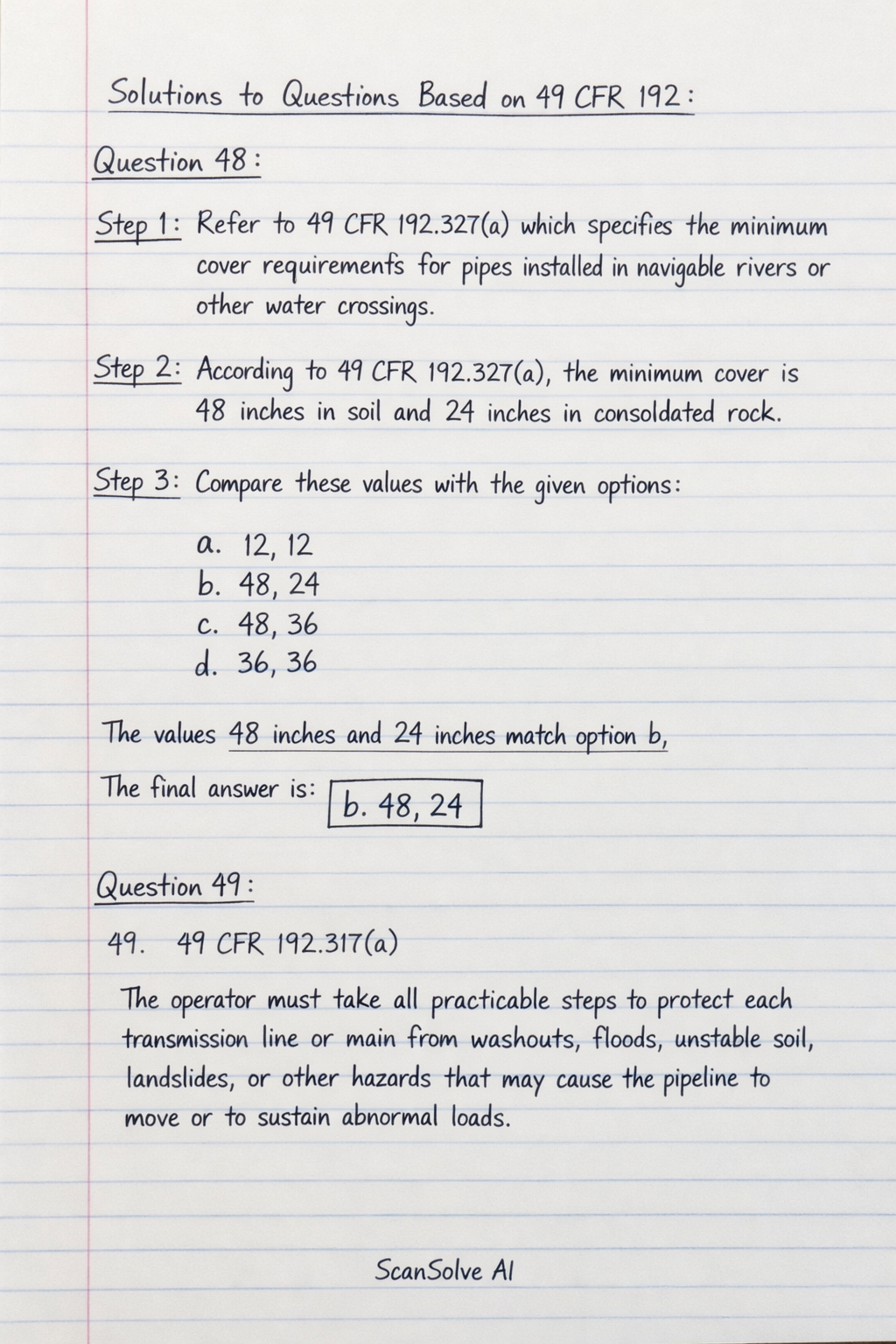
Here are the solutions to the questions based on 49 CFR 192: Question 48: 48. 49 CFR 192.192.327(a) All pipe installed in a navigable river or other water crossing must be installed with a minimum cover of ______ inches in soil or ______ inches of consolidated rock between the top of the pipe and the natural bottom. Step 1: Refer to 49 CFR 192.327(a) which specifies the minimum cover requirements for pipes installed in navigable rivers or other water crossings. Step 2: According to 49 CFR 192.327(a), the minimum cover is 48 inches in soil and 24 inches in consolidated rock. Step 3: Compare these values with the given options. a. 12, 12 b. 48, 24 c. 48, 36 d. 36, 36 The values 48 inches and 24 inches match option b. The final answer is b. 48, 24 Question 49: 49. 49 CFR 192.192.317(a) The operator must take all practicable steps to protect each transmission line or main from washouts, floods, unstable soil, landslides, or other hazards that may cause the pipeline to move or to sustain abnormal loads. Step 1: Refer to 49 CFR 192.317(a) which addresses the protection of transmission lines and mains from hazards. Step 2: 49 CFR 192.317(a) states that "Each transmission line or main must be installed so as to minimize exposure to hazards such as washouts, floods, unstable soil, landslides, or other conditions that could cause abnormal loads on the pipe." The statement in the question accurately reflects this requirement. Step 3: Determine if the statement is true or false. The statement is consistent with the regulation. The final answer is b. True Question 50: 50. 49 CFR 192.192.313 Each bend used in a pipeline must comply with the following, except: Step 1: Refer to 49 CFR 192.313, which outlines the requirements for bends in a pipeline. Step 2: Analyze each option against the regulation: • 49 CFR 192.313(a)(1) states that each bend must be "Made so that the pipe is not damaged or impaired." Option a, "It must not impair the serviceability of the pipe," is consistent with this. • 49 CFR 192.313(a)(2) states that each bend must be "Free from buckling, cracks, or other mechanical damage." Option b, "A bend must be free from buckling, cracks, or any other mechanical damage," is consistent with this. • 49 CFR 192.313(b)(3) states that "Each field bend must comply with... A bend must be made so that the bend has a smooth contour and a uniform thickness." Option c, "Each field bend must be made so that the bend has a smooth contour and a uniform thickness," is consistent with this. • Option d states: "The bend must be made so that the bend has a smooth contour and a uniform thickness, and the bend must be made so that the bend has a smooth contour and a uniform thickness." This is a redundant statement of the requirement found in 49 CFR 192.313(a)(3) and (b)(3). Step 3: Identify the "except" option. Options a, b, and c are all direct and correctly stated requirements. While the core assertion in option d is a requirement, its redundant phrasing makes it an unusual and non-standard way to state a regulatory compliance. In the context of an "except" question, a poorly phrased or redundant option is often the intended answer. The final answer is d. The bend must be made so that the bend has a smooth contour and a uniform thickness, and the bend must be made so that the bend has a smooth contour and a uniform thickness. Send me the next one 📸