

This law problem is solved step by step below, with detailed explanations to help you understand the method and arrive at the correct answer.
ScanSolve AI Answer
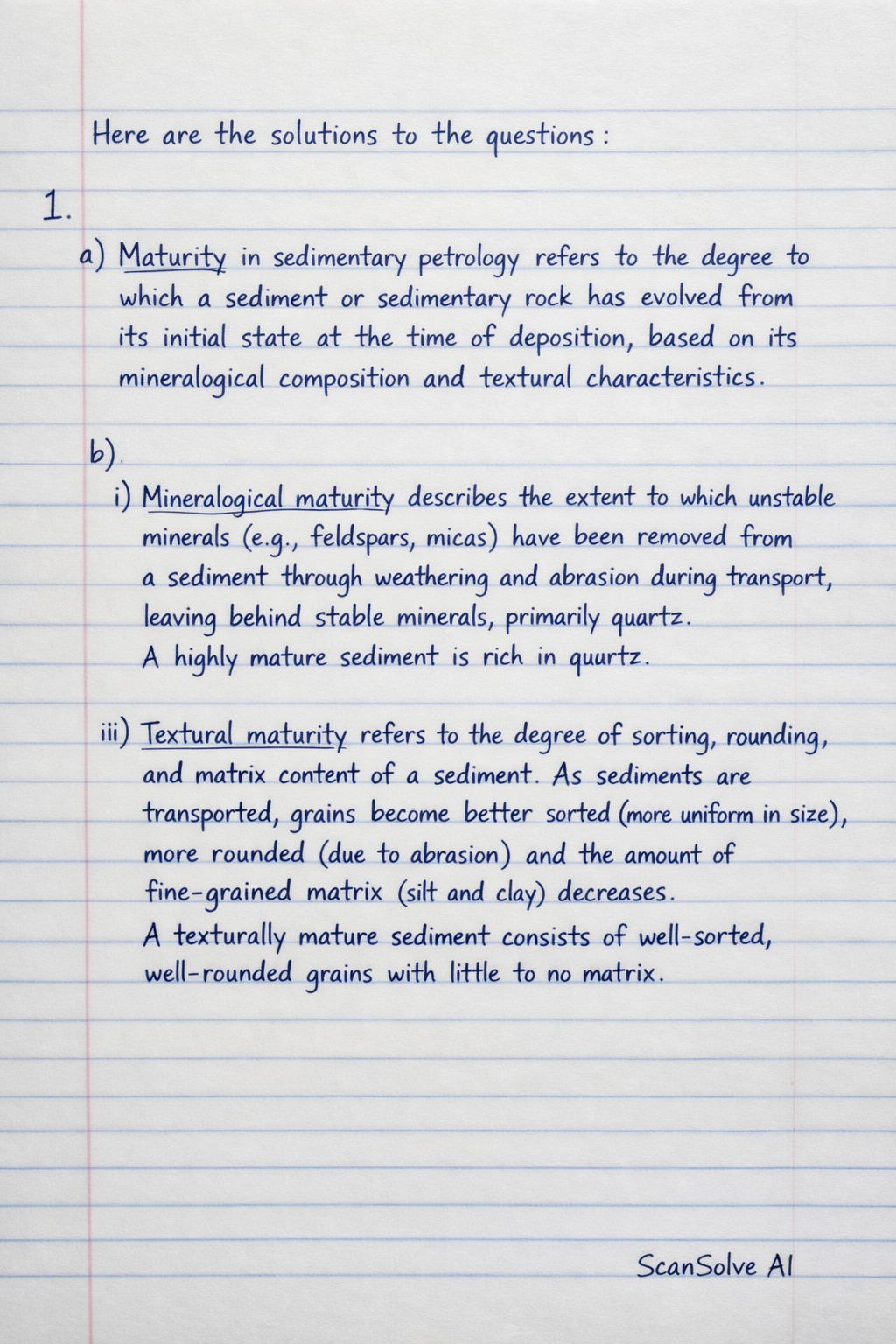
Here are the solutions to the questions: 1. a) Maturity in sedimentary petrology refers to the degree to which a sediment or sedimentary rock has evolved from its initial state at the time of deposition, based on its mineralogical composition and textural characteristics. b) i) Mineralogical maturity describes the extent to which unstable minerals (e.g., feldspars, micas) have been removed from a sediment through weathering and abrasion during transport, leaving behind stable minerals, primarily quartz. A highly mature sediment is rich in quartz. ii) Textural maturity refers to the degree of sorting, rounding, and matrix content of a sediment. As sediments are transported, grains become better sorted (more uniform in size), more rounded (due to abrasion), and the amount of fine-grained matrix (silt and clay) decreases. A texturally mature sediment consists of well-sorted, well-rounded grains with little to no matrix. c) The conversion of loose sediments into sedimentary rock is called diagenesis, which involves several stages: • Compaction: Overlying sediments exert pressure, reducing pore space and expelling water, bringing grains closer together. • Cementation: Dissolved minerals precipitate in the remaining pore spaces, binding the sediment grains together. Common cements include calcite, silica, and iron oxides. • Recrystallization: Some minerals may change their crystal structure or grow larger crystals due to changes in pressure and temperature. • Authigenesis: New minerals may form within the sediment during diagenesis. 2. a) Mass wasting (or mass movement) is the downslope movement of rock, regolith, and soil under the direct influence of gravity. Flows are a type of mass wasting where the material moves downslope as a viscous fluid, typically saturated with water. • Mudflow: A rapid flow of soil and rock fragments mixed with a significant amount of water, common in arid regions after heavy rain. • Debris flow: Similar to mudflows but contains a larger proportion of coarse-grained material (boulders, gravel) mixed with water and fine sediment. • Earthflow: A slower, more viscous flow of fine-grained soil and regolith, often occurring on hillsides with thick, clay-rich soils, moving as a tongue-shaped mass. • Creep: The slowest form of mass wasting, involving the gradual, imperceptible downslope movement of soil and regolith, often caused by repeated expansion and contraction. • Solifluction: A type of creep in permafrost regions where the thawed surface layer (active layer) flows slowly over the frozen impermeable layer. b) Measures to eliminate the potential for increased mass wasting: i) As an engineer: • Slope stabilization: Constructing retaining walls, gabions, or rock bolts to support unstable slopes. • Drainage control: Installing drainage systems to remove excess water from slopes, reducing saturation and pore water pressure. • Terracing/Benching: Creating steps on steep slopes to reduce the overall slope angle and intercept falling debris. ii) As a geologist: • Hazard mapping: Identifying and mapping areas prone to mass wasting based on geological factors and past landslide activity. •