
Answers have been provided already. Choose the correct one. Kindly attempt all the questions A program is usually a group of ……… 0 points plans people and work related projects related portfolio Public health programs particularly tend to provide; 1 point I. Educational services II. Have a preventive focus III. Population-focused The chief Public Health Nurse in your region is in charge of a health program to promote exclusive breast feeding. Your understanding of a health program is usually a group of ……… 1 point A. plans B. people and work C. related projects D. related portfolio In health-related program planning, what are the key considerations when selecting program strategies? 1 point The preferences of program staff The availability of funding The needs and characteristics of the target population The popularity of the strategies in other programs Which of the following describe the purpose of planning for a health program? 1 point I. Ensure that a program has the best possible likelihood of being successful II. Ensure that a program is being effective with the least possible resources III. Ensure that a program consume maximum resources in the community In general, nurses using the program planning model would begin by: 1 point A. Assessing the community B. Clarifying the health problem C. Understanding the underlying factors that contribute to the problem D. Developing an intervention When developing a health-related program, why is it important to involve key stakeholders in the planning process? 1 point To ensure accountability To gain support and buy-in To increase program visibility To streamline program operations A community health organization is planning to implement a new program to address the rising rates of diabetes in their community. They have conducted a thorough needs assessment and identified key objectives for the program. What should be the next step in the program planning process? 1 point A. Developing program objectives B. Implementing the program without evaluation C. Evaluating program outcomes D. Conducting a budget analysis What is the purpose of the program design phase of a health program? 1 point Defining the program's goals, objectives, and activities Conduct summative evaluation of the program Evaluating the program's impact and effectiveness Monitoring program progress and outcomes A public health department is in the process of designing a new program to promote physical activity among youth in the community. They have created a logic model to outline program activities and expected outcomes. What is the main purpose of using a logic model in this context? 1 point A. To identify program stakeholders B. To establish a program budget C. To evaluate program effectiveness D. To guide program planning and implementation A health promotion organization is planning to evaluate the impact of their smoking cessation program. They are considering using surveys to collect data on program outcomes. Which of the following is a key benefit of using surveys for program evaluation in this scenario? 1 point A. Surveys provide in-depth insights into stakeholder perspectives B. Surveys can help identify program stakeholders C. Surveys allow for quantitative data collection on program outcomes D. Surveys facilitate social media engagement for program promotion Which planning feature is related to engaging your intellectual capacity to analyze the surroundings and predict the future and comparing it all with different other alternatives that select the best? 1 point A. Planning is a mental exercise B. Planning is forward-looking C. Planning is the primary function of management D. Planning involves decision making In considering the choice of approach when developing health programs, which of the following factors is least important? 1 point A. available resources B. the nature of the health issue C. the target population D. political advantage During the program planning phase, why is it important to conduct a needs assessment? 1 point To determine the available resources for the program To identify the target population's needs and priorities To evaluate the program's outcomes To assess the program's cost-effectiveness During the planning phase of a health-related program, the project team is conducting a SWOT analysis. What does SWOT stand for? 1 point Strengths, Weaknesses, Opportunities, Timelines Stakeholders, Work plan, Objectives, Targets Strengths, Weaknesses, Opportunities, Threats Strategy, Workflow, Organization, Targets You are part of a team of public health officials developing a health program to address a health problem in you region which requires the setting of program goal. A good program goal should conform to the following characteristics or criteria EXCEPT; 1 point A. Concise B. Declarative statement C. Easily understood D. formulated for technocrats What is the primary purpose of setting program goals and objectives? 1 point To establish a timeline for program implementation To determine the program's budget To guide program activities and measure success To evaluate program staff performance A hospital is facing a nursing shortage. Which problem analysis approach would be best suited to understand the root causes of this shortage to inform a recruitment and retention program? 1 point A. Fish-bone analysis B. Problem tree analysis C. Five whys D. Pareto analysis How can a clear vision statement contribute to effective program management? 1 point It provides a roadmap for the project's direction and goals It helps in allocating resources effectively It ensures timely completion of project tasks It determines the project's budget As part of a team in charge of a health program, you want to ensure that program activities are aligned with the needs and preferences of the target population. Which of the following strategies would be most effective? 1 point A. Conducting focus groups or interviews with the target population B. Reviewing existing data and research on the target population's needs C. Engaging community representatives and stakeholders for input D. All of the above When you are thinking about potential barriers to you may encounter when developing an implementation plan for a specific health program, which of the following is least important; 1 point Availability of resources Economics Personal preferences Political/community support of the program As part of a team of health professionals planning a health program, what activities are typically undertaken during the planning phase? 1 point I. Setting goals and objectives II. Developing action plans III. Allocating resources A health-related program is targeting a diverse population with varying cultural backgrounds. How should cultural considerations be integrated into the program planning process? 1 point Develop a one-size-fits-all approach to ensure consistency Provide culturally tailored interventions and materials Ignore cultural differences to maintain program neutrality Implement programs that are consistent with the majority culture After researching evidence-based interventions, you it is important to determine how well the intervention matches the program’s 1 point I. Target audience II. Goals and objectives III. Staff preference IV. Organizational capacity to implement it The community is a major stakeholder in community health programs. What is the role of the community in the design phase of a program? 1 point Providing input and feedback on program goals and activities Implementing program activities in the community Evaluating the program's impact and effectiveness Allocating resources for program implementation When you are thinking about potential barriers to you may encounter when developing an implementation plan for a specific health program, which of the following is least important; 1 point A. Availability of resources B. Economics C. Personal preferences D. Political/community support of the program Ama Tawiah, the head of a health program wants to ensure effective stakeholder engagement throughout the program planning and implementation phases. Which of the following strategies would be most effective in achieving this? 1 point Engaging stakeholders early in the planning process Providing regular updates on program progress and outcomes Seeking input and feedback from stakeholders at key decision points Holding one-time meetings with stakeholders to gather input During program implementation, what is the purpose of monitoring program activities? 1 point To ensure compliance with organizational policies To assess the program's long-term outcomes To identify areas for program improvement To evaluate the program's impact on the target population Consider the following vision statement: "A community where everyone has access to affordable healthcare." Which of the following mission statements best aligns with this vision? 1 point A. To provide free medical equipment to low-income families. B. To advocate for increased government funding for healthcare. C. To develop a network of affordable clinics across the city. D. To educate the community on healthy lifestyle choices. When evaluating a health-related program, what is the purpose of conducting a summative evaluation? 1 point To assess the program's overall impact and effectiveness To measure the program's short-term outcomes To identify areas for program improvement To gather feedback from program participants A health team in charge of a specific health program wants to assess the program's impact on improving access to healthcare services. Which evaluation method would be most appropriate? 1 point Analysis of healthcare utilization data Surveys measuring changes in participants' healthcare-seeking behaviors Focus group discussions exploring participants' experiences with the program Observational assessments of healthcare facility infrastructure As par
ScanSolve AI Answer
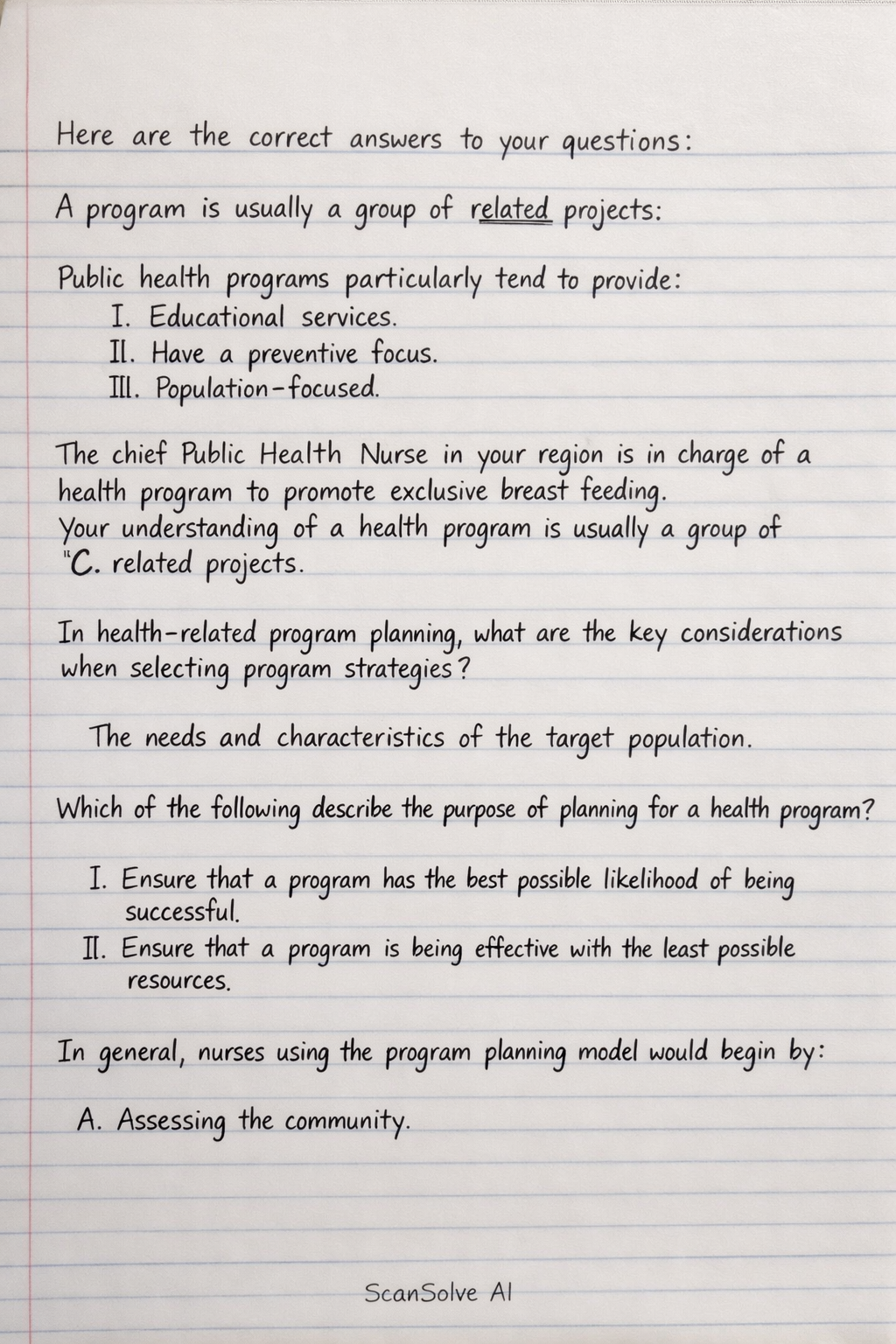
Here are the correct answers to your questions:
A program is usually a group of related projects.
Public health programs particularly tend to provide;
- I. Educational services
- II. Have a preventive focus
- III. Population-focused
The chief Public Health Nurse in your region is in charge of a health program to promote exclusive breast feeding. Your understanding of a health program is usually a group of C. related projects.
In health-related program planning, what are the key considerations when selecting program strategies?
- The needs and characteristics of the target population
Which of the following describe the purpose of planning for a health program?
- I. Ensure that a program has the best possible likelihood of being successful
- II. Ensure that a program is being effective with the least possible resources
In general, nurses using the program planning model would begin by:
- A. Assessing the community
When developing a health-related program, why is it important to involve key stakeholders in the planning process?
- To gain support and buy-in
A community health organization is planning to implement a new program to address the rising rates of diabetes in their community. They have conducted a thorough needs assessment and identified key objectives for the program. What should be the next step in the program planning process?
- D. Conducting a budget analysis
What is the purpose of the program design phase
Still stuck on this one?
Ask a follow-up, and the answer starts from this question.
More Law Questions
Handwritten Step-by-Step Solution
Get this as a handwritten image on WhatsApp — like a tutor wrote it for you.
Try on WhatsApp