ScanSolve logoScanSolve
Toggle sidebar
  • Homework
  • Tutor
  • Humanizer
  • AI Detector
  • Questions
  • Blog
  • History
  • Mobile App

  • Homework
  • Tutor
  • Humanizer
  • AI Detector

  • Questions
  • Math homework helpMath
    Physics homework helpPhysics
    Chemistry homework helpChemistry
    Biology homework helpBiology
    Computer Science homework helpComputer Science
    History homework helpHistory
    More homework helpMore
  • Blog
  • History

  • Mobile App
ScanSolvePLUS
  • Unlimited answers
  • ScanSolve AI Pro
Start Free Trial →
Try on WhatsApp
Home > Law Homework Help > Solution

Based on the images provided, here is the transcription of the history examination questions (numbered 1 through 50). ​History Examination Questions ​Section 1: African and Cameroon History ​Succession disputes in the 19th Century were responsible for the migrations of all of the following tribes EXCEPT: A. Duala B. Bali C. Bakosi D. Nso ​A significant political feature of the forest kingdoms in the 19th Century was that: A. the people practiced hunting and fishing B. the secret societies were very powerful C. the chiefs were elected and had limited powers D. the people practiced ancestral worship ​The main reason for the success of the Fulani jihads in North Cameroon in the 19th Century was: A. the economic potentials of the Fulani B. the determination of Modibo Adama C. the presence of barriers to Calvary warfare D. the lack of unity among the Kirdi ​An external factor which favoured evangelization along the coast of Cameroon in the 19th Century was: A. the hospitality of the coastal chiefs B. the failure of the Niger Expedition C. the anti-slave trade movements in Europe D. the influence of Ex-slaves from Jamaica ​The French treaty of April 1883 with King Pass All of Malimba was a threat to British and German traders in that: A. it allowed goods from other nations to be sold in Malimba B. it put an end to the discriminatory tariff system C. it granted autonomy to the natives of Malimba D. it imposed high tariffs on non-French goods ​A significant negative impact of the introduction of plantation agriculture on Cameroon was: A. food shortages B. expropriation of indigenous lands C. the establishment of mixed settlements D. the spread of diseases ​The Bali, Bamum and Ewondo collaborated with German colonial authorities mainly because of: A. the need to assist the German spread Christianity B. the desire to receive gifts from the Germans C. the need to protect their interest D. the fear of German intimidations ​The First World War was a blessing to Cameroon in that: A. Cameroon was placed under the League of Nations B. Confiscated Duala lands were returned to them C. The German harsh rule was brought to an end D. German plantations were handed to the indigenous ​The indigenous population appreciated British administration during the Mandate era because: A. they promoted local governance B. they developed road infrastructures C. they encouraged cash crop production D. they promoted healthcare services ​The French policy of "La mise en valeur" practiced in French Cameroon during the mandate was aimed at: A. granting religious toleration to the people B. developing the territory to satisfy the interest of France C. limiting the powers of traditional rulers D. promoting the rise of nationalism in French Cameroon ​An internal factor for the rise of nationalism in the British Southern Cameroons was: A. the wartime promises made by Britain B. the Atlantic Charter C. the British neglect of the territory D. the Second World War ​The immediate cause of the U.P.C. revolts of 1955 was: A. the rigging of the 1951 and 1952 elections B. the assassination of Um Nyobe C. the anti-UPC policies of Roland Pre D. the 100% increase in the price of market stalls in Yaoundé main market ​The following were limitations of the Lyttelton Constitution of 1954 EXCEPT: A. the granting of internal autonomy to the territory B. the establishment of ministerial council C. the creation of the post of Prime Minister D. the establishment of a Legislative Assembly ​The KUP called for the boycott of the 1961 plebiscite because: A. the UNO failed to send observers to monitor the plebiscite B. Britain manifested support for the CPNC C. the Third option was ignored D. the voters were poorly sensitized ​The Southern Cameroons delegation was responsible for their failure to negotiate a satisfactory constitution for Southern Cameroons mainly because of: A. the persistent use of the French language during the conference B. the short duration of the conference C. the refusal to accept constitutional experts D. the division within the Southern Cameroons delegation ​Andre Marie Mbida, Bebey Eyidi, Charles Okala and Theodore Mayi Matip were arrested and tried in the 1960s because: A. they were against the idea of a federal state B. they supported the activities of the UPC C. they opposed Ahidjo's call for a unified party D. they wanted a unitary state ​A major political achievement of the government of Augustine Ngom Jua in West Cameroon between 1965 and 1968 was: A. the promotion of small-scale industries B. the formation of a coalition government with the CPNC C. the revitalization of the Cameroon Bank D. the creation of many Primary and Secondary schools ​The 1972 constitution brought frustration to West Cameroonians mainly because: A. it abolished the House of Chiefs B. it suppressed the two stars on the Cameroon flag C. it created a single National Assembly D. it abolished the state of West Cameroon ​An external factor which aggravated the economic crisis in Cameroon in the 1980s and 1990s was: A. capital flight B. structural adjustment program C. too much dependence on European manufactured goods D. embezzlement of state funds ​The greatest political problem faced by the Biya regime in Cameroon is: A. tax evasion B. misappropriation of public funds C. rising unemployment D. anglophone crisis ​An economic impact of the abolition of the Trans-Atlantic Slave Trade on West Africa was: A. the loss of healthy population B. the spread of diseases among West Africans C. the collapse of some West African states D. the growth of legitimate trade ​An undeclared motive of Christian missionaries in West Africa was: A. to prepare for eventual colonization B. to appease Africans for the maltreatment during slave trade C. to promote the cultivation of cash crops D. to provide health facilities for the poor in West Africa ​The 19th Century jihads in the Western Sudan were considered as political movements in that: A. the Fulani wanted to end European domination B. the Fulani wanted to spread Islam C. the Fulani wanted to seize power from pagan rulers D. the Fulani wanted to put an end to heavy taxation ​The most outstanding reason for King Leopold's establishment of the Congo Free State was: A. to deprive other nations of the trade advantage B. the strategic importance C. the availability of minerals and agricultural resources D. the navigable nature of the river Congo ​One way in which Samori Toure contributed to his own defeat was that: A. he collaborated with the French B. he incorporated captives into his army C. he refused to form an alliance with the British D. he failed to adopt the scorched earth policy ​A natural factor that contributed to the defeat of Italy by Abyssinia at the battle of Adowa in 1896 was: A. the use of modern weapons by Abyssinians armies B. the effective military leadership of Menelik II C. the political instability in Italy D. the harsh Abyssinian tropical climate ​The French colonial policy of Assimilation was advantageous to Africans in that: A. it retarded the growth of nationalism B. it promoted the economic exploitation of the colonies C. it enhanced collaboration between the assimilated and non-assimilated D. it promoted economic development ​Africans participated in the Second World War in the following ways EXCEPT: A. African soldiers commanded European troops B. provision of basic raw materials and food stuff to the belligerents C. donation of financial support to the allied war fund D. hosting of allied conferences ​The Convention People's Party of Kwame Nkrumah in the Gold Coast adopted "positive action" with the main objective to: A. promote education B. increase the salaries of black workers C. paralyze the colonial administration D. fight against Communism ​The decolonization process in Algeria was violent and bloody because: A. many French citizens were transferred out of Algeria B. the French President Charles De Gaulle organized a referendum C. the colons were determined to stay in Algeria D. the Berbers never wanted to practice Islam ​A political manifestation of neocolonialism in the former French Equatorial Africa can be seen through: A. the adoption of French as a medium of communication B. the promotion of French culture in the territories C. the adoption of the French presidential system D. the maintenance of close monetary ties with France ​F.W. De Klerk contributed to the dismantling of apartheid in South Africa in that: A. he imprisoned Nelson Mandela B. he encouraged the creation of Bantustans C. he adopted repressive policies against anti-apartheid activists D. he opened dialogue with anti-apartheid activists ​An African Country that was plunged into a civil war immediately after independence because of the issue of secession was: A. Nigeria B. The Congo C. Mozambique D. Angola ​The January 1966 Coup d'etat in Nigeria was caused by: A. domination of the federal government by Northerners B. election rigging by Shehu Shagari C. creation of the independent republic of Biafra D. modification of the constitution by General Ironsi ​A social factor which has been responsible for refugee crisis in Africa is: A. human rights violation B. religious persecution C. famine D. civil wars ​Section 2: World History ​The abolition of the Test Act by King James II of England was intended to: A. prohibit Roman Catholics from holding public offices in England B. grant religious toleration to the people of England C. allow Roman Catholics to occupy public offices without taking oaths D. solve the succession problem of England ​A political factor which contributed to the defeat of the British in North America was: A. the long-distance separating Britain from the colonies B. the rising national debt of Britain C. the division within the British parliament D. the shortage of food supply to British forces ​The Congress of Laibach of 1821 was important to Ferdin

Asked on March 28, 2026|Law

This law problem is solved step by step below, with detailed explanations to help you understand the method and arrive at the correct answer.

ScanSolve AI AnswerAnswered on March 28, 2026
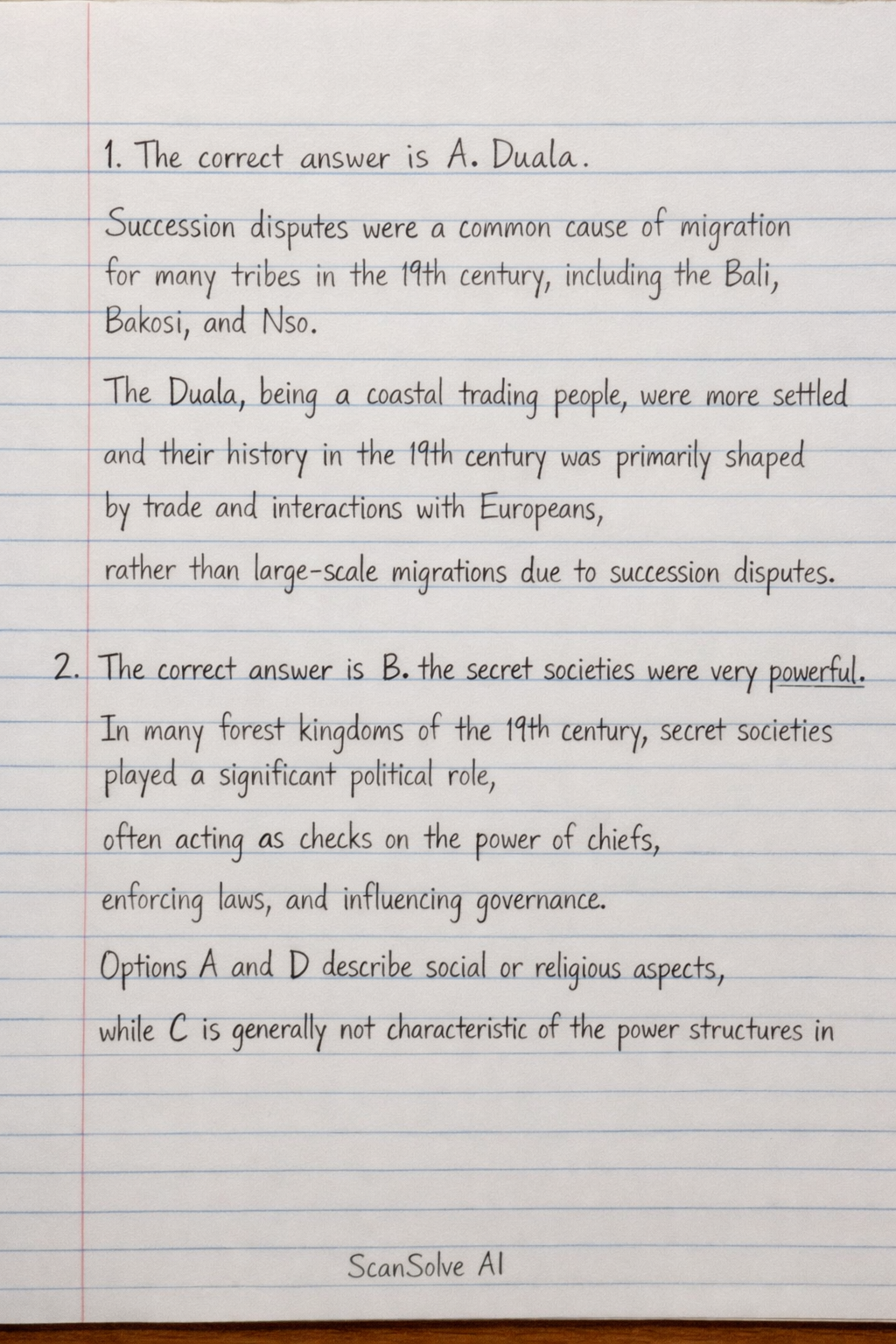
1. The correct answer is A. Duala. Succession disputes were a common cause of migration for many tribes in the 19th century, including the Bali, Bakosi, and Nso. The Duala, being a coastal trading people, were more settled and their history in the 19th century was primarily shaped by trade and interactions with Europeans, rather than large-scale migrations due to succession disputes. 2. The correct answer is B. the secret societies were very powerful. In many forest kingdoms of the 19th century, secret societies played a significant political role, often acting as checks on the power of chiefs, enforcing laws, and influencing governance. Options A and D describe social or religious aspects, while C is generally not characteristic of the power structures in

Related Law Questions

  • The District Magistrate.
  • 16 EDCA411-2026 Assignment - In progress Add attachment(s), then choose the appropriate button at the bottom. Honor Pled...
  • What are the deadlines for maintenance inspections of technical equipment, and what is considered technical supervision?
  • 1a. Define Citizenry, b. State eight functions of Citizenry, 2a. What is Representative Democracy, b. Explain five chara...
  • The part of government that makes law is called (a) Judiciary (b) Executive (c) Democracy (d) Legislature
  • In a Request for Proposal (RFP), where would you find information related to tasks, activities, responsibilities, and de...
See all Law questions

This step-by-step solution was generated by ScanSolve AI. Need help with more law problems? Browse Law solutions or ask your own question.

Home›Law Homework Help›Based on the images provided, here is the transcription of t…
Q

Based on the images provided, here is the transcription of the history examination questions (numbered 1 through 50). ​History Examination Questions ​Section 1: African and Cameroon History ​Succession disputes in the 19th Century were responsible for the migrations of all of the following tribes EXCEPT: A. Duala B. Bali C. Bakosi D. Nso ​A significant political feature of the forest kingdoms in the 19th Century was that: A. the people practiced hunting and fishing B. the secret societies were very powerful C. the chiefs were elected and had limited powers D. the people practiced ancestral worship ​The main reason for the success of the Fulani jihads in North Cameroon in the 19th Century was: A. the economic potentials of the Fulani B. the determination of Modibo Adama C. the presence of barriers to Calvary warfare D. the lack of unity among the Kirdi ​An external factor which favoured evangelization along the coast of Cameroon in the 19th Century was: A. the hospitality of the coastal chiefs B. the failure of the Niger Expedition C. the anti-slave trade movements in Europe D. the influence of Ex-slaves from Jamaica ​The French treaty of April 1883 with King Pass All of Malimba was a threat to British and German traders in that: A. it allowed goods from other nations to be sold in Malimba B. it put an end to the discriminatory tariff system C. it granted autonomy to the natives of Malimba D. it imposed high tariffs on non-French goods ​A significant negative impact of the introduction of plantation agriculture on Cameroon was: A. food shortages B. expropriation of indigenous lands C. the establishment of mixed settlements D. the spread of diseases ​The Bali, Bamum and Ewondo collaborated with German colonial authorities mainly because of: A. the need to assist the German spread Christianity B. the desire to receive gifts from the Germans C. the need to protect their interest D. the fear of German intimidations ​The First World War was a blessing to Cameroon in that: A. Cameroon was placed under the League of Nations B. Confiscated Duala lands were returned to them C. The German harsh rule was brought to an end D. German plantations were handed to the indigenous ​The indigenous population appreciated British administration during the Mandate era because: A. they promoted local governance B. they developed road infrastructures C. they encouraged cash crop production D. they promoted healthcare services ​The French policy of "La mise en valeur" practiced in French Cameroon during the mandate was aimed at: A. granting religious toleration to the people B. developing the territory to satisfy the interest of France C. limiting the powers of traditional rulers D. promoting the rise of nationalism in French Cameroon ​An internal factor for the rise of nationalism in the British Southern Cameroons was: A. the wartime promises made by Britain B. the Atlantic Charter C. the British neglect of the territory D. the Second World War ​The immediate cause of the U.P.C. revolts of 1955 was: A. the rigging of the 1951 and 1952 elections B. the assassination of Um Nyobe C. the anti-UPC policies of Roland Pre D. the 100% increase in the price of market stalls in Yaoundé main market ​The following were limitations of the Lyttelton Constitution of 1954 EXCEPT: A. the granting of internal autonomy to the territory B. the establishment of ministerial council C. the creation of the post of Prime Minister D. the establishment of a Legislative Assembly ​The KUP called for the boycott of the 1961 plebiscite because: A. the UNO failed to send observers to monitor the plebiscite B. Britain manifested support for the CPNC C. the Third option was ignored D. the voters were poorly sensitized ​The Southern Cameroons delegation was responsible for their failure to negotiate a satisfactory constitution for Southern Cameroons mainly because of: A. the persistent use of the French language during the conference B. the short duration of the conference C. the refusal to accept constitutional experts D. the division within the Southern Cameroons delegation ​Andre Marie Mbida, Bebey Eyidi, Charles Okala and Theodore Mayi Matip were arrested and tried in the 1960s because: A. they were against the idea of a federal state B. they supported the activities of the UPC C. they opposed Ahidjo's call for a unified party D. they wanted a unitary state ​A major political achievement of the government of Augustine Ngom Jua in West Cameroon between 1965 and 1968 was: A. the promotion of small-scale industries B. the formation of a coalition government with the CPNC C. the revitalization of the Cameroon Bank D. the creation of many Primary and Secondary schools ​The 1972 constitution brought frustration to West Cameroonians mainly because: A. it abolished the House of Chiefs B. it suppressed the two stars on the Cameroon flag C. it created a single National Assembly D. it abolished the state of West Cameroon ​An external factor which aggravated the economic crisis in Cameroon in the 1980s and 1990s was: A. capital flight B. structural adjustment program C. too much dependence on European manufactured goods D. embezzlement of state funds ​The greatest political problem faced by the Biya regime in Cameroon is: A. tax evasion B. misappropriation of public funds C. rising unemployment D. anglophone crisis ​An economic impact of the abolition of the Trans-Atlantic Slave Trade on West Africa was: A. the loss of healthy population B. the spread of diseases among West Africans C. the collapse of some West African states D. the growth of legitimate trade ​An undeclared motive of Christian missionaries in West Africa was: A. to prepare for eventual colonization B. to appease Africans for the maltreatment during slave trade C. to promote the cultivation of cash crops D. to provide health facilities for the poor in West Africa ​The 19th Century jihads in the Western Sudan were considered as political movements in that: A. the Fulani wanted to end European domination B. the Fulani wanted to spread Islam C. the Fulani wanted to seize power from pagan rulers D. the Fulani wanted to put an end to heavy taxation ​The most outstanding reason for King Leopold's establishment of the Congo Free State was: A. to deprive other nations of the trade advantage B. the strategic importance C. the availability of minerals and agricultural resources D. the navigable nature of the river Congo ​One way in which Samori Toure contributed to his own defeat was that: A. he collaborated with the French B. he incorporated captives into his army C. he refused to form an alliance with the British D. he failed to adopt the scorched earth policy ​A natural factor that contributed to the defeat of Italy by Abyssinia at the battle of Adowa in 1896 was: A. the use of modern weapons by Abyssinians armies B. the effective military leadership of Menelik II C. the political instability in Italy D. the harsh Abyssinian tropical climate ​The French colonial policy of Assimilation was advantageous to Africans in that: A. it retarded the growth of nationalism B. it promoted the economic exploitation of the colonies C. it enhanced collaboration between the assimilated and non-assimilated D. it promoted economic development ​Africans participated in the Second World War in the following ways EXCEPT: A. African soldiers commanded European troops B. provision of basic raw materials and food stuff to the belligerents C. donation of financial support to the allied war fund D. hosting of allied conferences ​The Convention People's Party of Kwame Nkrumah in the Gold Coast adopted "positive action" with the main objective to: A. promote education B. increase the salaries of black workers C. paralyze the colonial administration D. fight against Communism ​The decolonization process in Algeria was violent and bloody because: A. many French citizens were transferred out of Algeria B. the French President Charles De Gaulle organized a referendum C. the colons were determined to stay in Algeria D. the Berbers never wanted to practice Islam ​A political manifestation of neocolonialism in the former French Equatorial Africa can be seen through: A. the adoption of French as a medium of communication B. the promotion of French culture in the territories C. the adoption of the French presidential system D. the maintenance of close monetary ties with France ​F.W. De Klerk contributed to the dismantling of apartheid in South Africa in that: A. he imprisoned Nelson Mandela B. he encouraged the creation of Bantustans C. he adopted repressive policies against anti-apartheid activists D. he opened dialogue with anti-apartheid activists ​An African Country that was plunged into a civil war immediately after independence because of the issue of secession was: A. Nigeria B. The Congo C. Mozambique D. Angola ​The January 1966 Coup d'etat in Nigeria was caused by: A. domination of the federal government by Northerners B. election rigging by Shehu Shagari C. creation of the independent republic of Biafra D. modification of the constitution by General Ironsi ​A social factor which has been responsible for refugee crisis in Africa is: A. human rights violation B. religious persecution C. famine D. civil wars ​Section 2: World History ​The abolition of the Test Act by King James II of England was intended to: A. prohibit Roman Catholics from holding public offices in England B. grant religious toleration to the people of England C. allow Roman Catholics to occupy public offices without taking oaths D. solve the succession problem of England ​A political factor which contributed to the defeat of the British in North America was: A. the long-distance separating Britain from the colonies B. the rising national debt of Britain C. the division within the British parliament D. the shortage of food supply to British forces ​The Congress of Laibach of 1821 was important to Ferdin

March 28, 2026|Law
ScanSolve AI

ScanSolve AI Answer

Answered on March 28, 2026
  1. The correct answer is A. Duala. Succession disputes were a common cause of migration for many tribes in the 19th century, including the Bali, Bakosi, and Nso. The Duala, being a coastal trading people, were more settled and their history in the 19th century was primarily shaped by trade and interactions with Europeans, rather than large-scale migrations due to succession disputes.

  2. The correct answer is B. the secret societies were very powerful. In many forest kingdoms of the 19th century, secret societies played a significant political role, often acting as checks on the power of chiefs, enforcing laws, and influencing governance. Options A and D describe social or religious aspects, while C is generally not characteristic of the power structures in

Need help with your own homework?

Get instant step-by-step solutions to any question. Free to start.

Ask Your Question
Handwritten step-by-step solution

Handwritten Step-by-Step Solution

Get this solution as a handwritten image on WhatsApp — just like a tutor wrote it for you.

Try on WhatsApp

More Law Questions

The District Magistrate.16 EDCA411-2026 Assignment - In progress Add attachment(s), then choose the appropriate button at th…What are the deadlines for maintenance inspections of technical equipment, and what is considered te…1a. Define Citizenry, b. State eight functions of Citizenry, 2a. What is Representative Democracy, b…The part of government that makes law is called (a) Judiciary (b) Executive (c) Democracy (d) Legisl…In a Request for Proposal (RFP), where would you find information related to tasks, activities, resp…
See all Lawquestions →