
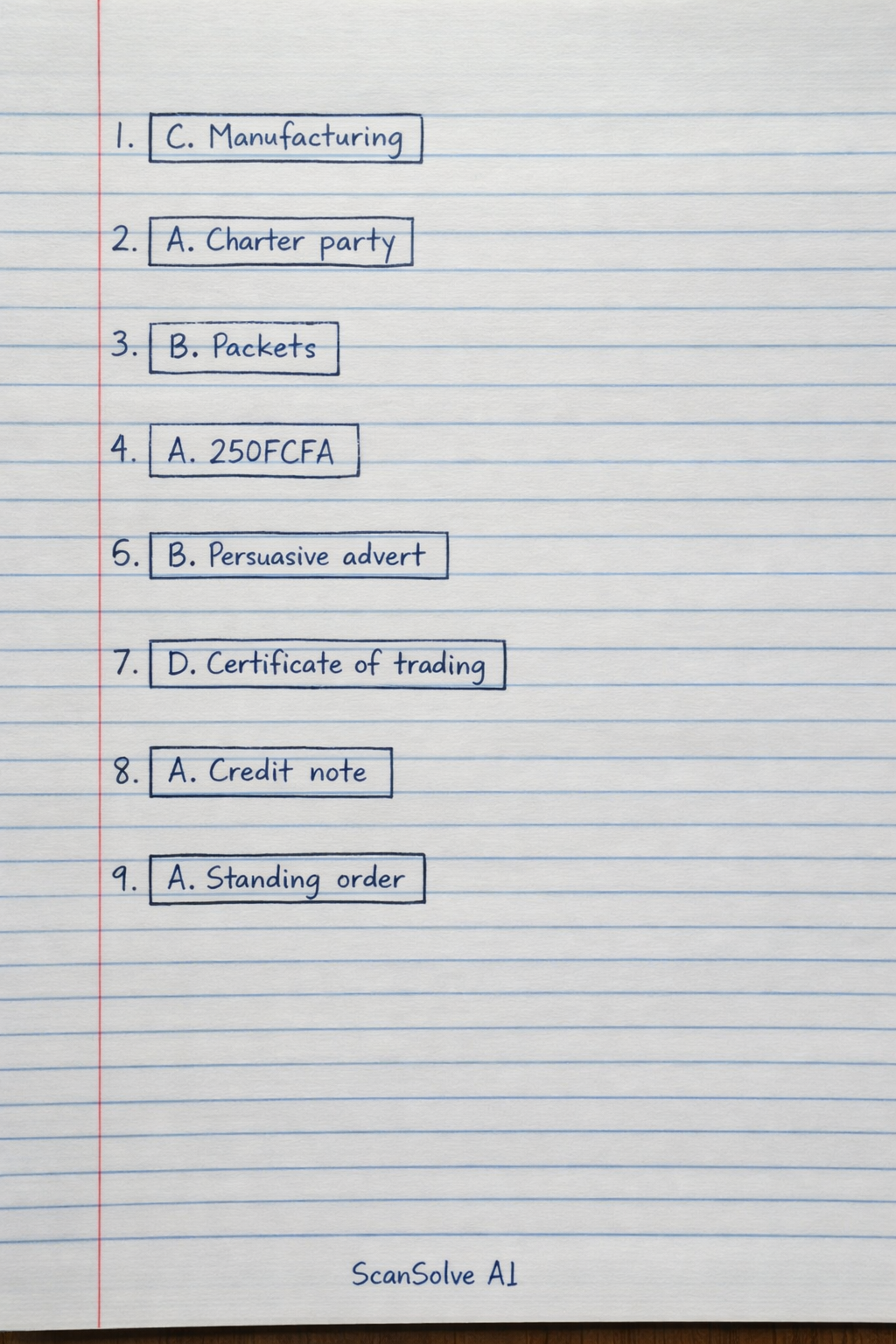
C) Manufacturing (The transformation of raw materials into finished goods). A) Charter party (The contract for the hire of a ship or its cargo space). B) Packets (Based on the text: "70 HB pencils at 250FCFA per packet"). A) 250FCFA. A) 70. B) Persuasive advert (Designed to appeal to emotions and trigger impulse buys). D) Certificate of trading (Public companies need this to legally begin operations). A) Credit note (Used to correct an overcharged invoice). A) Standing order (A service for fixed regular payments). B) Tramp ships (Vessels that do not follow fixed routes or schedules). B) Articles of association (Governs the internal management and issue of shares). C) Indemnity (Restores the insured to their position before the loss, preventing profit). C) Direct debit. B) Dumping (Selling goods at lower prices in foreign markets). C) Standing order. B) 4,800,000frs (24,000,000 x 20\% = 4,800,000). D) Divisibility (Collateral needs to be durable and accessible, but not necessarily divisible). A) He has limited liabilities. Questions 19–35: Finance, Marketing, and Operations B) Current assets less current liabilities (Working\ Capital = Current\ Assets - Current\ Liabilities). D) Sales realized by the agent (Commission is usually a percentage of sales). B) Chain stores. A) Facsimile. C) Price control. C) Account holder (Standard features are the Drawer, Drawee, and Amount). B) Balance of Trade (The difference between visible exports and imports). C) Multiple shop (A group of similar shops with a central headquarters/warehouse). A) Supermarkets. C) Public relation. B) Purchases department. C) Outcome cannot be measured. B) Registered post. A) Fork lifts (A facility/tool found inside, though B, C, and D are standard moving equipment). B) Department of veterinary (Consumer protection usually involves Trade Unions and Acts). C) Variety goods (Classification is usually by Capital, Ownership, or Size). B) Labour. Questions 36–50: Insurance, Transport, and Market Principles B) Insurable interest (You must prove ownership or financial loss to insure property). C) Statement of account. A) Supermarket. B) Lending money (The primary source of profit via interest). A) Good for bulk carrying. B) Current account. D) Quotation. A) LOCO (Price of goods at the seller's warehouse, excluding transport). A) Air (Air and rail typically operate on the strictest fixed timetables). B) General crossing. B) 200,000frs (2,000,000 x 10\% = 200,000). A) Letter of enquiry. B) Tariffs (Tariffs are taxes on imports that generate revenue; Quotas and Embargoes do not). D) Industry (Specifically extractive industry). C) Sales promotion. Number the walking
ScanSolve AI Answer
Step-by-step solution
2 steps1. C. Manufacturing is the transformation of raw materials into finished goods.
2. A. A charter party is the contract for the hire of a ship or its cargo space.
3. B. Based on the text, "70 HB pencils at 250FCFA per packet," the unit of sale is packets.
4. A. The price per packet is given as 250FCFA.
5. A. The quantity of HB pencils is given as 70.
6. B. A persuasive advert is designed to appeal to emotions and trigger impulse buys.
7. D. Public companies need a Certificate of trading to legally begin operations.
8. A. A credit note is used to correct an overcharged invoice.
9. A. A standing order is a service for fixed regular payments.
10. B. Tramp ships are vessels that do not follow fixed routes or schedules.
11. B. Articles of association govern the internal management and issue of shares of a company.
12. C. Indemnity restores the insured to their position before the loss, preventing profit.
13. C. Direct debit is a payment method where a company is authorized to collect varying amounts directly from a customer's bank account.
14. B. Dumping is the practice of selling goods at lower prices in foreign markets than in the domestic market.
15. C. A standing order is a bank instruction to pay a fixed amount at regular intervals.
16. B.
Calculate 20% of 24,000,000frs.
The value is .
17. D. Collateral needs to be durable and accessible, but not necessarily divisible.
18. A. Limited liability means that the personal assets of the owner are protected from the business's debts.
19. B. Working Capital is calculated as Current Assets less Current Liabilities.
20. D. Commission is usually a percentage of sales realized by the agent.
21. B. Chain stores are a group of retail outlets with common ownership and centralized management.
22. A. A facsimile (fax) is a copy of a document transmitted electronically.
23. C. Price control is a government regulation that sets maximum or minimum prices for goods and services.
24. C. The standard features of a cheque are the Drawer, Drawee, and Amount. The account holder is the Drawer.
25. B. The Balance of Trade is the difference between visible exports and imports.
26. C. A multiple shop is a group of similar shops with a central headquarters/warehouse.
27. A. Supermarkets are large self-service retail stores offering a wide variety of food and household products.
28. C. Public relations involves managing the spread of information between an individual or an organization and the public.
29. B. The Purchases department is responsible for acquiring goods and services for the organization.
30. C. A disadvantage of advertising is that its outcome cannot always be precisely measured.
31. B. Registered post provides proof of posting and delivery, offering security for important documents.
32. A. Forklifts are a facility/tool found inside a warehouse for moving goods.
33. B. Consumer protection usually involves government bodies, trade unions, and specific acts, not typically the Department of Veterinary.
34. C. Classification of businesses is usually by Capital, Ownership, or Size, not by "variety goods."
35. B. Labour refers to the human effort, both physical and mental, used in the production of goods and services.
36. B. Insurable interest means you must prove ownership or financial loss to insure property.
37. C. A statement of account is a summary of financial transactions over a period.
38. A. A supermarket is a large self-service store selling a wide variety of goods.
39. B. Lending money is the primary source of profit for banks, primarily through interest.
40. A. Water transport is generally good for carrying bulk goods due to its capacity.
41. B. A current account is a bank account that allows frequent deposits and withdrawals.
42. D. A quotation is a formal statement of the price for a specific job or goods.
43. A. LOCO (Loco price) refers to the price of goods at the seller's warehouse, excluding transport costs.
44. A. Air and rail transport typically operate on the strictest fixed timetables.
45. B. A general crossing on a cheque means it can only be paid into a bank account.
46. B.
Calculate 10% of 2,000,000frs.
The value is .
47. A. A letter of enquiry is sent to request information about goods or services.
48. B. Tariffs are taxes on imports that generate revenue; quotas and embargoes restrict quantity but do not directly generate revenue.
49. D. Industry refers to the sector of the economy involved in the production of goods, specifically extractive industry for raw materials.
50. C. Sales promotion refers to activities designed to stimulate purchases, such as discounts or special offers.
Still stuck on this one?
Ask a follow-up, and the answer starts from this question.
More Law Questions
Handwritten Step-by-Step Solution
Get this as a handwritten image on WhatsApp — like a tutor wrote it for you.
Try on WhatsApp