
We read your photo as:
Define the following terms as they are used in estate planning. Legatee, Heir, Testate succession, Collation, Codicil
ScanSolve AI Answer
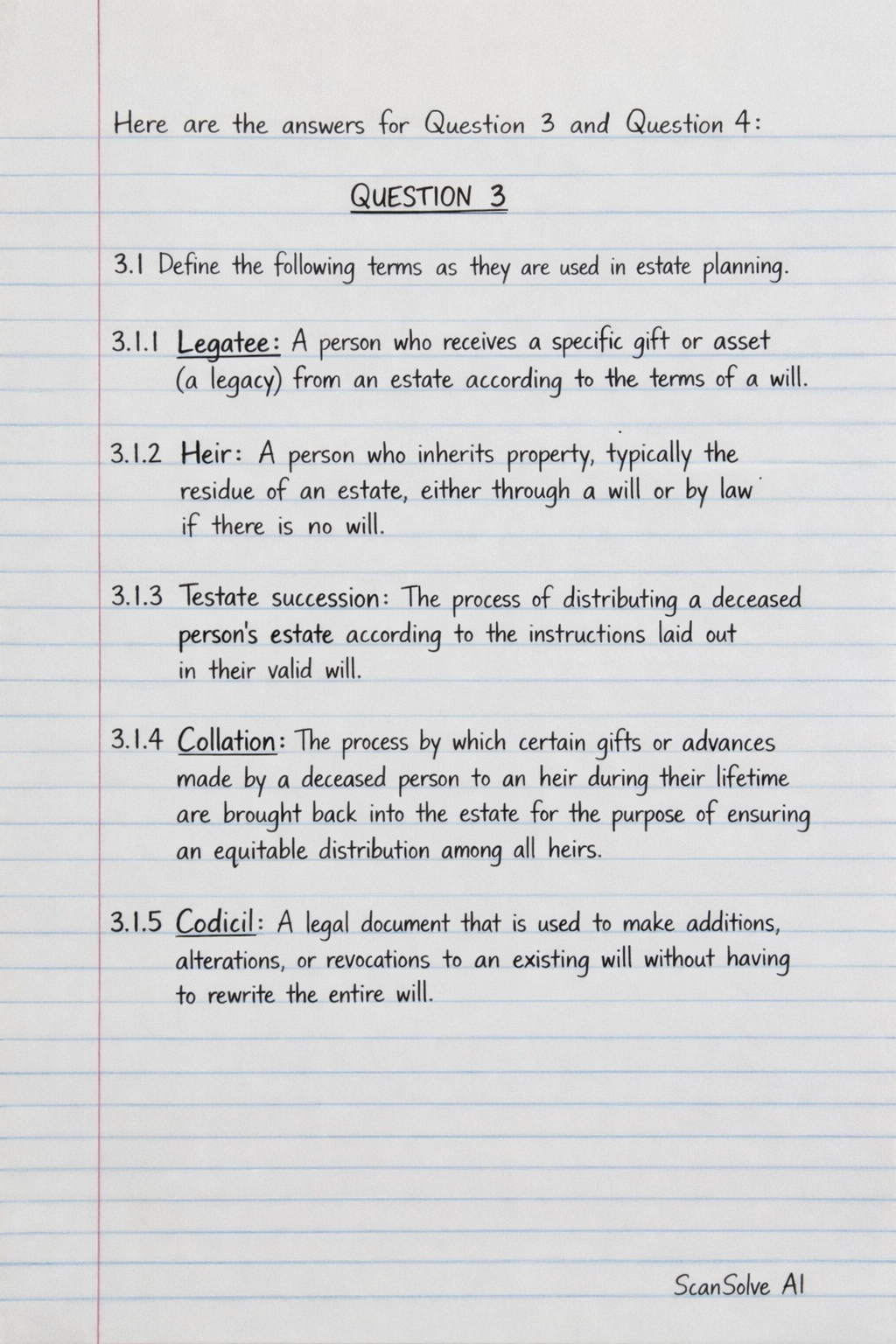
Here are the answers for Question 3 and Question 4:
QUESTION 3
3.1 Define the following terms as they are used in estate planning.
3.1.1 Legatee: A person who receives a specific gift or asset (a legacy) from an estate according to the terms of a will.
3.1.2 Heir: A person who inherits property, typically the residue of an estate, either through a will or by law if there is no will.
3.1.3 Testate succession: The process of distributing a deceased person's estate according to the instructions laid out in their valid will.
3.1.4 Collation: The process by which certain gifts or advances made by a deceased person to an heir during their lifetime are brought back into the estate for the purpose of ensuring an equitable distribution among all heirs.
3.1.5 Codicil: A legal document that is used to make additions, alterations, or revocations to an existing will without having to rewrite the entire will.
3.2 Name any FIVE requirements of drafting a practical and effective will.
- It must be in writing.
- It must be signed by the testator (the person making the will) or by someone else in their presence and at their direction.
- The signature must be made or acknowledged in the presence of two or more competent witnesses.
- The witnesses must attest and sign the will in the presence of the testator and each other.
- The testator must be at least 16 years old and of sound mind.
- It should clearly identify beneficiaries and the assets they are to receive.
- It should appoint an executor to administer the estate.
- It should be unambiguous and clearly express the testator's wishes.
3.3 Upon the death of Mr Dlamini, some processes had to be followed before his estate was distributed among the beneficiaries as stated in his will. When he wrote his will, Mr. Dlamini indicated that Noluvuyo would oversee the distribution of his estate.
3.3.1 Name FIVE documents that Mr. Dlamini's next of kin submitted to the magistrate's court within 14 days of Mr. Dlamini's death.
- Death certificate
- Original will (if one exists)
- Inventory of assets
- Next of kin affidavit
- Marriage certificate (if applicable)
3.3.2 What technical name is given to Noluvuyo?
- Executor (or Executrix)
3.3.3 State FOUR duties that would be performed by Noluvuyo regarding Mr. Dlamini's estate.
- Collect all assets belonging to the deceased's estate.
- Pay all debts, taxes, and administration costs of the estate.
- Distribute the remaining assets to the beneficiaries as specified in the will.
- Open a bank account for the estate.
- Prepare a liquidation and distribution account for submission to the Master of the High Court.
QUESTION 4
4.1 GAP is a set of standards that are applied across the world in the production of agricultural crops and livestock.
4.1.1 Briefly explain what GAP means.
- Good Agricultural Practices (GAP) are a set of principles, regulations, and technical recommendations applied to agricultural production processes. Their primary aim is to ensure food safety and quality, protect the environment, and promote worker health and welfare.
4.1.2 List any FIVE benefits to farmers who use GAP.
- Improved food safety and quality of produce.
- Enhanced market access, both locally and internationally.
- Increased consumer confidence in their products.
- Better resource management (e.g., water, soil, pesticides).
- Reduced environmental impact through sustainable practices.
- Improved worker health and safety on the farm.
4.1.3 Name FOUR beneficiaries that reap benefits from the application of GAP in South Africa.
- Consumers (receive safer, higher-quality food).
- Farmers (gain market access, improve efficiency, reduce risks).
- The Environment (benefits from sustainable farming practices).
- Agricultural workers (experience improved working conditions and safety).
- The South African economy (through increased exports and competitiveness).
4.2 Name FIVE things you would consider when buying a drone for the farm.
- Purpose/Application: What specific tasks will it perform (e.g., crop scouting, spraying, livestock monitoring, security)?
- Battery life/Flight time: How long can it operate on a single charge?
- Range/Coverage area: How far can it fly and how much land can it cover?
- Camera/Sensor quality: The resolution and type of sensors (e.g., multispectral for crop health) required.
- Durability/Weather resistance: Its ability to withstand typical farm conditions and weather.
- Ease of use/Software: The user-friendliness of its controls and accompanying data analysis software.
- Cost: The initial purchase price and ongoing maintenance expenses.
- Regulations/Licensing: Compliance with local drone operation laws and requirements.
4.3 Briefly explain what is mulch tillage.
- Mulch tillage is a conservation tillage system where the soil is minimally disturbed, and a significant amount of crop residue (mulch) is left on the soil surface. This practice helps to reduce soil erosion, conserve soil moisture, and improve soil health and organic matter content.
Still stuck on this one?
Ask a follow-up, and the answer starts from this question.
More Law Questions
Handwritten Step-by-Step Solution
Get this as a handwritten image on WhatsApp — like a tutor wrote it for you.
Try on WhatsApp