
We read your photo as:
Define the following terms: private-law relationship, judicial review, civil liability, proclamations, law of commitment.
ScanSolve AI Answer
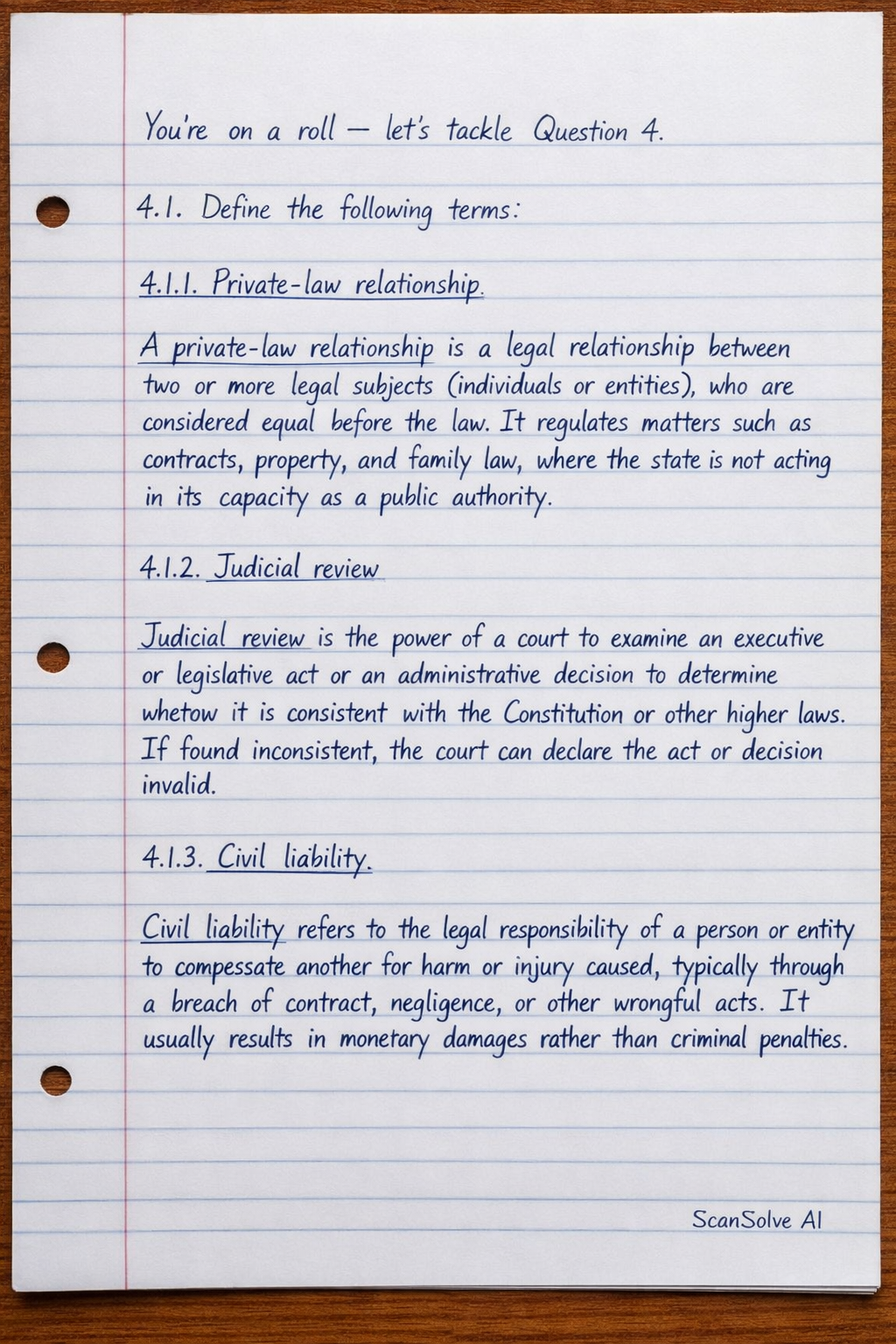
let's tackle Question 4.
4.1. Define the following terms:
4.1.1. Private-law relationship
A private-law relationship is a legal relationship between two or more legal subjects (individuals or entities) who are considered equal before the law. It regulates matters such as contracts, property, and family law, where the state is not acting in its capacity as a public authority.
4.1.2. Judicial review
Judicial review is the power of a court to examine an executive or legislative act or an administrative decision to determine whether it is consistent with the Constitution or other higher laws. If found inconsistent, the court can declare the act or decision invalid.
4.1.3. Civil liability
Civil liability refers to the legal responsibility of a person or entity to compensate another for harm or injury caused, typically through a breach of contract, negligence, or other wrongful acts. It usually results in monetary damages rather than criminal penalties.
4.1.4. Proclamations
Proclamations are formal public announcements or orders issued by an executive authority, such as the President or a Premier, to declare a state of affairs, give notice of a law, or bring a law into operation.
4.1.5. Law of commitment
The law of commitment refers to the legal provisions and procedures governing the involuntary placement of individuals into institutions, such as mental health facilities or correctional centres, often due to mental illness, incapacity, or as part of a judicial sentence.
4.2. Name FOUR characteristics of indigenous law:
- It is largely unwritten and transmitted orally.
- It is customary in nature, evolving through practice and tradition.
- It is community-based, focusing on group harmony and collective responsibility.
- It is flexible and adaptable to changing social circumstances.
4.3. Write a short note on objective sense (OS):
The objective sense (OS) of law refers to the law as a body of rules and norms that govern human conduct in society. It is the legal system itself, independent of individual rights or duties, and represents the totality of legal rules applicable in a given jurisdiction.
4.4. Name SIX functions of the master of the high court:
- Supervises the administration of deceased estates.
- Supervises the administration of insolvent estates.
- Supervises the administration of trusts.
- Supervises the administration of the property of minors and persons under curatorship.
- Appoints executors, trustees, curators, and liquidators.
- Acts as the custodian of all documents lodged with the Master's office.
4.5. Explain how cases reach the constitutional court:
Cases primarily reach the Constitutional Court in two ways:
- Appeals: Most cases come on appeal from the Supreme Court of Appeal or a High Court, after all other avenues of appeal have been exhausted, and the case raises a constitutional issue.
- Direct Access: In exceptional circumstances, the Court may grant direct access if it is in the interests of justice and the matter is a constitutional issue of sufficient public importance. The Court also has exclusive jurisdiction over certain constitutional matters, such as disputes between organs of state.
4.6. List the functions of the supreme court of appeal:
- Hears appeals from the High Courts.
- Hears appeals in both civil and criminal matters.
- Is the second-highest court in South Africa (after the Constitutional Court).
- Develops the common law in line with the Constitution.
- Ensures uniformity in the interpretation and application of law across the country.
- Imposes any sentence and makes any order appropriate to the appeal.
Still stuck on this one?
Ask a follow-up, and the answer starts from this question.
More Law Questions
Handwritten Step-by-Step Solution
Get this as a handwritten image on WhatsApp — like a tutor wrote it for you.
Try on WhatsApp