
We read your photo as:
Write the half-reaction for the deposition of copper.
ScanSolve AI Answer
Answer
Step-by-step solution
6 stepsHere's the solution to questions 2 and 3:
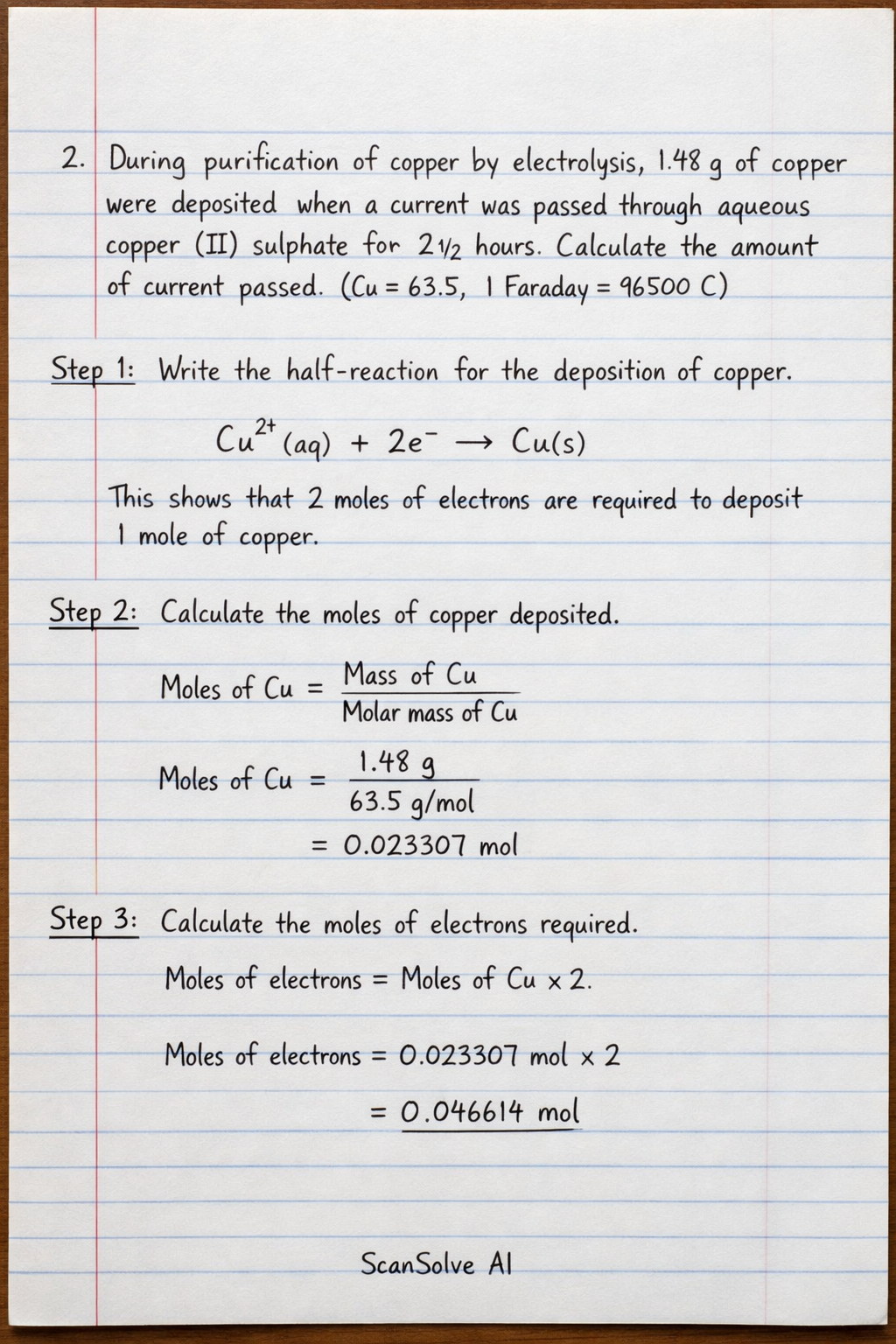
2. During purification of copper by electrolysis, of copper were deposited when a current was passed through aqueous copper (II) sulphate for hours. Calculate the amount of current passed. (, )
Write the half-reaction for the deposition of copper.
This shows that 2 moles of electrons are required to deposit 1 mole of copper.
Calculate the moles of copper deposited.
Calculate the moles of electrons required.
Calculate the total charge (Q) passed.
Convert the time to seconds.
Calculate the current (I).
The amount of current passed is
3. The diagram below represents a set-up that can be used for the electrolysis of dilute sulphuric acid
a) Name the electrodes A and B
Electrode A is connected to the positive terminal of the battery.
Electrode B is connected to the negative terminal of the battery.
Anode: Electrode A
Cathode: Electrode Bb) Write an equation for the reaction taking place at electrode B
Electrode B is the cathode (negative electrode). In dilute sulphuric acid, the species present are , , and . At the cathode, reduction occurs. Hydrogen ions are preferentially reduced over water.c) What happens to the concentration dilute sulphuric acid as the reaction continues?
At the cathode (B), ions are consumed to produce hydrogen gas.
At the anode (A), water is oxidized to produce oxygen gas and ions: .
The overall reaction is the decomposition of water: .
Since water is consumed and sulphuric acid acts as a catalyst (its ions are regenerated or not consumed), the amount of solvent (water) decreases. Therefore, the concentration of the dilute sulphuric acid increases.
Try one yourself
A new problem that tests the same skill.
Still stuck on this one?
Ask a follow-up, and the answer starts from this question.
More Law Questions
Handwritten Step-by-Step Solution
Get this as a handwritten image on WhatsApp — like a tutor wrote it for you.
Try on WhatsApp