
We read your photo as:
Which option is INCORRECT regarding the criteria for accession (inaedificatio) in South African law?
ScanSolve AI Answer
The question asks to identify the incorrect option regarding the criteria applied by courts to determine whether a movable thing became attached to an immovable thing by means of accession (inaedificatio).
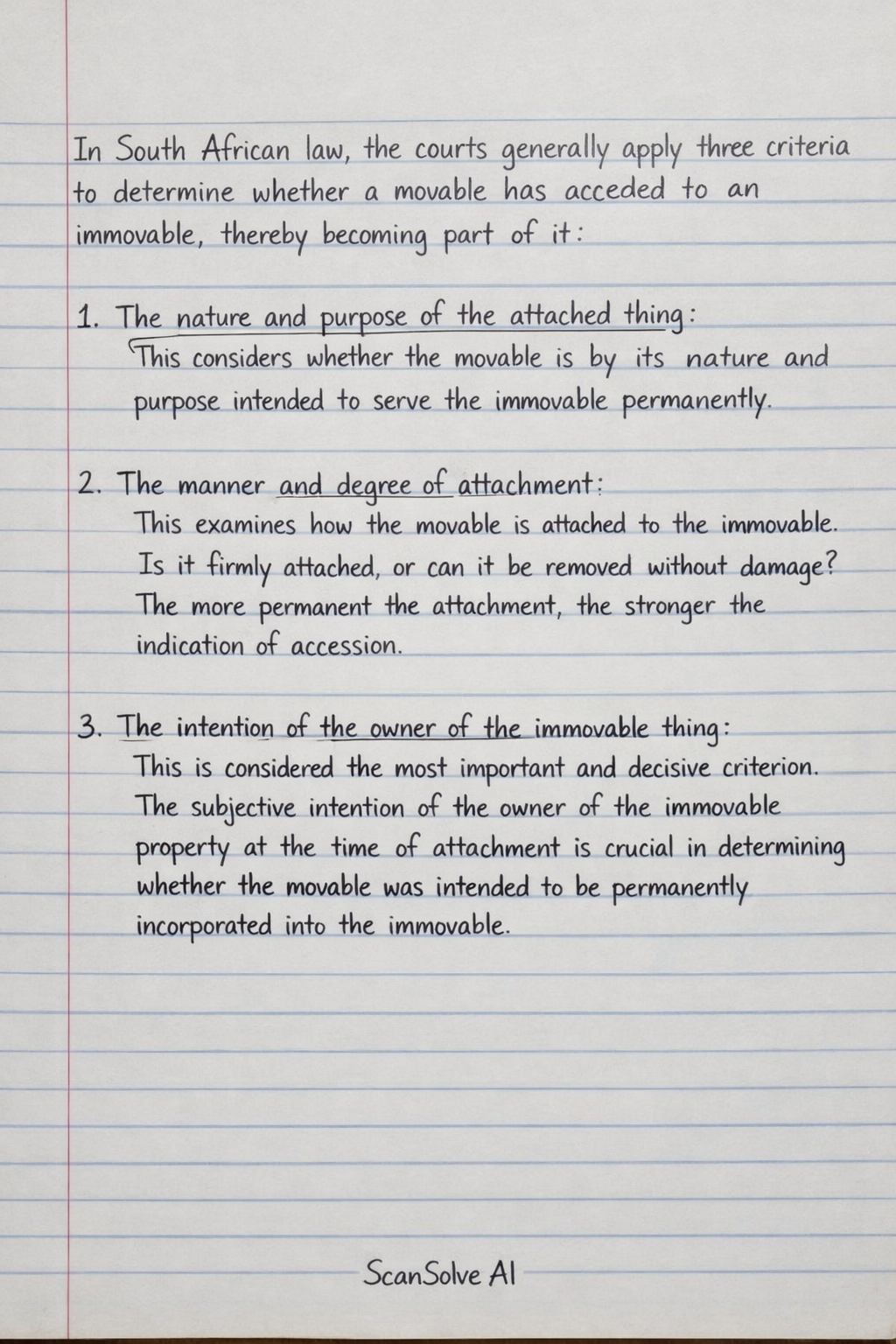
In South African law, the courts generally apply three criteria to determine whether a movable has acceded to an immovable, thereby becoming part of it:
- The nature and purpose of the attached thing: This considers whether the movable is by its nature and purpose intended to serve the immovable permanently.
- The manner and degree of attachment: This examines how the movable is attached to the immovable. Is it firmly attached, or can it be removed without damage? The more permanent the attachment, the stronger the indication of accession.
- The intention of the owner of the immovable thing: This is considered the most important and decisive criterion. The subjective intention of the owner of the immovable property at the time of attachment is crucial in determining whether the movable was intended to be permanently incorporated into the immovable.
Let's evaluate the given options:
- a. the intention of the person annexing it: While the intention of the person who physically attaches the movable might be considered, the decisive intention for accession is that of the owner of the immovable thing. If the person annexing it is not the owner of the immovable, their intention alone is not sufficient to cause accession. Therefore, this statement is generally incorrect as a primary, independent criterion.
- b. the manner and degree of attachment: This is a well-established criterion for accession.
- c. the intention of the owner of the immovable thing: This is the most important and often decisive criterion.
- d. the nature and purpose of the attached thing: This is also a well-established criterion for accession.
Comparing the options, "the intention of the person annexing it" is the incorrect criterion because the focus is on the intention of the owner of the immovable property, not necessarily the person who performs the physical act of annexation, especially if they are not the owner.
The final answer is
Still stuck on this one?
Ask a follow-up, and the answer starts from this question.
More Law Questions
Handwritten Step-by-Step Solution
Get this as a handwritten image on WhatsApp — like a tutor wrote it for you.
Try on WhatsApp