
We read your photo as:
Which statement is INCORRECT regarding Tebogo's legal position concerning Angi's rented car?
Law
ScanSolve AI Answer
The question asks to identify the incorrect statement regarding Tebogo's legal position concerning Angi's car, which Tebogo is renting.
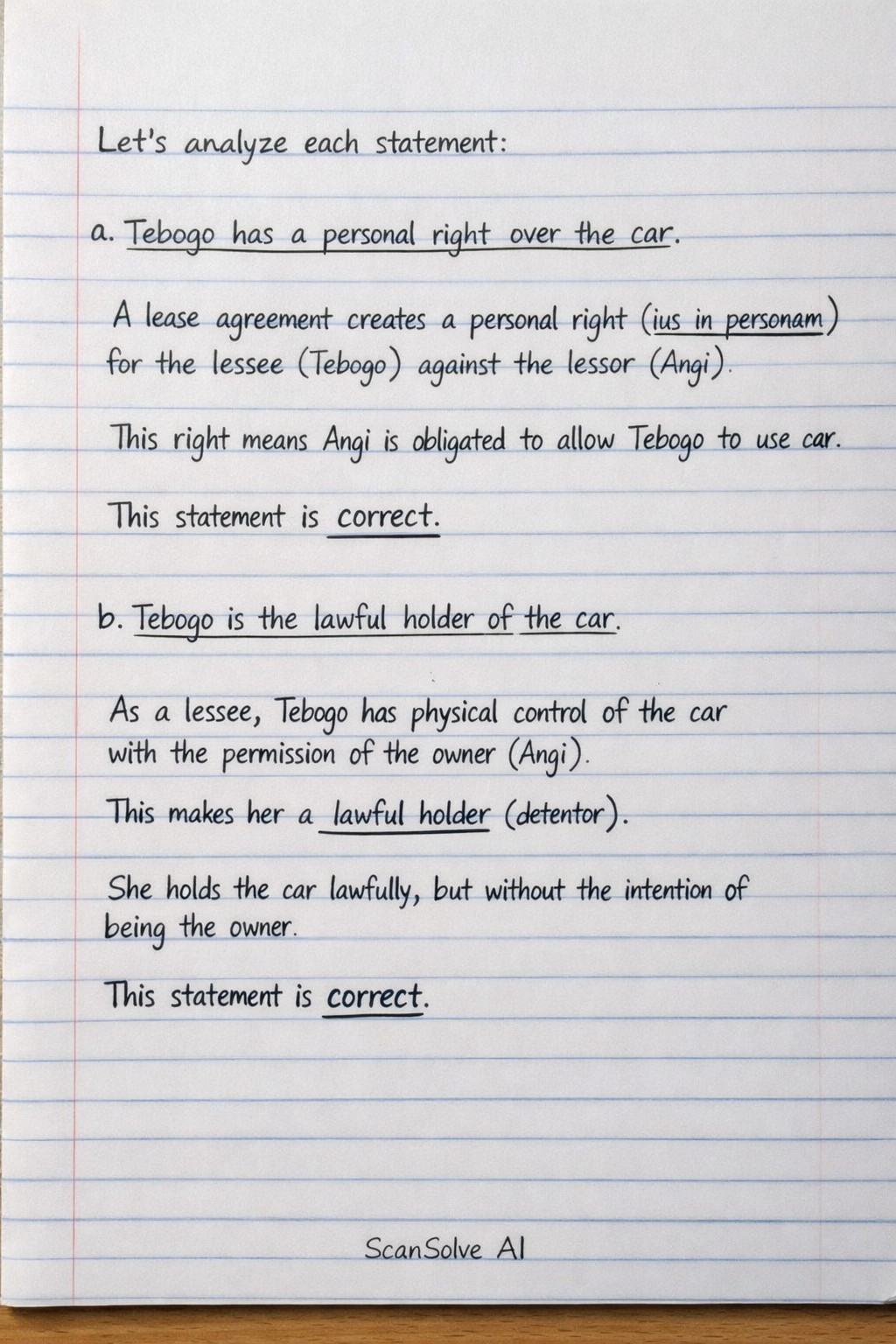
Let's analyze each statement:
-
a. Tebogo has a personal right over the car.
- A lease agreement creates a personal right (or ius in personam) for the lessee (Tebogo) against the lessor (Angi). This right means Angi is obligated to allow Tebogo to use the car. This statement is correct.
-
b. Tebogo is the lawful holder of the car.
- As a lessee, Tebogo has physical control of the car with the permission of the owner (Angi). This makes her a lawful holder (or detentor). She holds the car lawfully, but without the intention of being the owner. This statement is correct.
-
c. Tebogo has a real right over the car.
- A real right (or ius in rem) is a right in a thing itself, enforceable against the whole world (e.g., ownership, servitude, usufruct). A lease agreement, however, only creates personal rights between the parties to the contract. Tebogo does not own the car, nor does she have any other real right over it. This statement is incorrect.
-
d. Tebogo is a lessee of the car.
- The scenario states that "Angi rents her car to Tebogo." In a rental agreement, the person who rents the property is called the lessee. This statement is correct.
Therefore, the incorrect statement is that Tebogo has a real right over the car.
The final answer is
Was this helpful?
Still stuck on this one?
Ask a follow-up, and the answer starts from this question.
Got a different question?Ask your own question
More Law Questions
QSipho rented a room from Thandi for six months. What is Sipho's legal standing regarding the room?QWhich option is INCORRECT regarding the criteria for accession (inaedificatio) in South African law?QVerify, with calculations, whether Lerato's claim is valid.QThulani wants to start a transport business. He owns one minibus and employs Lebogang to be the…QDiscuss the limitations on ownership in South African law, referring to the definition in Gien v…
Handwritten Step-by-Step Solution
Get this as a handwritten image on WhatsApp — like a tutor wrote it for you.
Try on WhatsApp