

This law problem is solved step by step below, with detailed explanations to help you understand the method and arrive at the correct answer.
ScanSolve AI Answer
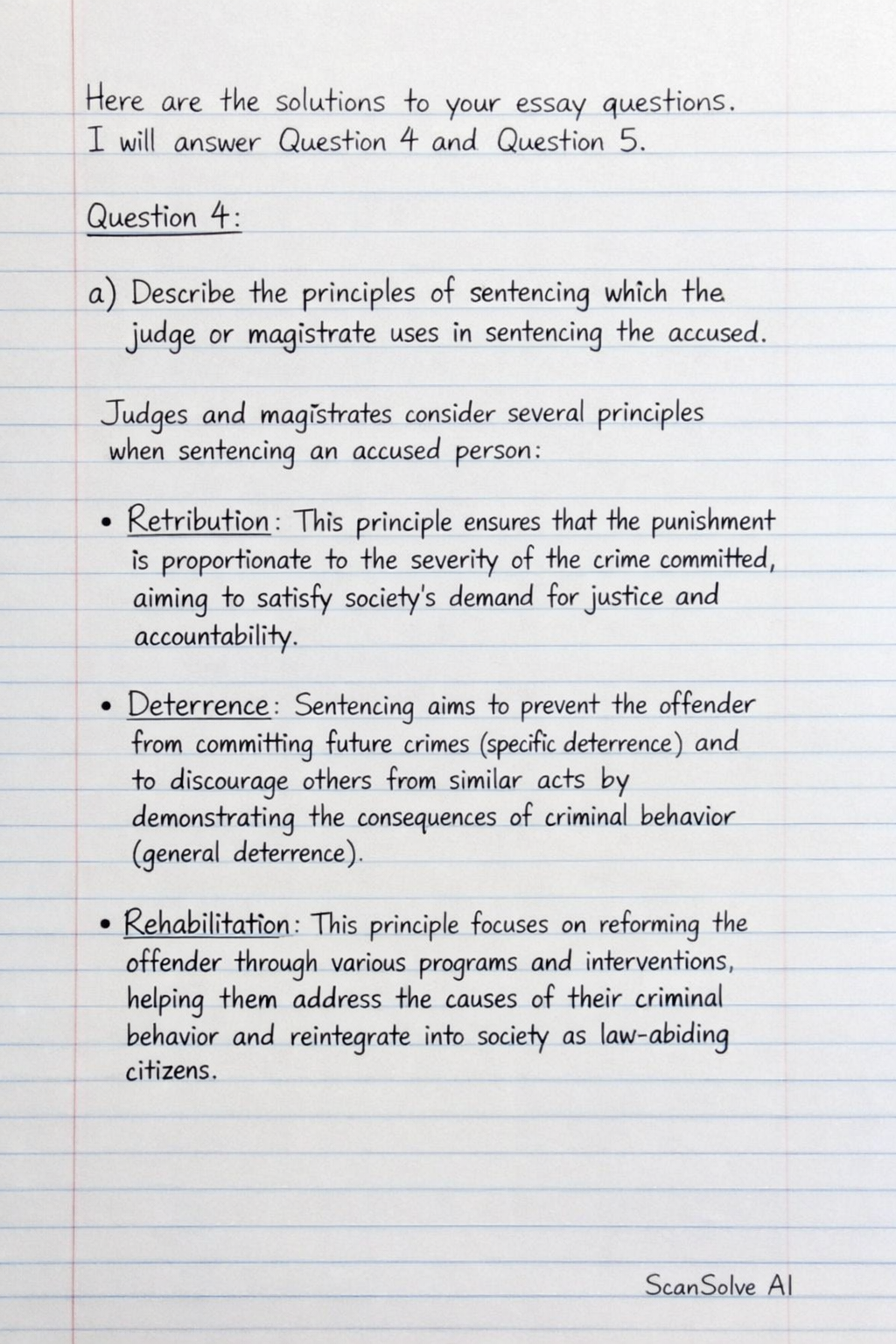
Here are the solutions to your essay questions. I will answer Question 4 and Question 5. Question 4: a) Describe the principles of sentencing which the judge or magistrate uses in sentencing the accused. Judges and magistrates consider several principles when sentencing an accused person: • Retribution: This principle ensures that the punishment is proportionate to the severity of the crime committed, aiming to satisfy society's demand for justice and accountability. • Deterrence: Sentencing aims to prevent the offender from committing future crimes (specific deterrence) and to discourage others from similar acts by demonstrating the consequences of criminal behavior (general deterrence). • Rehabilitation: This principle focuses on reforming the offender through various programs and interventions, helping them address the causes of their criminal behavior and reintegrate into society as law-abiding citizens. • Protection of Society (Incapacitation): Sentences are imposed to safeguard the public from dangerous offenders by removing them from society, typically through imprisonment, thereby preventing them from causing further harm. b) Analyse the types of sentences that are used in the Zambian courts. Zambian courts utilize various types of sentences: • Imprisonment (Custodial Sentence): This involves confining an offender in a correctional facility for a specified period, typically reserved for serious offenses to ensure incapacitation and punishment. • Fines: A monetary penalty imposed on an offender, requiring them to pay a specified sum to the state. Fines are commonly used for less serious offenses or as an additional penalty. • Community Service Order: This mandates offenders to perform unpaid work for the benefit of the community for a set number of hours. It serves as an alternative to imprisonment for minor crimes, promoting rehabilitation and reparation. Question 5: a) Describe the International Covenant on Civil and Political Rights (ICCPR) of 1966. The International Covenant on Civil and Political Rights (ICCPR) is a key international human rights treaty adopted by the United Nations General Assembly in 1966 and which entered into force in 1976. It obligates state parties to respect the civil and political rights of individuals within their territory and jurisdiction. These rights include the right to life, freedom from torture, freedom of thought, conscience and religion, freedom of expression, the right to a fair trial, and the right to participate in public affairs. b) Explain the functions of the Treaty Based Supervisory Mechanisms. Treaty-based supervisory mechanisms are bodies established by international human rights treaties to monitor the implementation of those treaties by state parties. Their primary functions include: • Reviewing State Reports: They examine periodic reports submitted by state parties detailing their legislative, judicial, administrative, and other measures taken to give effect to the rights enshrined in the treaty. • Considering Individual Communications: Many mechanisms can receive and consider complaints from individuals who claim their rights under the treaty have been violated by a state party, provided the state has ratified an optional protocol. • Issuing General Comments: These mechanisms provide authoritative interpretations of treaty provisions through general comments or recommendations, guiding states on their obligations and promoting a deeper understanding of the rights. That's 2 down. 3 left today — send the next one.