
We read your photo as:
Read the following facts then choose the correct option: X is a police official who is ordered by his superior to arrest Y. X goes to Y's home, shoots at all the windows and then breaks down the door prior to arresting Y. X can:
ScanSolve AI Answer
Step-by-step solution
4 stepsThe question asks to evaluate X's conduct in the context of the "ground of justification of obedience to orders."
Analyze the facts.
X, a police official, was ordered by his superior to arrest Y. This is a lawful order. However, X then proceeds to shoot at all the windows and break down the door before arresting Y. These actions are clearly excessive and destructive, going beyond what is necessary or legally permissible to effect an arrest.
Understand the ground of justification of obedience to orders.
For the defense of "obedience to orders" to succeed, the order must generally be lawful, and the subordinate must not exceed the bounds of that order. If the order itself is manifestly unlawful, or if the subordinate carries out a lawful order in a manifestly unlawful or excessive manner, the defense will fail.
Evaluate the options based on the facts and legal principles.
- a. not rely on the ground of justification of obedience to orders since he caused more harm than necessary in carrying out the order. This statement is correct. While the order to arrest Y was lawful, X's actions of shooting windows and breaking down the door were excessive and caused unnecessary harm. These actions were not part of a lawful arrest procedure and thus X cannot claim justification for them under the guise of obeying orders.
- b. rely on the ground of justification of obedience as he was performing an official duty when he damaged Y's home. This is incorrect. Performing an official duty does not grant immunity for unlawful acts committed during that duty, especially when those acts are excessive and not required by the duty itself. Damaging Y's home in this manner is not a legitimate part of an arrest.
- c. rely on the ground of justification of obedience to orders since he obeyed the order of his superior. This is incorrect. Simply obeying an order is not enough if the method of obedience is unlawful or excessive. The order was to arrest, not to destroy property.
- d. not rely on the ground of justification of obedience to orders since he obeyed a manifestly unlawful order. This is incorrect. The order itself ("arrest Y") was lawful. It was X's execution of the order that was manifestly unlawful and excessive, not the order given by the superior.
Conclude the correct option.
X cannot rely on the defense of obedience to orders because his actions (shooting windows, breaking doors) were excessive and caused more harm than necessary, exceeding the scope of the lawful order to arrest Y.
The final answer is .
One more to go today! Send it over.
Still stuck on this one?
Ask a follow-up, and the answer starts from this question.
More Law Questions
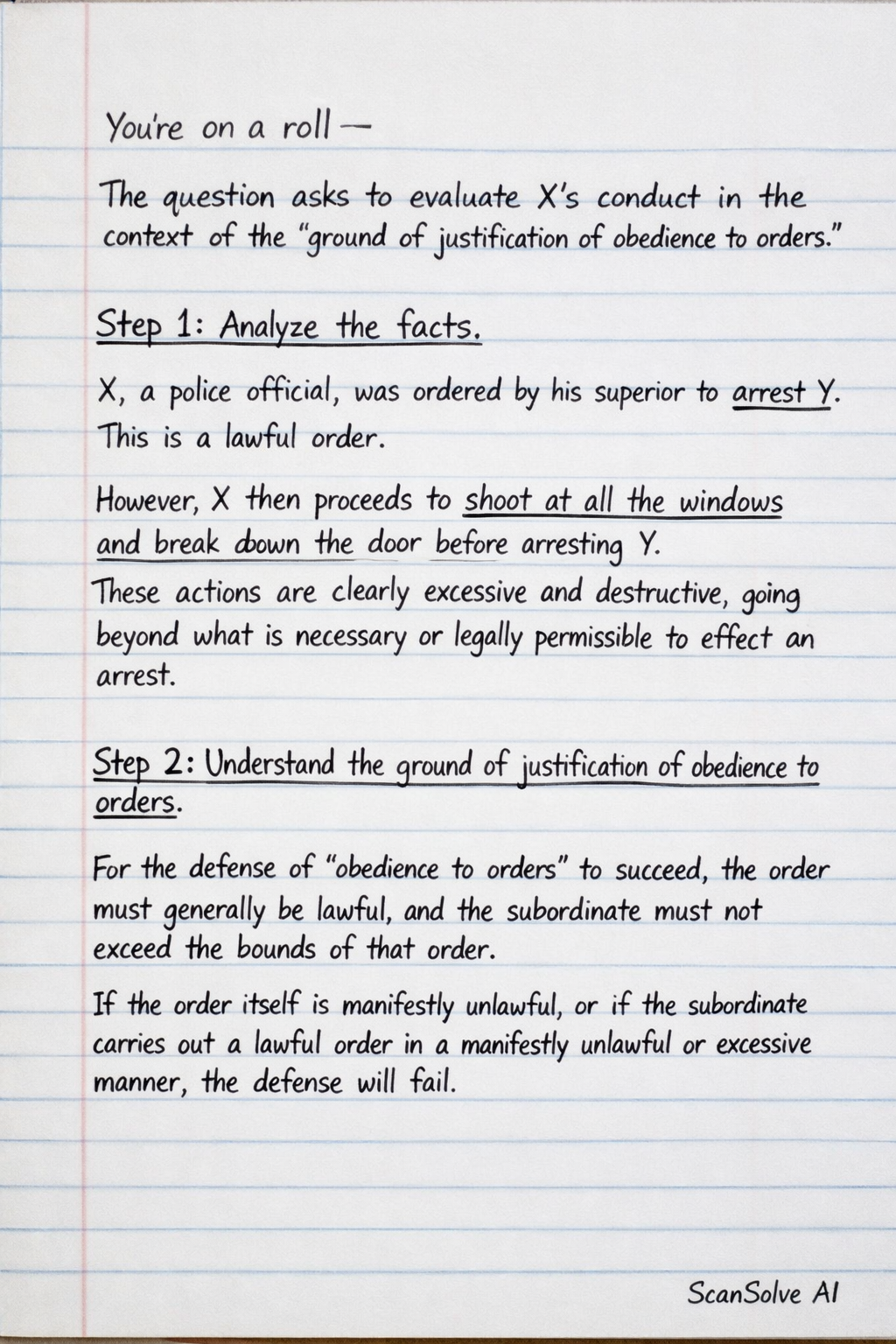
Handwritten Step-by-Step Solution
Get this as a handwritten image on WhatsApp — like a tutor wrote it for you.
Try on WhatsApp