

This law problem is solved step by step below, with detailed explanations to help you understand the method and arrive at the correct answer.
ScanSolve AI Answer
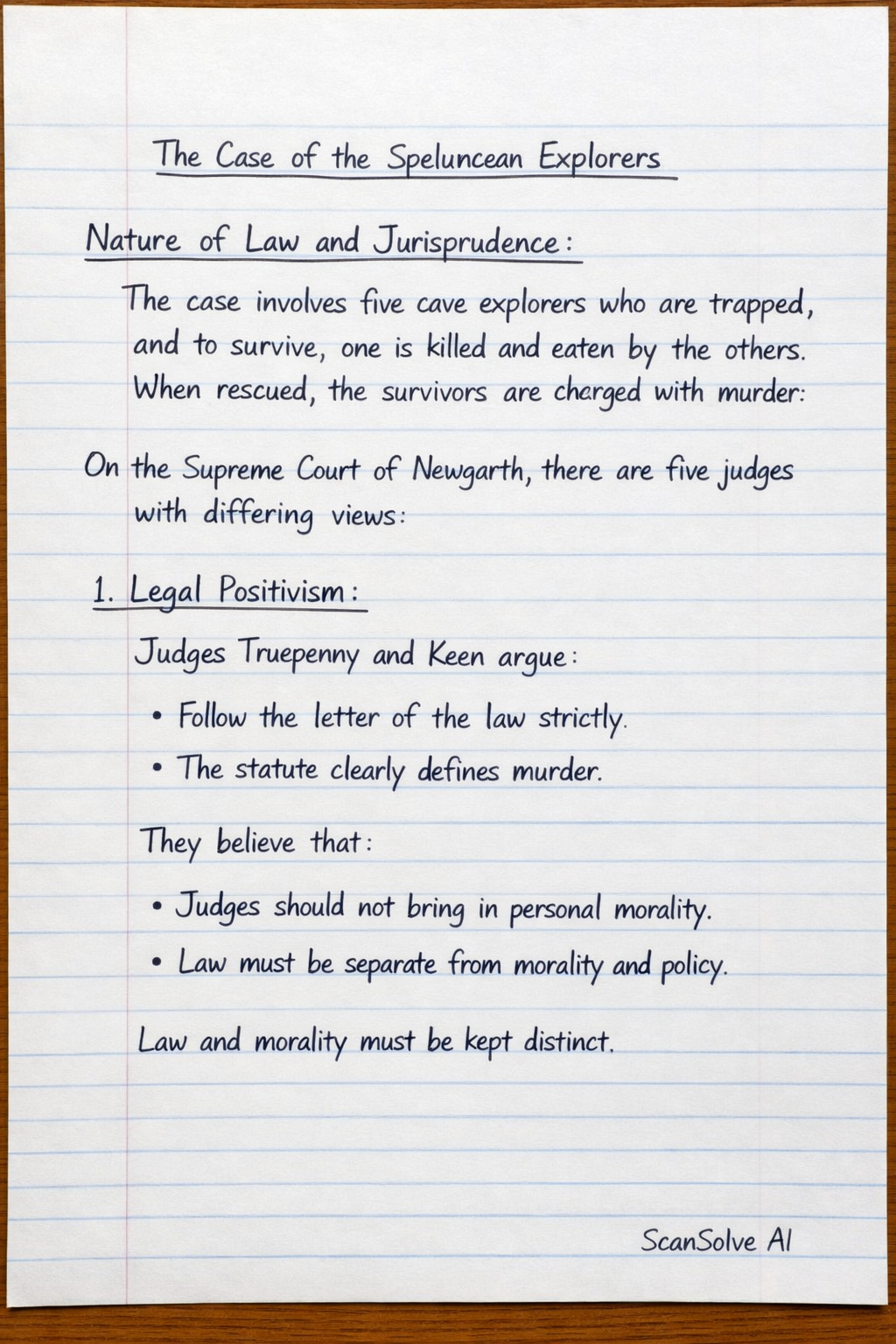
The Case of the Speluncean Explorers is a hypothetical legal case that explores fundamental questions about the nature of law, justice, and judicial interpretation. Nature of Law and Jurisprudence: The case presents a scenario where five cave explorers are trapped, and to survive, one is killed and eaten by the others. When rescued, the survivors are charged with murder. The five judges on the fictional Supreme Court of Newgarth deliver diverse opinions, each representing a different school of jurisprudential thought: Legal Positivism: Judges like Truepenny and Keen advocate for strict adherence to the letter of the law, arguing that the statute clearly defines murder and that judges should not inject personal morality or policy considerations. They emphasize the separation of law and morality. Natural Law: Justice Foster argues that in such extreme circumstances, the explorers were outside the jurisdiction of positive law and reverted to a "state of nature" where a natural law of self-preservation applied. He also suggests a purposive interpretation of the statute, arguing that its purpose (deterrence) would not be served by punishing those acting out of necessity. Legal Realism: Justices Tatting and Handy highlight the practical difficulties and moral dilemmas in applying the law. Tatting struggles with the conflict between legal principles and moral outrage, while Handy focuses on public opinion and practical outcomes, suggesting that the law should align with common sense and public sentiment. The case thus illustrates the tension between legal formalism (strict application of rules) and substantive justice (achieving a fair outcome), the role of morality in law, and the different approaches to statutory interpretation (literal vs. purposive). Relevance to Contemporary Nigerian Legal System: The insights from The Case of the Speluncean Explorers are highly relevant to the Nigerian legal system in several ways: Statutory Interpretation: Nigerian courts frequently grapple with whether to adopt a literal or purposive approach to interpreting statutes, especially in areas like criminal law, constitutional law, and human rights. The case highlights the consequences of each approach. Rule of Law vs. Justice/Equity: The Nigerian legal system, while founded on the rule of law, also strives for justice and equity. The Speluncean Explorers case underscores the conflict that arises when strict application of the law might lead to an outcome perceived as unjust or morally repugnant. Judicial Activism vs. Restraint: Nigerian judges often face the dilemma of whether to strictly apply existing laws and precedents (judicial restraint) or to interpret them broadly to achieve social justice or protect fundamental rights (judicial activism). The varying opinions in the case reflect this ongoing debate. Influence of Morality and Societal Values: While Nigerian law is largely secular, societal values, cultural norms, and religious beliefs often influence legal discourse and judicial decisions, particularly in areas like customary law, family law, and public morality. The natural law arguments in the case resonate with the idea that law should reflect fundamental moral principles. Defence of Necessity: The extreme circumstances in the case push the boundaries of the defence of necessity, which exists in Nigerian criminal law (e.g., under the Criminal Code and Penal Code). The case prompts reflection on the scope and limitations of such defences when human life is at stake. Send me the next one 📸