
[04/04, 22:30] Gift Juicy Mbbs🔥: A child presents with severe fasting hypoglycemia and hepatomegaly. Likely deficiency: A. Glucose-6-phosphatase B. PFK-1 C. Pyruvate kinase D. Aldolase E. Enolase [06/04, 08:19] Gift Juicy Mbbs🔥: Please, can someone explain to be why Phosphoenolpyruvate will be inhibiting pyruvate kinase?
ScanSolve AI Answer
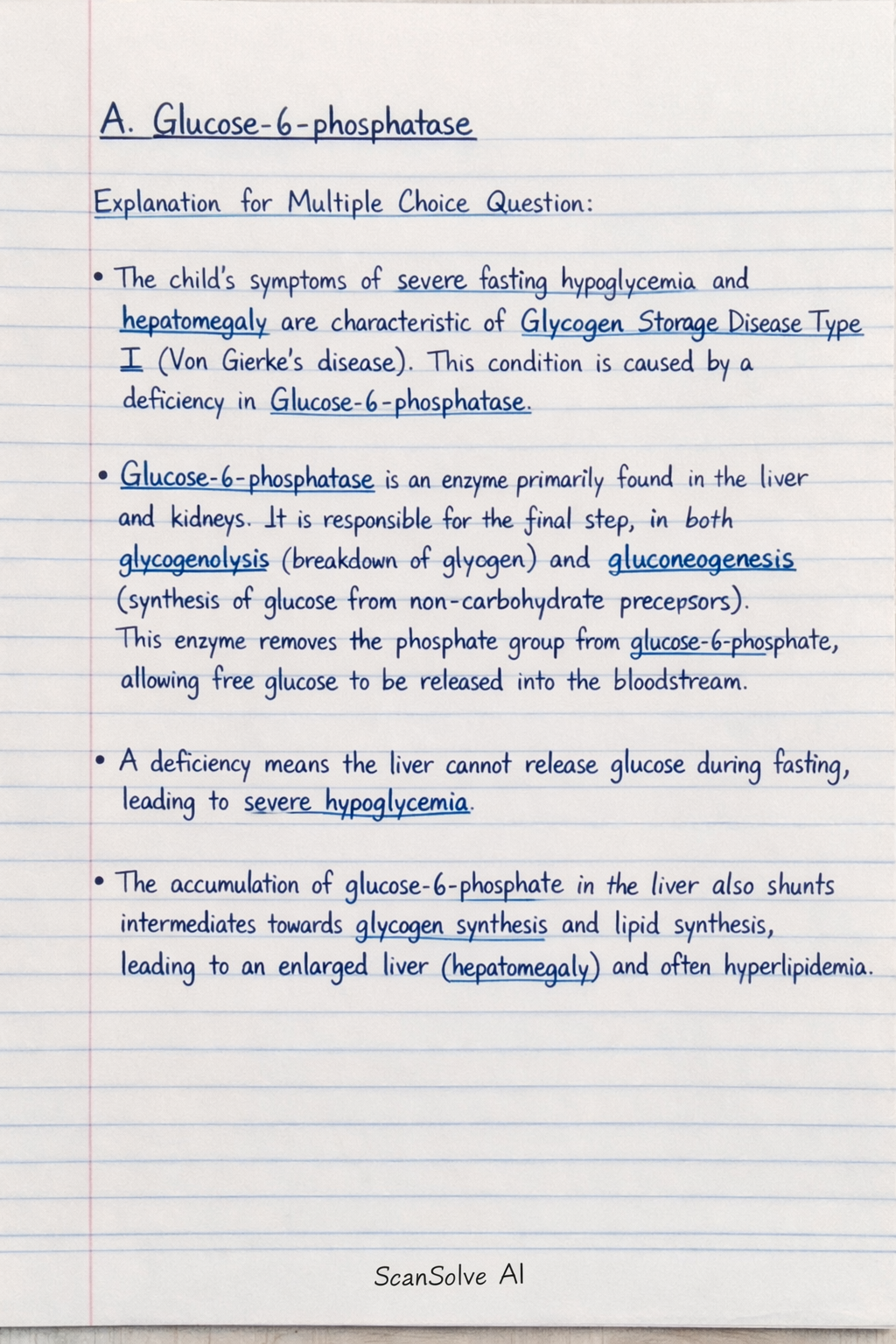
A. Glucose-6-phosphatase
Explanation for Multiple Choice Question:
The child's symptoms of severe fasting hypoglycemia and hepatomegaly are characteristic of Glycogen Storage Disease Type I (Von Gierke's disease). This condition is caused by a deficiency in Glucose-6-phosphatase.
- Glucose-6-phosphatase is an enzyme primarily found in the liver and kidneys. It is responsible for the final step in both glycogenolysis (breakdown of glycogen) and gluconeogenesis (synthesis of glucose from non-carbohydrate precursors). This enzyme removes the phosphate group from glucose-6-phosphate, allowing free glucose to be released into the bloodstream.
- A deficiency means the liver cannot release glucose during fasting, leading to severe hypoglycemia.
- The accumulation of glucose-6-phosphate in the liver also shunts intermediates towards glycogen synthesis and lipid synthesis, leading to an enlarged liver (hepatomegaly) and often hyperlipidemia.
The other options are less likely:
- PFK-1 (Phosphofructokinase-1) and Pyruvate kinase are enzymes in glycolysis. Deficiencies typically cause hemolytic anemia (especially pyruvate kinase) or muscle weakness, not this specific combination of severe fasting hypoglycemia and hepatomegaly.
- Aldolase deficiency (specifically Aldolase B in hereditary fructose intolerance) can cause hypoglycemia and hepatomegaly, but the primary defect is in fructose metabolism, and the hypoglycemia is often triggered by fructose intake, not solely severe fasting.
- Enolase is also a glycolytic enzyme, and its deficiency would not typically present with these symptoms.
Regarding your second question:
Phosphoenolpyruvate (PEP) is the substrate for pyruvate kinase, not typically an inhibitor in human metabolism. Pyruvate kinase catalyzes the irreversible conversion of PEP to pyruvate, generating ATP.
The regulation of pyruvate kinase in human metabolism is primarily as follows:
- Activation: Pyruvate kinase is allosterically activated by high concentrations of fructose-1,6-bisphosphate. This is an example of feed-forward activation, where an intermediate earlier in the glycolytic pathway (F-1,6-BP) signals that there is a high flux through glycolysis, thus stimulating the final step.
- Inhibition: Pyruvate kinase is allosterically inhibited by:
- ATP: High levels of ATP signal a high energy state in the cell, reducing the need for further glucose breakdown.
- Alanine: High levels of alanine (an amino acid that can be synthesized from pyruvate) indicate that there are sufficient building blocks, and pyruvate is abundant, thus slowing down glycolysis.
- Long-chain fatty acids: These can also serve as an alternative fuel source, signaling reduced need for glucose catabolism.
While some bacterial pyruvate kinases can be inhibited by PEP, this is not a common or significant regulatory mechanism for human pyruvate kinase. In human metabolism, PEP's role is primarily as the substrate that drives the reaction forward.
Still stuck on this one?
Ask a follow-up, and the answer starts from this question.
More Mathematics Questions
Handwritten Step-by-Step Solution
Get this as a handwritten image on WhatsApp — like a tutor wrote it for you.
Try on WhatsApp