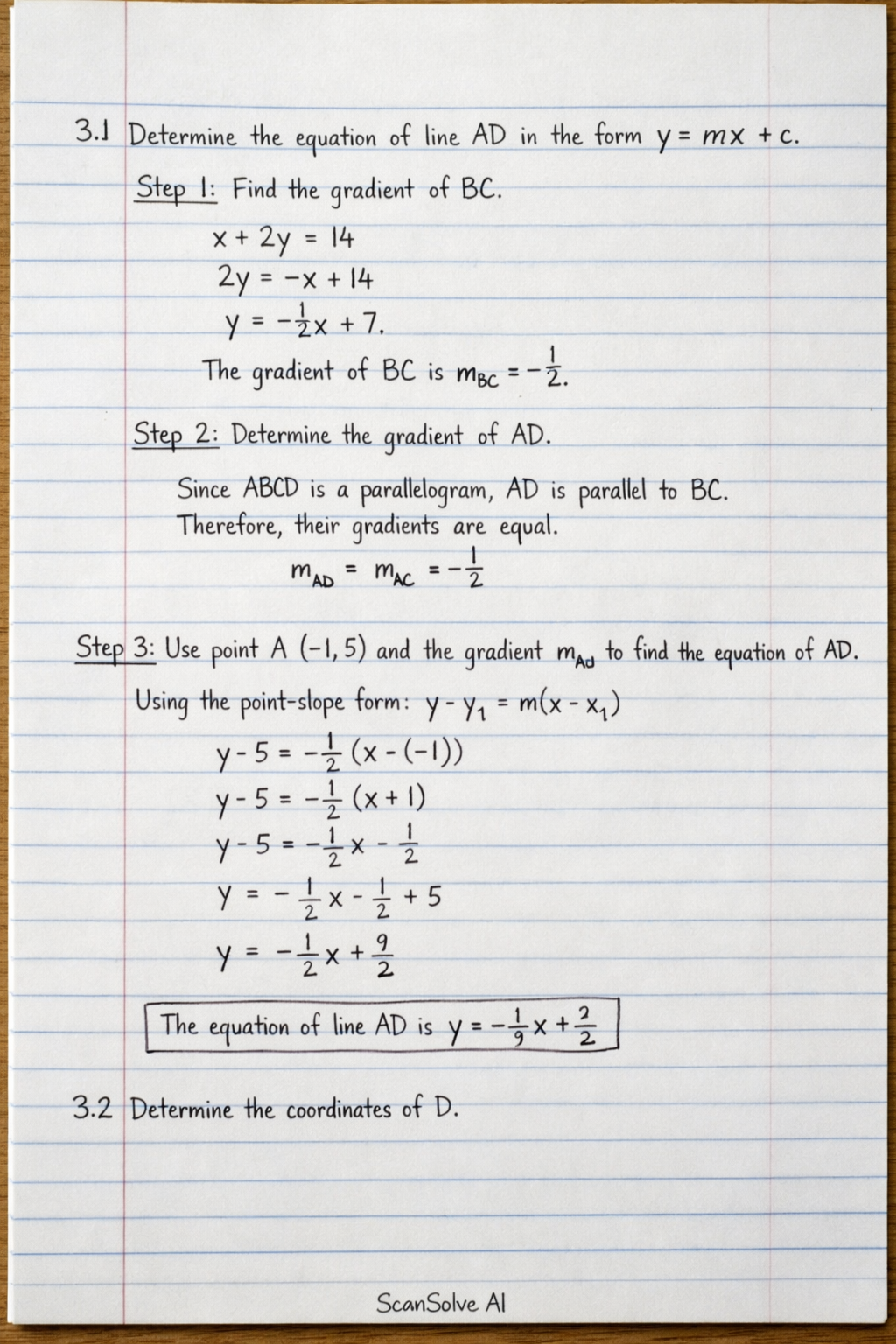
1 Determine the equation of line AD in the form y = mx + c. 3.2 Determine the coordinates of D.
|Mathematics
1 Determine the equation of line AD in the form y = mx + c. 3.2 Determine the coordinates of D.
ScanSolve AI Answer
Answer
y=−21x+29
You're on a roll —
Here's the solution to the analytical geometry problem.
Given:
Parallelogram ABCD
A (−1;5)
B (2;6)
Vertex D lies on the x-axis.
Equation of BC is x+2y=14.
3.1 Determine the equation of line AD in the form y=mx+c.
Step 1: Find the gradient of BC.
The equation of BC is x+2y=14.
Rearrange to y=mx+c form:
2y=−x+14y=−21x+7
The gradient of BC is mBC=−21.
Step 2: Determine the gradient of AD.
Since ABCD is a parallelogram, AD is parallel to BC. Therefore, their gradients are equal.
mAD=mBC=−21
Step 3: Use point A (−1;5) and the gradient mAD to find the equation of AD.
Using the point-slope form y−y1=m(x−x1):
y−5=−21(x−(−1))y−5=−21(x+1)y−5=−21x−21y=−21x−21+5y=−21x+29
The equation of line AD is y=−21x+29.
3.2 Determine the coordinates of D.
Step 1: Use the fact that D lies on the x-axis.
If D lies on the x-axis, its y-coordinate is 0. So, D (xD;0).
Step 2: Substitute y=0 into the equation of line AD.
From 3.1, the equation of AD is y=−21x+29.
0=−21xD+29
Multiply by 2 to clear the denominators:
0=−xD+9xD=9
The coordinates of D are (9;0).
3.3 If the coordinates of F are (10;2), show that DF is perpendicular to BC.
Step 1: Calculate the gradient of DF.
Given F (10;2) and D (9;0).
mDF=xF−xDyF−yD=10−92−0=12=2
Step 2: Compare mDF with mBC.
From 3.1, mBC=−21.
For two lines to be perpendicular, the product of their gradients must be −1.
mDF×mBC=2×(−21)=−1
Since the product of their gradients is −1, DF is perpendicular to BC.
3.4 Calculate the length of AD. (Leave your answer in surd form.)
Step 1: Use the distance formula.
A (−1;5) and D (9;0).
AD=(xD−xA)2+(yD−yA)2AD=(9−(−1))2+(0−5)2AD=(9+1)2+(−5)2AD=(10)2+25AD=100+25AD=125
Step 2: Simplify the surd.
AD=25×5=25×5=55
The length of AD is 55units.
3.5 Hence, or otherwise, calculate the area of parallelogram ABCD.
Step 1: Find the length of BC.
Since ABCD is a parallelogram, AD=BC.
From 3.4, AD=55.
So, BC=55.
Step 2: Find the perpendicular height of the parallelogram.
The perpendicular height from D to BC is the length of DF, since DF is perpendicular to BC (shown in 3.3).
D (9;0) and F (10;2).
DF=(xF−xD)2+(yF−yD)2DF=(10−9)2+(2−0)2DF=(1)2+(2)2DF=1+4DF=5
Step 3: Calculate the area of the parallelogram.
Area of parallelogram = base × perpendicular height.
Using BC as the base and DF as the perpendicular height:
Area=BC×DFArea=(55)×(5)Area=5×(5×5)Area=5×5Area=25
The area of parallelogram ABCD is 25squareunits.
3.6 Calculate the size of ∠ABC.
Step 1: Find the gradient of AB.
A (−1;5) and B (2;6).
mAB=xB−xAyB−yA=2−(−1)6−5=31
Step 2: Find the angle of inclination for AB and BC.
Let α be the angle of inclination for AB and β be the angle of inclination for BC.
mAB=tanα=31⟹α=arctan(31)≈18.43∘mBC=tanβ=−21
Since mBC is negative, β is an obtuse angle.
The reference angle is arctan(−21)=arctan(21)≈26.57∘.
So, β=180∘−26.57∘=153.43∘.
Step 3: Calculate ∠ABC.
∠ABC is the angle between line AB and line BC.
Using the formula for the angle between two lines: tanθ=1+m1m2m1−m2.
Let m1=mBC=−21 and m2=mAB=31.
tan(∠ABC)=1+(−21)(31)−21−31tan(∠ABC)=1−61−63−62tan(∠ABC)=65−65tan(∠ABC)=∣−1∣tan(∠ABC)=1∠ABC=arctan(1)∠ABC=45∘
The size of ∠ABC is 45∘.
What's next? 📸
Was this helpful?
Need help with your own homework?
Get instant step-by-step solutions to any question. Free to start.
This mathematics problem involves applying core mathematical principles and formulas. Below you will find a complete step-by-step solution with detailed explanations for each step, helping you understand not just the answer but the method behind it.
ScanSolve AI Answer
You're on a roll — Here's the solution to the analytical geometry problem. Given: Parallelogram ABCD A (-1; 5) B (2; 6) Vertex D lies on the x-axis. Equation of BC is x + 2y = 14. 3.1 Determine the equation of line AD in the form y = mx + c. Step 1: Find the gradient of BC. The equation of BC is x + 2y = 14. Rearrange to y = mx + c form: 2y = -x + 14 y = -(1)/(2)x + 7 The gradient of BC is m_BC = -(1)/(2). Step 2: Determine the gradient of AD. Since ABCD is a parallelogram, AD is parallel to BC. Therefore, their gradients are equal. m_AD = m_BC = -(1)/(2) Step 3: Use point A (-1; 5) and the gradient m_AD to find the equation of AD. Using the point-slope form y - y_1 = m(x - x_1): y - 5 = -(1)/(2)(x - (-1)) y - 5 = -(1)/(2)(x + 1) y - 5 = -(1)/(2)x - (1)/(2) y = -(1)/(2)x - (1)/(2) + 5 y = -(1)/(2)x + (9)/(2) The equation of line AD is y = -(1)/(2)x + (9)/(2). 3.2 Determine the coordinates of D. Step 1: Use the fact that D lies on the x-axis. If D lies on the x-axis, its y-coordinate is 0. So, D (x_D; 0). Step 2: Substitute y = 0 into the equation of line AD. From 3.1, the equation of AD is y = -(1)/(2)x + (9)/(2). 0 = -(1)/(2)x_D + (9)/(2) Multiply by 2 to clear the denominators: 0 = -x_D + 9 x_D = 9 The coordinates of D are (9; 0). 3.3 If the coordinates of F are (10; 2), show that DF is perpendicular to BC. Step 1: Calculate the gradient of DF. Given F (10; 2) and D (9; 0). m_DF = (y_F - y_D)/(x_F - x_D) = (2 - 0)/(10 - 9) = (2)/(1) = 2 Step 2: Compare m_DF with m_BC. From 3.1, m_BC = -(1)/(2). For two lines to be perpendicular, the product of their gradients must be -1. m_DF × m_BC = 2 × (-(1)/(2)) = -1 Since the product of their gradients is -1, DF is perpendicular to BC. 3.4 Calculate the length of AD. (Leave your answer in surd form.) Step 1: Use the distance formula. A (-1; 5) and D (9; 0). AD = sqrt((x_D - x_A)^2 + (y_D - y_A)^2) AD = sqrt((9 - (-1))^2 + (0 - 5)^2) AD = sqrt((9 + 1)^2 + (-5)^2) AD = sqrt((10)^2 + 25) AD = sqrt(100 + 25) AD = sqrt(125) Step 2: Simplify the surd. AD = sqrt(25 × 5) = sqrt(25) × sqrt(5) = 5sqrt(5) The length of AD is 5sqrt(5) units. 3.5 Hence, or otherwise, calculate the area of parallelogram ABCD. Step 1: Find the length of BC. Since ABCD is a parallelogram, AD = BC. From 3.4, AD = 5sqrt(5). So, BC = 5sqrt(5). Step 2: Find the perpendicular height of the parallelogram. The perpendicular height from D to BC is the length of DF, since DF is perpendicular to BC (shown in 3.3). D (9; 0) and F (10; 2). DF = sqrt((x_F - x_D)^2 + (y_F - y_D)^2) DF = sqrt((10 - 9)^2 + (2 - 0)^2) DF = sqrt((1)^2 + (2)^2) DF = sqrt(1 + 4) DF = sqrt(5) Step 3: Calculate the area of the parallelogram. Area of parallelogram = base × perpendicular height. Using BC as the base and DF as the perpendicular height: Area = BC × DF Area = (5sqrt(5)) × (sqrt(5)) Area = 5 × (sqrt(5) × sqrt(5)) Area = 5 × 5 Area = 25 The area of parallelogram ABCD is 25 square units. 3.6 Calculate the size of ABC. Step 1: Find the gradient of AB. A (-1; 5) and B (2; 6). m_AB = (y_B - y_A)/(x_B - x_A) = (6 - 5)/(2 - (-1)) = (1)/(3) Step 2: Find the angle of inclination for AB and BC. Let be the angle of inclination for AB and be the angle of inclination for BC. m_AB = = (1)/(3) = ((1)/(3)) ≈ 18.43^ m_BC = = -(1)/(2) Since m_BC is negative, is an obtuse angle. The reference angle is (|-(1)/(2)|) = ((1)/(2)) ≈ 26.57^. So, = 180^ - 26.57^ = 153.43^. Step 3: Calculate ABC. ABC is the angle between line AB and line BC. Using the formula for the angle between two lines: = |(m_1 - m_2)/(1 + m_1 m_2)|. Let m_1 = m_BC = -(1)/(2) and m_2 = m_AB = (1)/(3). ( ABC) = |(-1)/(2) - (1)/(3)1 + (-(1)/(2))((1)/(3))| ( ABC) = |(-3)/(6) - (2)/(6)1 - (1)/(6)| ( ABC) = |(-5)/(6)(5)/(6)| ( ABC) = |-1| ( ABC) = 1 ABC = (1) ABC = 45^ The size of ABC is 45^. What's next? 📸