

This mathematics problem involves applying core mathematical principles and formulas. Below you will find a complete step-by-step solution with detailed explanations for each step, helping you understand not just the answer but the method behind it.
ScanSolve AI Answer
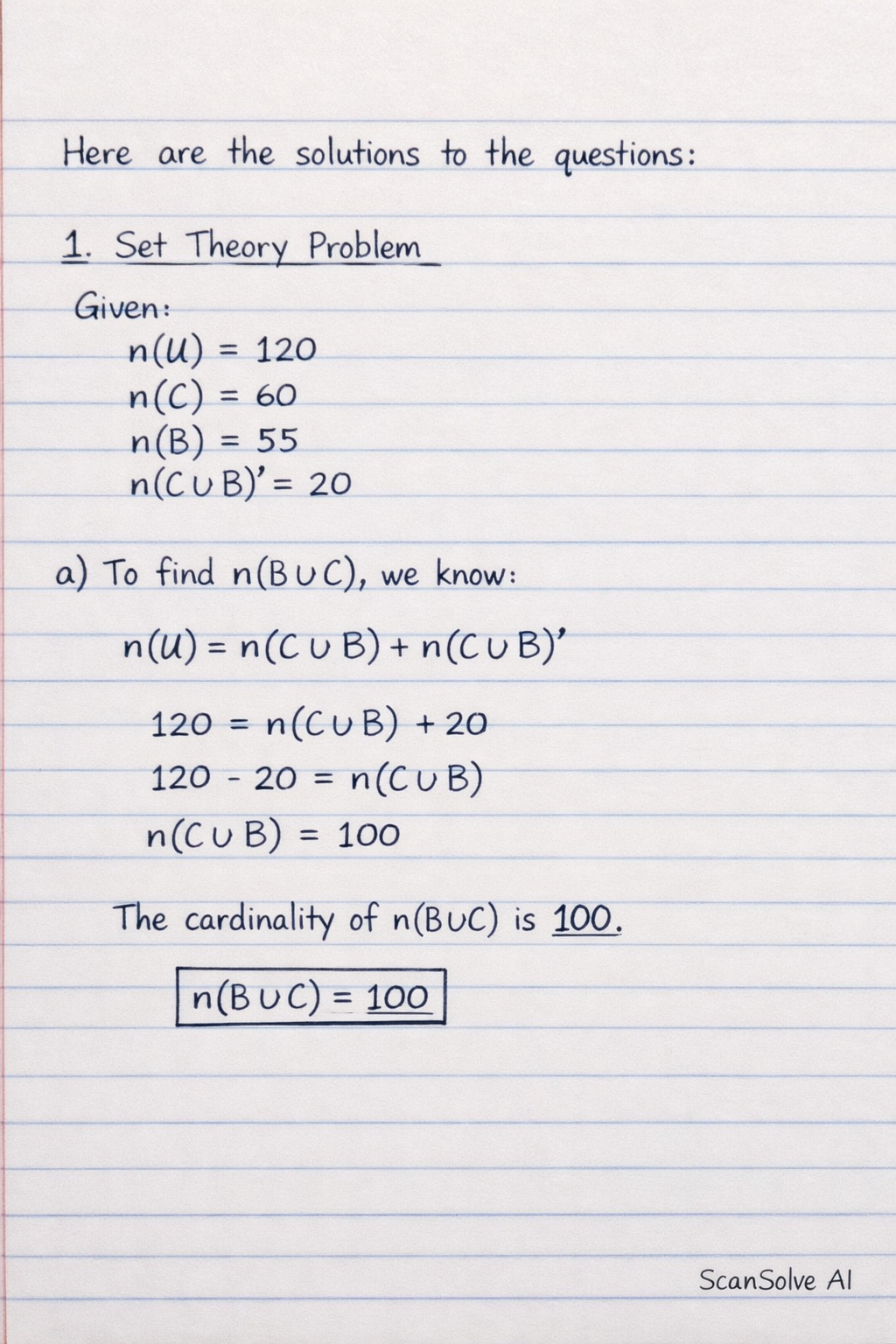
Here are the solutions to the questions: 1. Set Theory Problem Given: Total students, n(U) = 120 Students who liked cricket, n(C) = 60 Students who liked basketball, n(B) = 55 Students who did not like any of the two games, n(C B)' = 20 a) If C and B denote the sets of students who liked cricket and basketball game respectively, write the cardinality of n(B C). We know that n(U) = n(C B) + n(C B)'. 120 = n(C B) + 20 n(C B) = 120 - 20 n(C B) = 100 The cardinality of n(B C) is 100. b) Present the above information in a Venn-diagram. First, find the number of students who liked both games, n(C B). We use the formula: n(C B) = n(C) + n(B) - n(C B). 100 = 60 + 55 - n(C B) 100 = 115 - n(C B) n(C B) = 115 - 100 n(C B) = 15 Now, find the number of students who liked cricket only, n_0(C). n_0(C) = n(C) - n(C B) = 60 - 15 = 45 And the number of students who liked basketball only, n_0(B). n_0(B) = n(B) - n(C B) = 55 - 15 = 40 The Venn diagram is as follows: (Imagine two overlapping circles. The left circle represents Cricket (C), the right circle represents Basketball (B). The overlapping region is C B. The rectangle enclosing both circles represents the Universal set (U).) • In the region for C only: 45 • In the region for B only: 40 • In the intersection region (C B): 15 • Outside both circles (neither liked): 20 c) Find the number of students who liked cricket only. The number of students who liked cricket only is n_0(C). n_0(C) = n(C) - n(C B) = 60 - 15 = 45 The number of students who liked cricket only is 45. d) Compare the number of students who liked both cricket and basketball and who liked except these two games. Number of students who liked both cricket and basketball, n(C B) = 15. Number of students who liked neither of the two games, n(C B)' = 20. Comparing these two values: 20 > 15. Therefore, the number of students who liked neither game is greater than the number of students who liked both games. 2. Simple and Compound Interest Problem Given: Principal, P = Rs. 60,000 Time, T = 2 years Rate, R = 10\% p.a. a) Define compound interest. Compound interest is the interest calculated on the initial principal, which also includes all of the accumulated interest from previous periods on a deposit or loan. It is often referred to as "interest on interest." b) Find the compound interest received by Bijaya after 2 years. Step 1: Calculate the amount (A) using the compound interest formula.