

This mathematics problem involves applying core mathematical principles and formulas. Below you will find a complete step-by-step solution with detailed explanations for each step, helping you understand not just the answer but the method behind it.
ScanSolve AI Answer
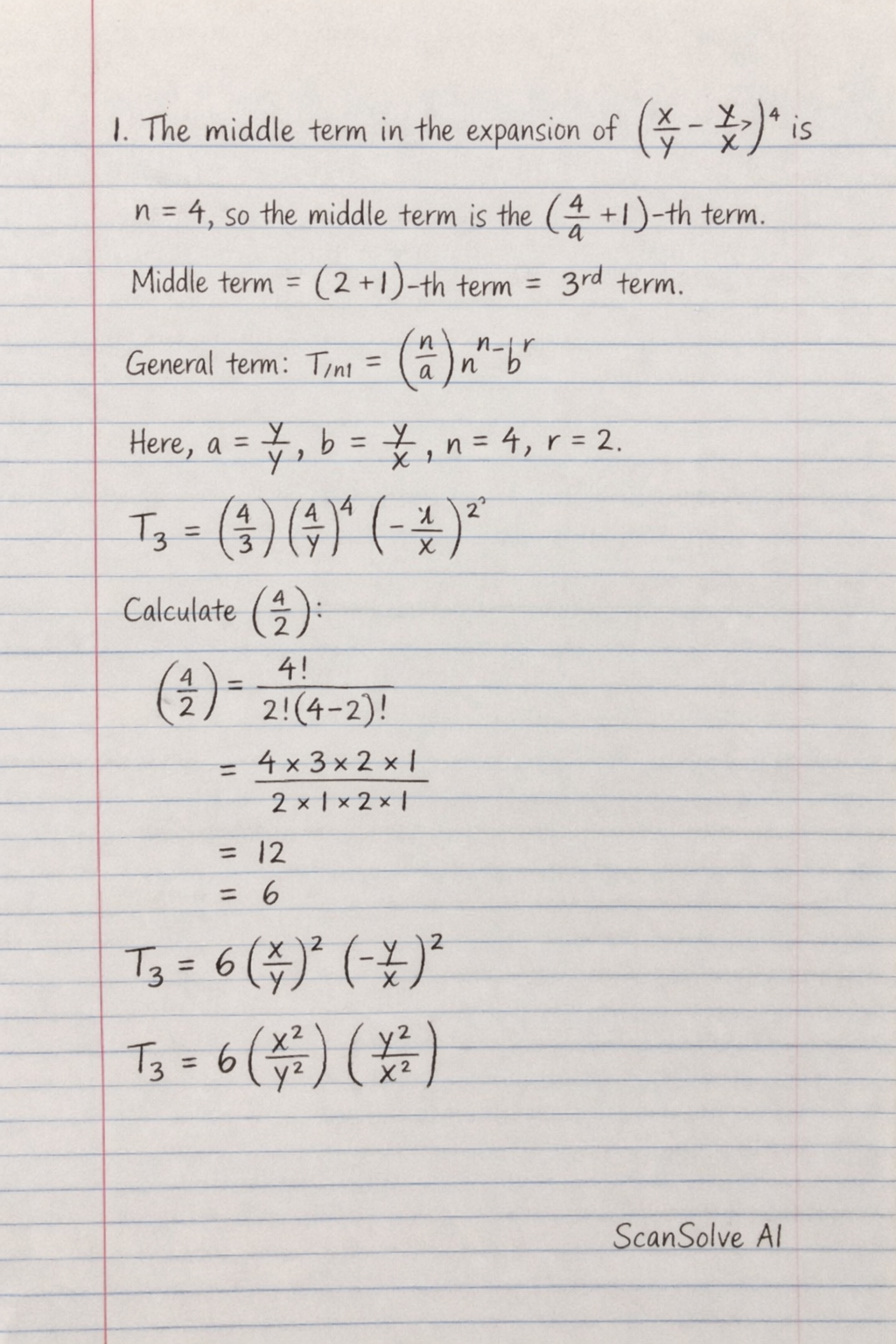
Here are the solutions to the questions: 1. The middle term in the expansion of ((x)/(y) - (y)/(x))^4 is The power of the expansion is n=4. Since n is an even number, there is one middle term, which is the ((n)/(2) + 1)-th term. Middle term = ((4)/(2) + 1)-th term = (2+1)-th term = 3rd term. The general term in the expansion of (a+b)^n is T_r+1 = nr a^n-r b^r. Here, a = (x)/(y), b = -(y)/(x), and n=4. For the 3rd term, r+1=3, so r=2. Substitute these values into the general term formula: T_3 = 42 ((x)/(y))^4-2 (-(y)/(x))^2 Calculate 42: 42 = (4!)/(2!(4-2)!) = (4 × 3 × 2 × 1)/((2 × 1)(2 × 1)) = (12)/(2) = 6 Substitute the value of 42 back into the expression for T_3: T_3 = 6 ((x)/(y))^2 (-(y)/(x))^2 T_3 = 6 ((x^2)/(y^2)) ((y^2)/(x^2)) T_3 = 6 × 1 T_3 = 6 The middle term is 6. The correct option is B. 2. The binomial series of (1 + kx)^n is valid only when: The binomial series expansion of (1+u)^n is valid for |u| < 1. In this expression, u = kx. Therefore, the series is valid when |kx| < 1. This inequality can be written as -1 < kx < 1. To isolate x, we divide by |k| (assuming k ≠ 0): -(1)/(|k|) < x < (1)/(|k|) If k is positive, |k|=k, so -(1)/(k) < x < (1)/(k). Option D uses K instead of k, but the form is consistent with the derived condition. The correct option is D. 3. The value of nn-3 is We use the property of binomial coefficients: nr = nn-r. Applying this property to nn-3: nn-3 = nn-(n-3) nn-3 = n3 Now, expand n3: n