
1 what is the com efficient of x3in the expansion of ( 1+x) 5 2 in the expansion of (2x- 3)4, what is the coefficient of x2 3 The term independent of (x) in the expansion of (1-2x) is 4 In the expansion of (a-b)n the sum of coefficient is? 5 The middle term in the expansion of ( 1-2x) -4
ScanSolve AI Answer
Step-by-step solution
5 stepsFind the coefficient of in the expansion of .
The general term in the binomial expansion of is given by .
For , we have , , and .
We want the term with , so we set .Calculate :
So the term is .
The coefficient of is 10.The coefficient of is .
Find the coefficient of in the expansion of .
The general term in the binomial expansion of is given by .
For , we have , , and .We want the term with , so the power of must be 2.
From , the power of is .
Set :Now substitute into the general term:
Calculate :
Substitute the values:
The coefficient of is 216.
The coefficient of is .
Find the term independent of in the expansion of .
The expression given is .
The term independent of is the constant term in this expression.
The constant term is 1.The term independent of is .
Find the sum of coefficients in the expansion of .
To find the sum of coefficients in any polynomial expansion, substitute 1 for each variable.
In the expansion of , we substitute and .
Sum of coefficients .
If , then .
If , then , and the sum of coefficients is 1.
Assuming is a positive integer, which is typical for binomial expansion questions of this type.The sum of coefficients is .
Find the middle term in the expansion of .
The expression represents an infinite series expansion, as the exponent is a negative integer.
For example, using the generalized binomial theorem
Here, and .An infinite series does not have a "middle term" because there is no finite number of terms to determine a central position.
The expansion of is an infinite series and therefore has .
Still stuck on this one?
Ask a follow-up, and the answer starts from this question.
More Mathematics Questions
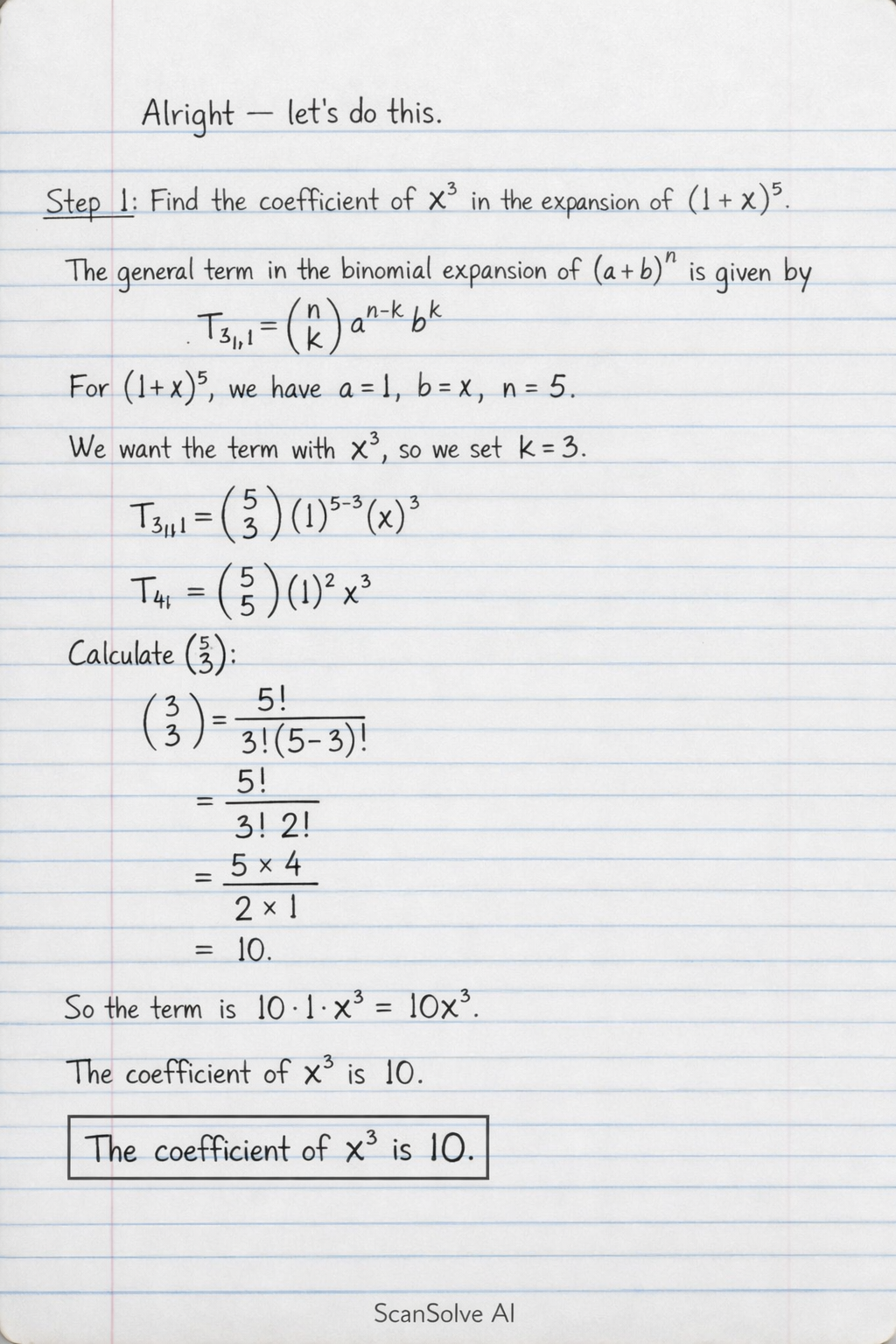
Handwritten Step-by-Step Solution
Get this as a handwritten image on WhatsApp — like a tutor wrote it for you.
Try on WhatsApp