

This mathematics problem involves applying core mathematical principles and formulas. Below you will find a complete step-by-step solution with detailed explanations for each step, helping you understand not just the answer but the method behind it.
ScanSolve AI Answer
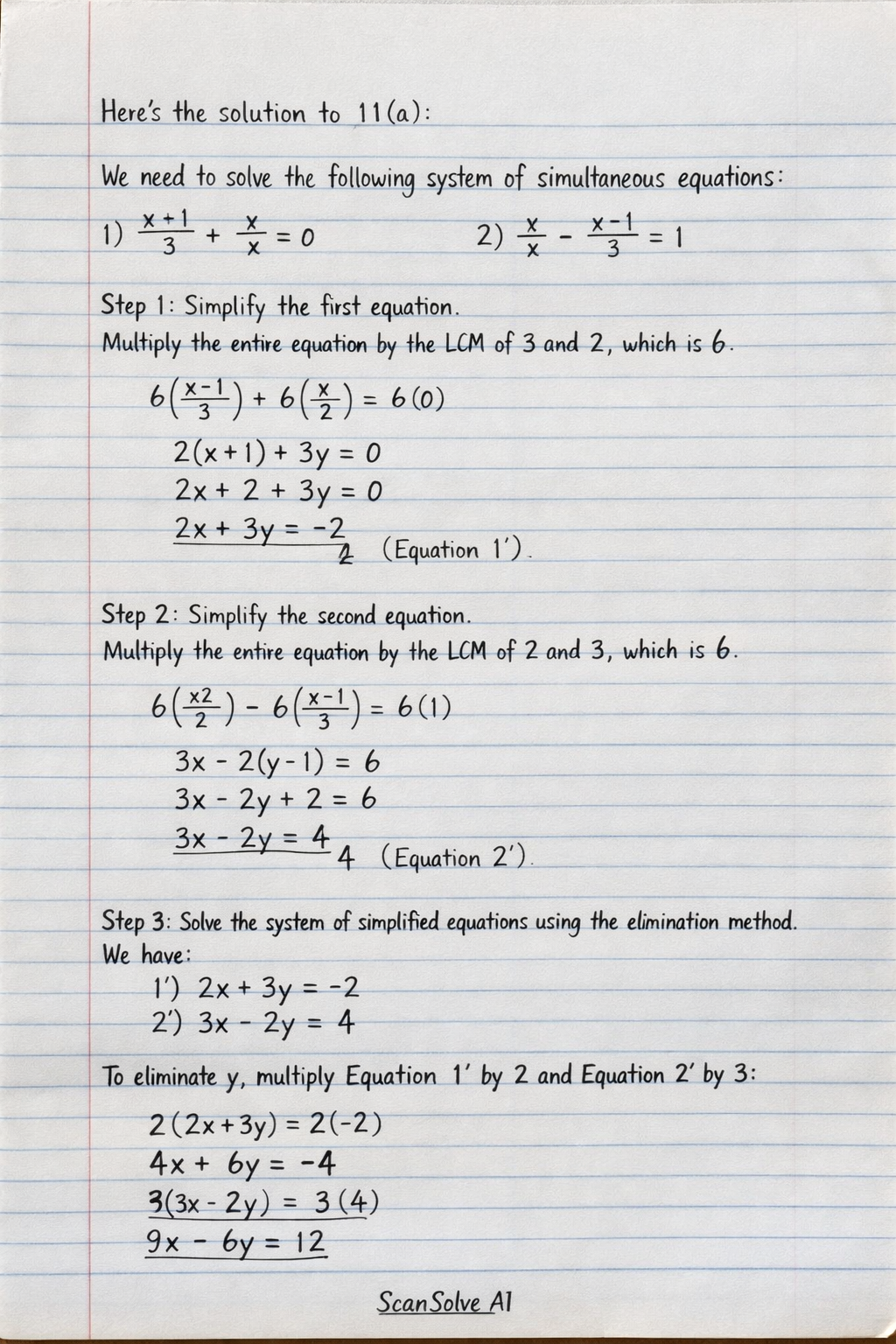
Here's the solution to 11(a): 11. (a) We need to solve the following system of simultaneous equations: 1) (x+1)/(3) + (y)/(2) = 0 2) (x)/(2) - (y-1)/(3) = 1 Step 1: Simplify the first equation. Multiply the entire equation by the least common multiple of 3 and 2, which is 6. 6 ( (x+1)/(3) ) + 6 ( (y)/(2) ) = 6(0) 2(x+1) + 3y = 0 2x + 2 + 3y = 0 2x + 3y = -2 (Equation 1') Step 2: Simplify the second equation. Multiply the entire equation by the least common multiple of 2 and 3, which is 6. 6 ( (x)/(2) ) - 6 ( (y-1)/(3) ) = 6(1) 3x - 2(y-1) = 6 3x - 2y + 2 = 6 3x - 2y = 6 - 2 3x - 2y = 4 (Equation 2') Step 3: Solve the system of simplified equations using the elimination method. We have: 1') 2x + 3y = -2 2') 3x - 2y = 4 To eliminate y, multiply Equation 1' by 2 and Equation 2' by 3: 2(2x + 3y) = 2(-2) 4x + 6y = -4 3(3x - 2y) = 3(4) 9x - 6y = 12 Add the two new equations: (4x + 6y) + (9x - 6y) = -4 + 12 13x = 8 x = (8)/(13) Step 4: Substitute the value of x into Equation 1' to find y. 2x + 3y = -2 2 ( (8)/(13) ) + 3y = -2 (16)/(13) + 3y = -2 3y = -2 - (16)/(13) 3y = -(26)/(13) - (16)/(13) 3y = -(42)/(13) y = -(42)/(13 × 3) y = -(14)/(13) The solution to the system of equations is x = (8)/(13) and y = -(14)/(13). x = (8)/(13), y = -(14)/(13)