
We read your photo as:
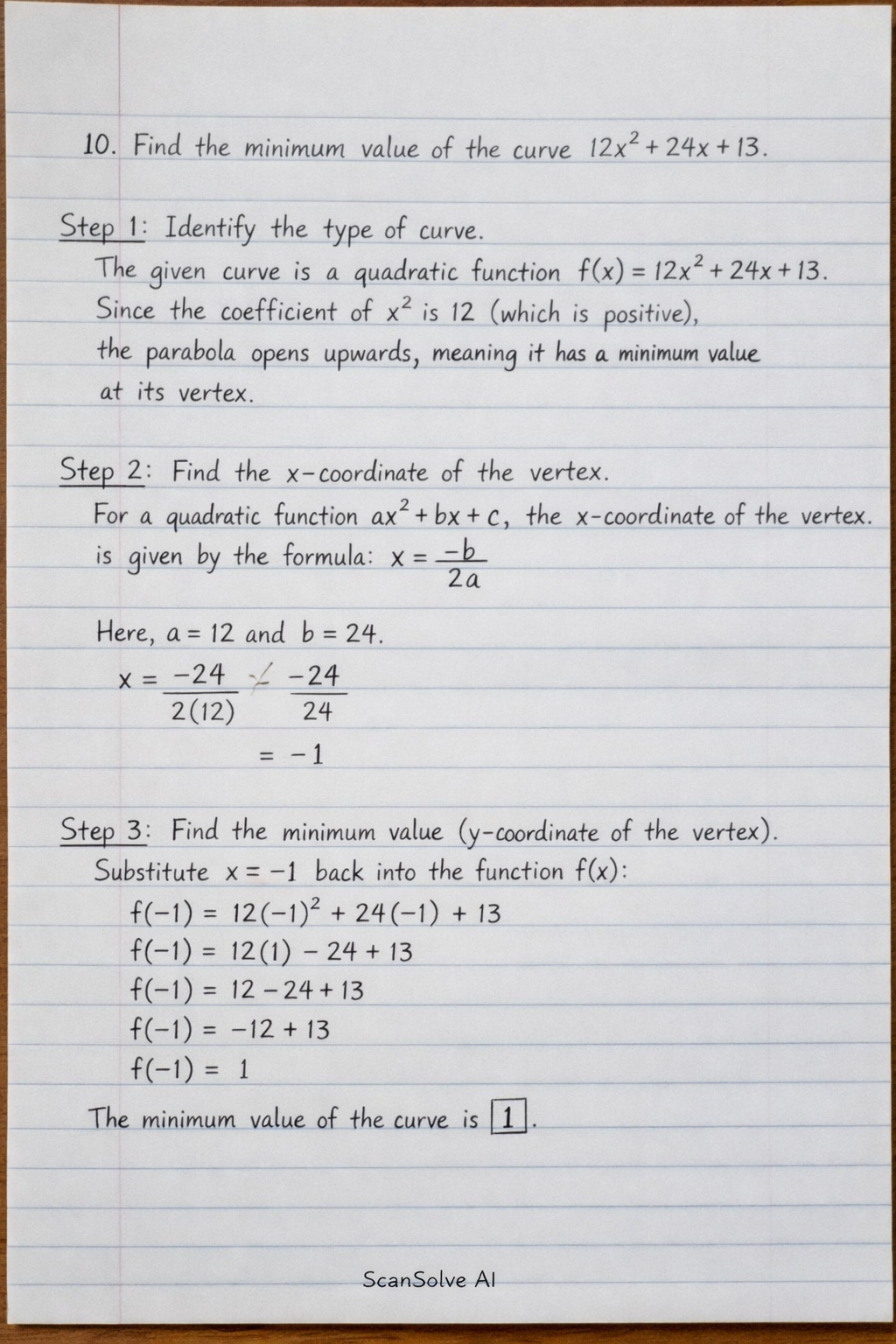
Find the minimum value of the curve 12x² + 24x + 13.
ScanSolve AI Answer
Answer
10. Find the minimum value of the curve .
-
Step 1: Identify the type of curve. The given curve is a quadratic function . Since the coefficient of is 12 (which is positive), the parabola opens upwards, meaning it has a minimum value at its vertex.
-
Step 2: Find the x-coordinate of the vertex. For a quadratic function , the x-coordinate of the vertex is given by the formula . Here, and .
-
Step 3: Find the minimum value (y-coordinate of the vertex). Substitute the x-coordinate of the vertex () back into the function :
The minimum value of the curve is 1.
The minimum value of the curve is .
11. If the roots of are and , show that and .
-
Step 1: Express the quadratic equation in terms of its roots. If and are the roots of the quadratic equation , then the polynomial can be factored as .
-
Step 2: Expand the factored form.
-
Step 3: Compare coefficients with the original equation. We have . Comparing this to the original equation :
- Comparing the coefficients of :
- Comparing the constant terms:
Thus, we have shown that and .
12. Find if is a factor of .
-
Step 1: Apply the Factor Theorem. According to the Factor Theorem, if is a factor of , then , where is the root of .
-
Step 2: Find the root of . Set :
-
Step 3: Substitute the root into and solve for . Since is a root, must be 0.
Multiply the entire equation by 2 to eliminate denominators:
The value of is .
Try one yourself
A new problem that tests the same skill.
Still stuck on this one?
Ask a follow-up, and the answer starts from this question.
More Mathematics Questions
Handwritten Step-by-Step Solution
Get this as a handwritten image on WhatsApp — like a tutor wrote it for you.
Try on WhatsApp