This mathematics problem involves applying core mathematical principles and formulas. Below you will find a complete step-by-step solution with detailed explanations for each step, helping you understand not just the answer but the method behind it.
ScanSolve AI Answer
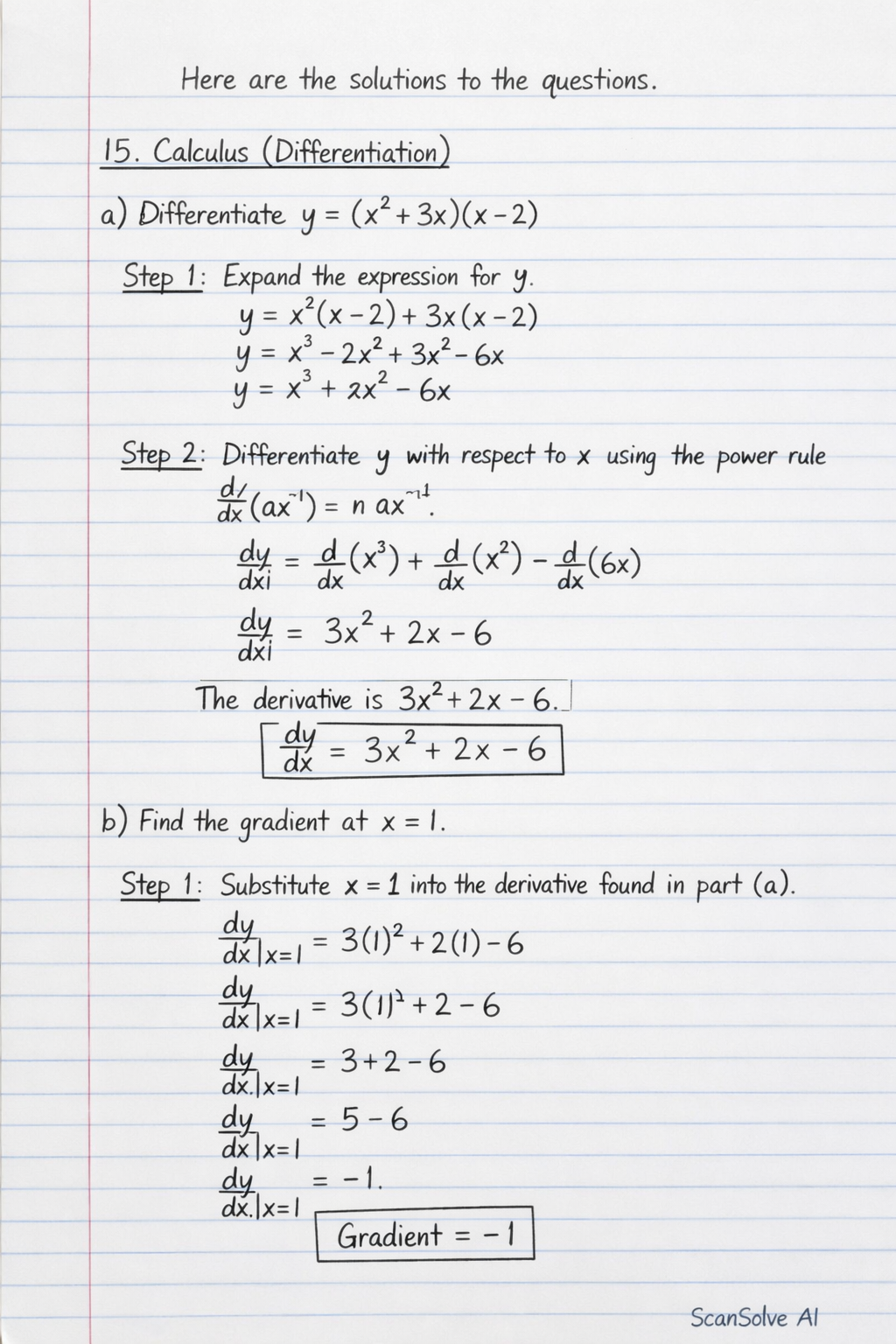
Here are the solutions to the questions.
15. Calculus (Differentiation)
a) Differentiate $y = (x^2 + 3x)(x - 2)$
Step 1: Expand the expression for $y$.
$$y = x^2(x - 2) + 3x(x - 2)$$
$$y = x^3 - 2x^2 + 3x^2 - 6x$$
$$y = x^3 + x^2 - 6x$$
Step 2: Differentiate $y$ with respect to $x$ using the power rule $\frac{d}{dx}(ax^n) = nax^{n-1}$.
$$\frac{dy}{dx} = \frac{d}{dx}(x^3) + \frac{d}{dx}(x^2) - \frac{d}{dx}(6x)$$
$$\frac{dy}{dx} = 3x^{3-1} + 2x^{2-1} - 6x^{1-1}$$
$$\frac{dy}{dx} = 3x^2 + 2x - 6$$
The derivative is $3x^2 + 2x - 6$.
$$\boxed{\frac{dy}{dx} = 3x^2 + 2x - 6}$$
b) Find the gradient at $x = 1$
Step 1: Substitute $x=1$ into the derivative found in part (a).
$$\frac{dy}{dx}\Big|_{x=1} = 3(1)^2 + 2(1) - 6$$
$$\frac{dy}{dx}\Big|_{x=1} = 3(1) + 2 - 6$$
$$\frac{dy}{dx}\Big|_{x=1} = 3 + 2 - 6$$
$$\frac{dy}{dx}\Big|_{x=1} = 5 - 6$$
$$\frac{dy}{dx}\Big|_{x=1} = -1$$
The gradient at $x=1$ is $-1$.
$$\boxed{\text{Gradient} = -1}$$
16. Calculus (Integration)
a) Integrate: $\int (3x^2 + 4x)\,dx$
Step 1: Apply the power rule for integration, $\int x^n\,dx = \frac{x^{n+1}}{n+1} + C$, to each term.
$$\int 3x^2\,dx + \int 4x\,dx$$
$$3\left(\frac{x^{2+1}}{2+1}\right) + 4\left(\frac{x^{1+1}}{1+1}\right) + C$$
$$3\left(\frac{x^3}{3}\right) + 4\left(\frac{x^2}{2}\right) + C$$
Step 2: Simplify the expression.
$$x^3 + 2x^2 + C$$
The integral is $x^3 + 2x^2 + C$.
$$\boxed{x^3 + 2x^2 + C}$$
b) Find area under curve from $x = 0$ to $x = 2$ for $y = 3x^2 + 4x$
Step 1: Set up the definite integral for the area.
$$\text{Area} = \int_0^2 (3x^2 + 4x)\,dx$$
Step 2: Integrate the function. From part (a), the indefinite integral is $x^3 + 2x^2$.
Step 3: Evaluate the definite integral using the limits of integration.
$$\text{Area} = \left[x^3 + 2x^2\right]_0^2$$
$$\text{Area} = (2^3 + 2(2^2)) - (0^3 + 2(0^2))$$
$$\text{Area} = (8 + 2(4)) - (0 + 0)$$
$$\text{Area} = (8 + 8) - 0$$
$$\text{Area} = 16$$
The area under the curve is $16$ square units.
$$\boxed{\text{Area} = 16 \text{ square units}}$$
17. Exponents
a) Solve: $2^{x+1} = 16$
Step 1: Express 16 as a power of 2.
$$16 = 2^4$$
Step 2: Substitute this back into the equation.
$$2^{x+1} = 2^4$$
Step 3: Since the bases are the same, equate the exponents.
$$x+1 = 4$$
Step 4: Solve for $x$.
$$x = 4 - 1$$
$$x = 3$$
The solution is $x=3$.
$$\boxed{x = 3}$$
b) Express your answer in simplest form
The answer from part (a) is $x=3$, which is already in its simplest form.
$$\boxed{x = 3}$$
18. Probability
a) A bag contains 4 red and 6 blue balls. Find probability of picking red.
Step 1: Find the total number of balls.
$$\text{Total balls} = 4 (\text{red}) + 6 (\text{blue}) = 10$$
Step 2: Calculate the probability of picking a red ball.
$$P(\text{red}) = \frac{\text{Number of red balls}}{\text{Total number of balls}}$$
$$P(\text{red}) = \frac{4}{10}$$
$$P(\text{red}) = \frac{2}{5}$$
The probability of picking a red ball is $\frac{2}{5}$.
$$\boxed{P(\text{red}) = \frac{2}{5}}$$
b) If two balls are picked, find probability both are red.
This implies picking without replacement.
Step 1: Probability of the first ball being red.
$$P(\text{1st red}) = \frac{4}{10}$$
Step 2: After picking one red ball, there are 3 red balls left and a total of 9 balls. Probability of the second ball being red.
$$P(\text{2nd red | 1st red}) = \frac{3}{9}$$
Step 3: Multiply the probabilities to find the probability of both being red.
$$P(\text{both red}) = P(\text{1st red}) \times P(\text{2nd red | 1st red})$$
$$P(\text{both red}) = \frac{4}{10} \times \frac{3}{9}$$
$$P(\text{both red}) = \frac{2}{5} \times \frac{1}{3}$$
$$P(\text{both red}) = \frac{2}{15}$$
The probability of picking two red balls is $\frac{2}{15}$.
$$\boxed{P(\text{both red}) = \frac{2}{15}}$$
19. Circles
a) Find the equation of a circle with center $(1, -2)$ and radius 4.
Step 1: Use the standard equation of a circle: $(x-h)^2 + (y-k)^2 = r^2$, where $(h, k)$ is the center and $r$ is the radius.
Given center $(h, k) = (1, -2)$ and radius $r = 4$.
Step 2: Substitute the values into the equation.
$$(x - 1)^2 + (y - (-2))^2 = 4^2$$
$$(x - 1)^2 + (y + 2)^2 = 16$$
The equation of the circle is $(x - 1)^2 + (y + 2)^2 = 16$.
$$\boxed{(x - 1)^2 + (y + 2)^2 = 16}$$
b) Find the area of the circle.
Step 1: Use the formula for the area of a circle: $A = \pi r^2$.
Given radius $r = 4$.
Step 2: Substitute the value of $r$ into the formula.
$$A = \pi (4)^2$$
$$A = 16\pi$$
The area of the circle is $16\pi$ square units.
$$\boxed{\text{Area} = 16\pi \text{ square units}}$$
20. Sequences (Arithmetic Progression)
a) A sequence has first term 5 and common difference 3. Find the 15th term.
Step 1: Use the formula for the $n$-th term of an arithmetic sequence: $a_n = a_1 + (n-1)d$.
Given $a_1 = 5$, $d = 3$, and $n = 15$.
Step 2: Substitute the values into the formula.
$$a_{15} = 5 + (15 - 1)(3)$$
$$a_{15} = 5 + (14)(3)$$
$$a_{15} = 5 + 42$$
$$a_{15} = 47$$
The 15th term is $47$.
$$\boxed{a_{15} = 47}$$
b) Find the sum of first 15 terms.
Step 1: Use the formula for the sum of the first $n$ terms of an arithmetic sequence: $S_n = \frac{n}{2}(2a_1 + (n-1)d)$.
Given $a_1 = 5$, $d = 3$, and $n = 15$.
Step 2: Substitute the values into the formula.
$$S_{15} = \frac{15}{2}(2(5) + (15 - 1)(3))$$
$$S_{15} = \frac{15}{2}(10 + (14)(3))$$
$$S_{15} = \frac{15}{2}(10 + 42)$$
$$S_{15} = \frac{15}{2}(52)$$
$$S_{15} = 15 \times 26$$
$$S_{15} = 390$$
The sum of the first 15 terms is $390$.
$$\boxed{S_{15} = 390}$$
That's 2 down. 3 left today — send the next one.
15. Calculus (Differentiation)
|Mathematics
15. Calculus (Differentiation)
ScanSolve AI Answer
Here are the solutions to the questions.
15. Calculus (Differentiation)
a) Differentiate y=(x2+3x)(x−2)
Step 1: Expand the expression for y.
y=x2(x−2)+3x(x−2)y=x3−2x2+3x2−6xy=x3+x2−6x
Step 2: Differentiate y with respect to x using the power rule dxd(axn)=naxn−1.
dxdy=dxd(x3)+dxd(x2)−dxd(6x)dxdy=3x3−1+2x2−1−6x1−1dxdy=3x2+2x−6
The derivative is 3x2+2x−6.
dxdy=3x2+2x−6
b) Find the gradient at x=1
Step 1: Substitute x=1 into the derivative found in part (a).
dxdyx=1=3(1)2+2(1)−6dxdyx=1=3(1)+2−6dxdyx=1=3+2−6dxdyx=1=5−6dxdyx=1=−1
The gradient at x=1 is −1.
Gradient=−1
16. Calculus (Integration)
a) Integrate: ∫(3x2+4x)dx
Step 1: Apply the power rule for integration, ∫xndx=n+1xn+1+C, to each term.
∫3x2dx+∫4xdx3(2+1x2+1)+4(1+1x1+1)+C3(3x3)+4(2x2)+C
Step 2: Simplify the expression.
x3+2x2+C
The integral is x3+2x2+C.
x3+2x2+C
b) Find area under curve from x=0 to x=2 for y=3x2+4x
Step 1: Set up the definite integral for the area.
Area=∫02(3x2+4x)dx
Step 2: Integrate the function. From part (a), the indefinite integral is x3+2x2.
Step 3: Evaluate the definite integral using the limits of integration.
Area=[x3+2x2]02Area=(23+2(22))−(03+2(02))Area=(8+2(4))−(0+0)Area=(8+8)−0Area=16
The area under the curve is 16 square units.
Area=16squareunits
17. Exponents
a) Solve: 2x+1=16
Step 1: Express 16 as a power of 2.
16=24
Step 2: Substitute this back into the equation.
2x+1=24
Step 3: Since the bases are the same, equate the exponents.
x+1=4
Step 4: Solve for x.
x=4−1x=3
The solution is x=3.
x=3
b) Express your answer in simplest form
The answer from part (a) is x=3, which is already in its simplest form.
x=3
18. Probability
a) A bag contains 4 red and 6 blue balls. Find probability of picking red.
Step 1: Find the total number of balls.
Total balls=4(red)+6(blue)=10
Step 2: Calculate the probability of picking a red ball.
P(red)=TotalnumberofballsNumberofredballsP(red)=104P(red)=52
The probability of picking a red ball is 52.
P(red)=52
b) If two balls are picked, find probability both are red.
This implies picking without replacement.
Step 1: Probability of the first ball being red.
P(1stred)=104
Step 2: After picking one red ball, there are 3 red balls left and a total of 9 balls. Probability of the second ball being red.
P(2ndred∣1stred)=93
Step 3: Multiply the probabilities to find the probability of both being red.
P(bothred)=P(1stred)×P(2ndred∣1stred)P(bothred)=104×93P(bothred)=52×31P(bothred)=152
The probability of picking two red balls is 152.
P(bothred)=152
19. Circles
a) Find the equation of a circle with center (1,−2) and radius 4.
Step 1: Use the standard equation of a circle: (x−h)2+(y−k)2=r2, where (h,k) is the center and r is the radius.
Given center (h,k)=(1,−2) and radius r=4.
Step 2: Substitute the values into the equation.
(x−1)2+(y−(−2))2=42(x−1)2+(y+2)2=16
The equation of the circle is (x−1)2+(y+2)2=16.
(x−1)2+(y+2)2=16
b) Find the area of the circle.
Step 1: Use the formula for the area of a circle: A=πr2.
Given radius r=4.
Step 2: Substitute the value of r into the formula.
A=π(4)2A=16π
The area of the circle is 16π square units.
Area=16πsquareunits
20. Sequences (Arithmetic Progression)
a) A sequence has first term 5 and common difference 3. Find the 15th term.
Step 1: Use the formula for the n-th term of an arithmetic sequence: an=a1+(n−1)d.
Given a1=5, d=3, and n=15.
Step 2: Substitute the values into the formula.
a15=5+(15−1)(3)a15=5+(14)(3)a15=5+42a15=47
The 15th term is 47.
a15=47
b) Find the sum of first 15 terms.
Step 1: Use the formula for the sum of the first n terms of an arithmetic sequence: Sn=2n(2a1+(n−1)d).
Given a1=5, d=3, and n=15.
Step 2: Substitute the values into the formula.
S15=215(2(5)+(15−1)(3))S15=215(10+(14)(3))S15=215(10+42)S15=215(52)S15=15×26S15=390
The sum of the first 15 terms is 390.
S15=390
That's 2 down. 3 left today — send the next one.
Need help with your own homework?
Get instant step-by-step solutions to any question. Free to start.