This mathematics problem involves applying core mathematical principles and formulas. Below you will find a complete step-by-step solution with detailed explanations for each step, helping you understand not just the answer but the method behind it.
ScanSolve AI Answer
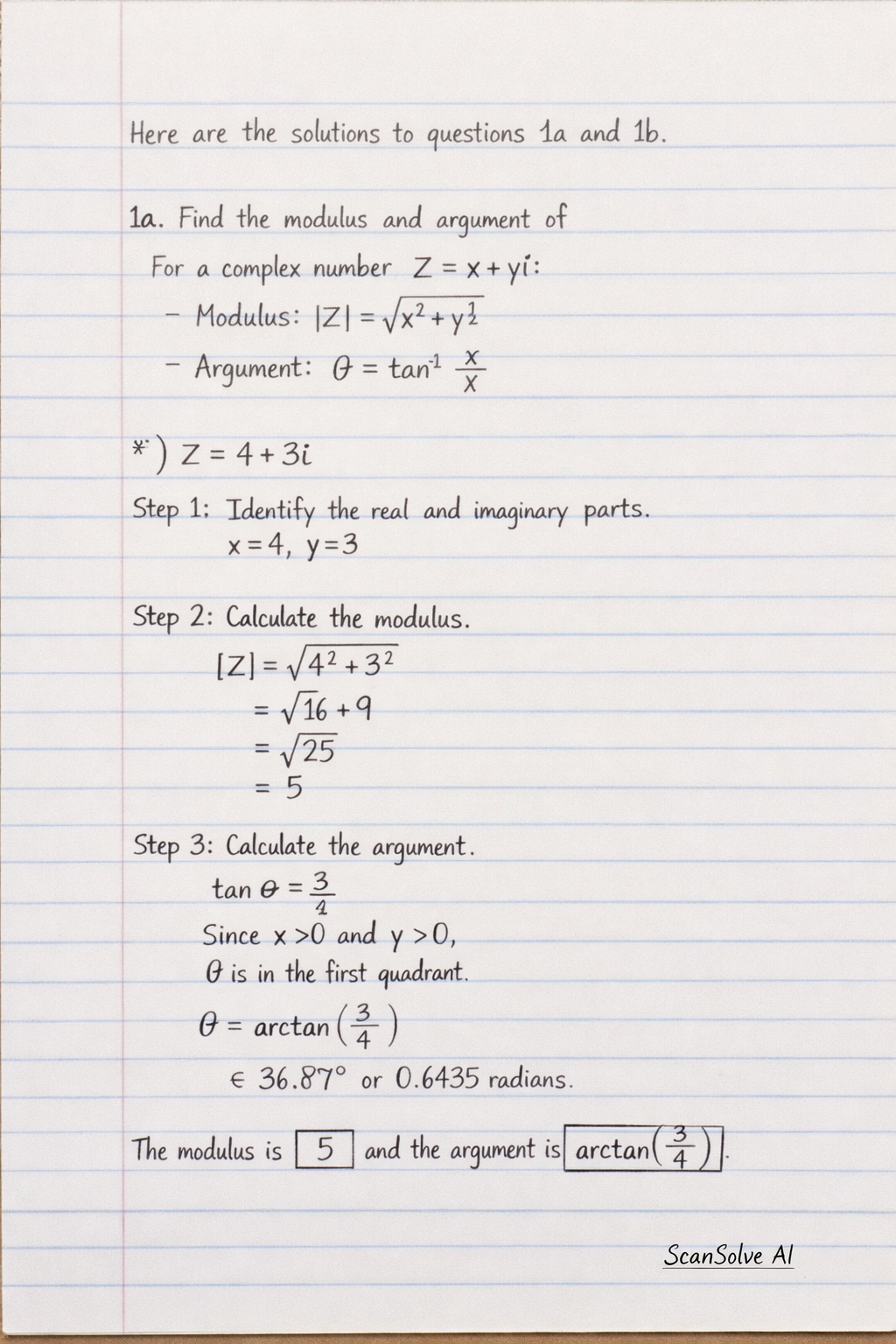
Here are the solutions to questions 1a and 1b.
1a. Find the modulus and argument of
For a complex number $Z = x + yi$:
The modulus is $|Z| = \sqrt{x^2 + y^2}$.
The argument is $\arg(Z) = \theta$, where $\tan\theta = \frac{y}{x}$, and $\theta$ is chosen based on the quadrant of $(x, y)$.
i) $Z = 4 + 3i$
Step 1: Identify the real and imaginary parts.
Here, $x = 4$ and $y = 3$.
Step 2: Calculate the modulus.
$$ |Z| = \sqrt{4^2 + 3^2} = \sqrt{16 + 9} = \sqrt{25} = 5 $$
Step 3: Calculate the argument.
$$ \tan\theta = \frac{3}{4} $$
Since $x > 0$ and $y > 0$, $\theta$ is in the first quadrant.
$$ \theta = \arctan\left(\frac{3}{4}\right) \approx 36.87^\circ \text{ or } 0.6435 \text{ radians} $$
The modulus is $\boxed{5}$ and the argument is $\boxed{\arctan\left(\frac{3}{4}\right)}$.
ii) $Z = 1 + i$
Step 1: Identify the real and imaginary parts.
Here, $x = 1$ and $y = 1$.
Step 2: Calculate the modulus.
$$ |Z| = \sqrt{1^2 + 1^2} = \sqrt{1 + 1} = \sqrt{2} $$
Step 3: Calculate the argument.
$$ \tan\theta = \frac{1}{1} = 1 $$
Since $x > 0$ and $y > 0$, $\theta$ is in the first quadrant.
$$ \theta = \arctan(1) = \frac{\pi}{4} \text{ or } 45^\circ $$
The modulus is $\boxed{\sqrt{2}}$ and the argument is $\boxed{\frac{\pi}{4}}$.
iii) $Z = \sin\theta + i\cos\theta$
Step 1: Identify the real and imaginary parts.
Here, $x = \sin\theta$ and $y = \cos\theta$.
Step 2: Calculate the modulus.
$$ |Z| = \sqrt{(\sin\theta)^2 + (\cos\theta)^2} = \sqrt{\sin^2\theta + \cos^2\theta} $$
Using the identity $\sin^2\theta + \cos^2\theta = 1$:
$$ |Z| = \sqrt{1} = 1 $$
Step 3: Calculate the argument.
The standard polar form of a complex number is $r(\cos\phi + i\sin\phi)$.
We have $Z = \sin\theta + i\cos\theta$.
Using the trigonometric identities $\sin\theta = \cos\left(\frac{\pi}{2} - \theta\right)$ and $\cos\theta = \sin\left(\frac{\pi}{2} - \theta\right)$:
$$ Z = \cos\left(\frac{\pi}{2} - \theta\right) + i\sin\left(\frac{\pi}{2} - \theta\right) $$
Comparing this to the polar form, the argument $\phi$ is $\frac{\pi}{2} - \theta$.
The modulus is $\boxed{1}$ and the argument is $\boxed{\frac{\pi}{2} - \theta}$.
1b. Evaluate
The powers of $i$ follow a cycle: $i^1 = i$, $i^2 = -1$, $i^3 = -i$, $i^4 = 1$. This cycle repeats every 4 powers. To evaluate $i^n$, find the remainder of $n$ when divided by 4.
i) $i^{20}$
Step 1: Divide the exponent by 4.
$$ 20 \div 4 = 5 \text{ with a remainder of } 0 $$
Step 2: Use the remainder to find the value.
Since the remainder is 0, $i^{20}$ is equivalent to $i^4$.
$$ i^{20} = i^4 = 1 $$
The value is $\boxed{1}$.
ii) $Z = -1 + i^2$
Step 1: Substitute the value of $i^2$.
We know $i^2 = -1$.
$$ Z = -1 + (-1) $$
Step 2: Simplify the expression.
$$ Z = -1 - 1 = -2 $$
The value is $\boxed{-2}$.
iii) $i^{-4}$
Step 1: Rewrite the expression with a positive exponent.
$$ i^{-4} = \frac{1}{i^4} $$
Step 2: Substitute the value of $i^4$.
We know $i^4 = 1$.
$$ \frac{1}{i^4} = \frac{1}{1} = 1 $$
The value is $\boxed{1}$.
iv) $i^5$
Step 1: Divide the exponent by 4.
$$ 5 \div 4 = 1 \text{ with a remainder of } 1 $$
Step 2: Use the remainder to find the value.
Since the remainder is 1, $i^5$ is equivalent to $i^1$.
$$ i^5 = i^1 = i $$
The value is $\boxed{i}$.
1a. Find the modulus and argument of
|Mathematics
1a. Find the modulus and argument of
ScanSolve AI Answer
Here are the solutions to questions 1a and 1b.
1a. Find the modulus and argument of
For a complex number Z=x+yi:
The modulus is ∣Z∣=x2+y2.
The argument is arg(Z)=θ, where tanθ=xy, and θ is chosen based on the quadrant of (x,y).
i)Z=4+3i
Step 1: Identify the real and imaginary parts.
Here, x=4 and y=3.
Step 2: Calculate the modulus.
∣Z∣=42+32=16+9=25=5
Step 3: Calculate the argument.
tanθ=43
Since x>0 and y>0, θ is in the first quadrant.
θ=arctan(43)≈36.87∘or0.6435radians
The modulus is 5 and the argument is arctan(43).
ii)Z=1+i
Step 1: Identify the real and imaginary parts.
Here, x=1 and y=1.
Step 2: Calculate the modulus.
∣Z∣=12+12=1+1=2
Step 3: Calculate the argument.
tanθ=11=1
Since x>0 and y>0, θ is in the first quadrant.
θ=arctan(1)=4πor45∘
The modulus is 2 and the argument is 4π.
iii)Z=sinθ+icosθ
Step 1: Identify the real and imaginary parts.
Here, x=sinθ and y=cosθ.
Step 2: Calculate the modulus.
∣Z∣=(sinθ)2+(cosθ)2=sin2θ+cos2θ
Using the identity sin2θ+cos2θ=1:
∣Z∣=1=1
Step 3: Calculate the argument.
The standard polar form of a complex number is r(cosϕ+isinϕ).
We have Z=sinθ+icosθ.
Using the trigonometric identities sinθ=cos(2π−θ) and cosθ=sin(2π−θ):
Z=cos(2π−θ)+isin(2π−θ)
Comparing this to the polar form, the argument ϕ is 2π−θ.
The modulus is 1 and the argument is 2π−θ.
1b. Evaluate
The powers of i follow a cycle: i1=i, i2=−1, i3=−i, i4=1. This cycle repeats every 4 powers. To evaluate in, find the remainder of n when divided by 4.
i)i20
Step 1: Divide the exponent by 4.
20÷4=5witharemainderof0
Step 2: Use the remainder to find the value.
Since the remainder is 0, i20 is equivalent to i4.
i20=i4=1
The value is 1.
ii)Z=−1+i2
Step 1: Substitute the value of i2.
We know i2=−1.
Z=−1+(−1)
Step 2: Simplify the expression.
Z=−1−1=−2
The value is −2.
iii)i−4
Step 1: Rewrite the expression with a positive exponent.
i−4=i41
Step 2: Substitute the value of i4.
We know i4=1.
i41=11=1
The value is 1.
iv)i5
Step 1: Divide the exponent by 4.
5÷4=1witharemainderof1
Step 2: Use the remainder to find the value.
Since the remainder is 1, i5 is equivalent to i1.
i5=i1=i
The value is i.
Need help with your own homework?
Get instant step-by-step solutions to any question. Free to start.