
We read your photo as:
2.4 Calculate the average speed of Bikeko's travel from Malmesbury to Springbok and determine if it was within the accepted speed limit of 120 km/hr.
ScanSolve AI Answer
Answer
Step-by-step solution
6 stepsHere are the solutions to questions 3.2.4 and 3.2.5:
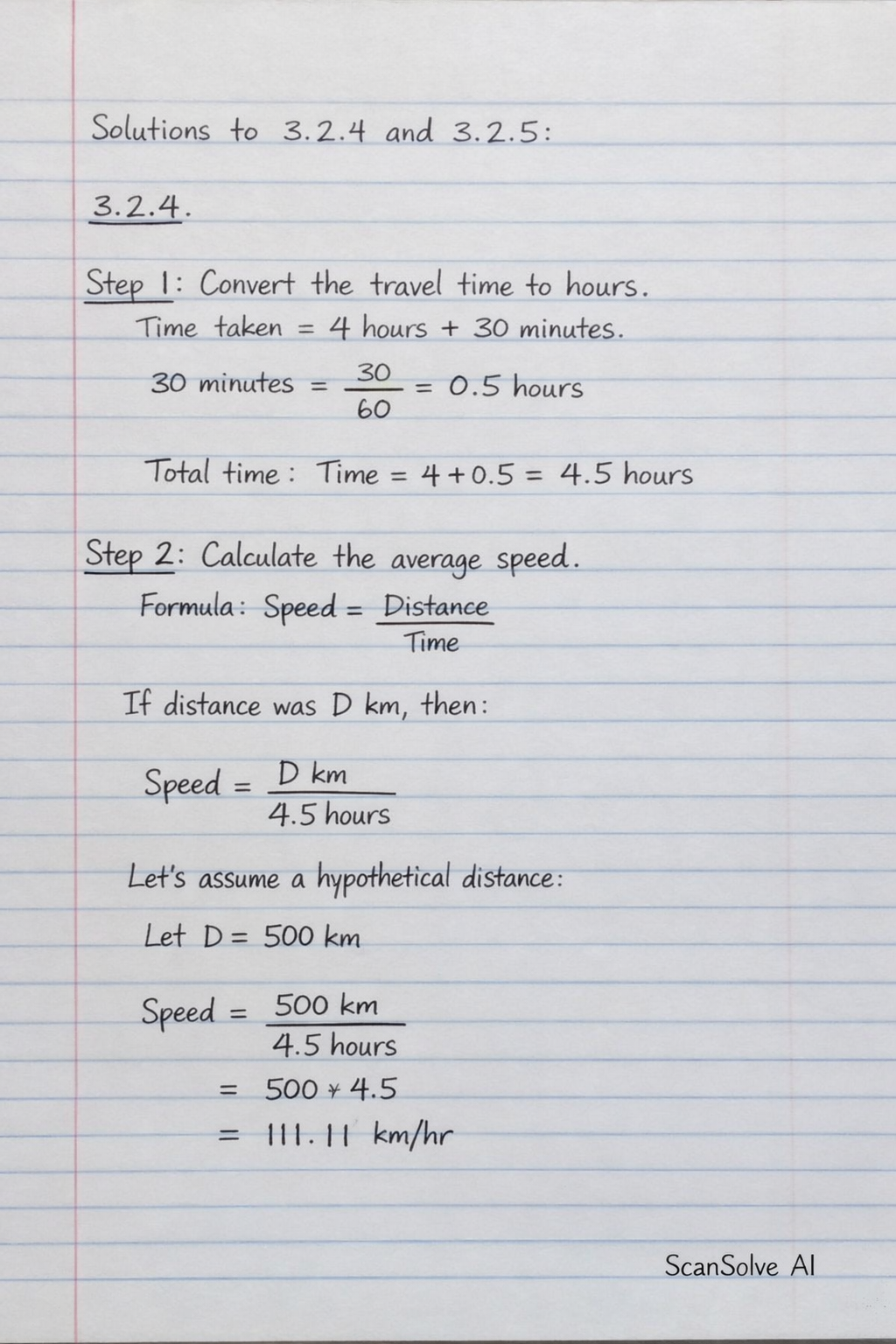
3.2.4
To determine if Bikeko was within the accepted speed limit, the distance travelled from Malmesbury to Springbok is required. This distance is not provided in the question. Assuming the distance was available, here's how you would solve it:
Convert the travel time to hours.
The time taken is 4 hours and 30 minutes.
Total time in hours:
Calculate the average speed.
The formula for speed is given as:
If, for example, the distance was km, the speed would be:
Let's assume a hypothetical distance, for instance, 500 km, to demonstrate the calculation.
Compare the calculated speed with the accepted speed limit.
The accepted speed limit is .
If the calculated speed (e.g., ) is less than or equal to , then Bikeko was within the accepted speed limit. If it was greater, he was not.Without the distance, a definitive answer cannot be provided.
3.2.5
To calculate the probability of choosing an even-numbered road, the total number of regional roads and the number of even-numbered regional roads are needed. This information is not provided in the question. Assuming this information was available, here's how you would solve it:Identify the total number of possible outcomes and the number of favorable outcomes.
Let be the total number of regional roads.
Let be the number of even-numbered regional roads.Calculate the probability.
The formula for probability is:
For example, if there were 10 regional roads in total (N=10) and 4 of them were even-numbered (E=4), the probability would be:
Round the probability to two decimal places.
Using the example above, 0.4 rounded to two decimal places is 0.40.
The probability would be (based on the example).Without the specific numbers of roads, a definitive answer cannot be provided.
Try one yourself
A new problem that tests the same skill.
Still stuck on this one?
Ask a follow-up, and the answer starts from this question.
More Mathematics Questions
Handwritten Step-by-Step Solution
Get this as a handwritten image on WhatsApp — like a tutor wrote it for you.
Try on WhatsApp