

This mathematics problem involves applying core mathematical principles and formulas. Below you will find a complete step-by-step solution with detailed explanations for each step, helping you understand not just the answer but the method behind it.
ScanSolve AI Answer
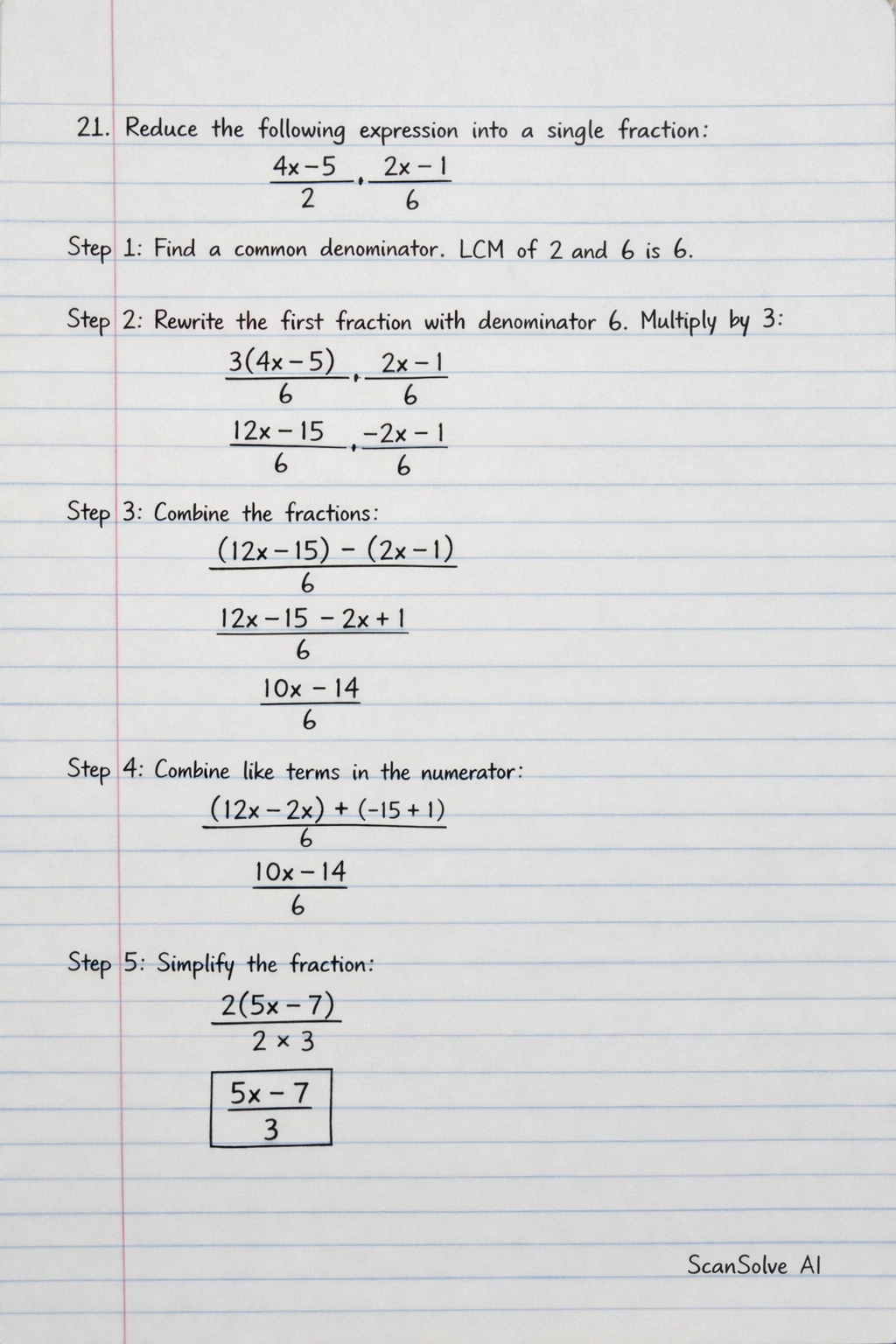
Here are the solutions to the problems: 21. Reduce the following expression into a single fraction (4x-5)/(2) - (2x-1)/(6) Step 1: Find a common denominator for the two fractions. The least common multiple of 2 and 6 is 6. Step 2: Rewrite the first fraction with the denominator 6. To do this, multiply both the numerator and the denominator by 3. (3(4x-5))/(3 × 2) - (2x-1)/(6) (12x-15)/(6) - (2x-1)/(6) Step 3: Combine the fractions by subtracting the numerators. Remember to distribute the negative sign to all terms in the second numerator. ((12x-15) - (2x-1))/(6) (12x-15-2x+1)/(6) Step 4: Combine like terms in the numerator. ((12x-2x) + (-15+1))/(6) (10x-14)/(6) Step 5: Simplify the fraction by dividing the numerator and the denominator by their greatest common divisor, which is 2. (2(5x-7))/(2 × 3) (5x-7)/(3) 22. Given that 1.05 = 1(a)/(b), Find the values of a and b. Step 1: Convert the repeating decimal 1.05 into a fraction. Let N = 1.05 Multiply by 10 to move the non-repeating part to the left of the decimal: 10N = 10.55 (1) Multiply by 100 to move one full repeating block to the left of the decimal: 100N = 105.5 (2) Step 2: Subtract equation (1) from equation (2) to eliminate the repeating part. 100N - 10N = 105.5 - 10.55 90N = 95 Step 3: Solve for N. N = (95)/(90) Step 4: Simplify the fraction by dividing the numerator and denominator by their greatest common divisor, which is 5. N = (95 ÷ 5)/(90 ÷ 5) = (19)/(18) Step 5: Express the improper fraction as a mixed number. (19)/(18) = 1(1)/(18) Step 6: Compare this to the given form 1(a)/(b). By comparison, a=1 and b=18. The values are a=1, b=18. 23. Evaluate (-2^2 - (-8))/(-2x - 12 ÷ 3) of 2.6 without using a calculator, in simplest form. The phrase "Evaluate [expression] of [value]" implies substituting the value into the expression for the variable x. So, we will substitute x = 2.6 into the given fraction. Step 1: Convert the repeating decimal 2.6 into a fraction. Let M = 2.6 10M = 26.6 Subtract M from 10M: 10M - M = 26.6 - 2.6 9M = 24 M = (24)/(9) Simplify the fraction by dividing by 3: M = (8)/(3) So, x = (8)/(3). Step 2: Evaluate the numerator of the fraction. Numerator = -2^2 - (-8) Recall that -2^2 = -(2 × 2) = -4. Numerator = -4 - (-8) Numerator = -4 + 8 Numerator = 4 Step 3: Evaluate the denominator of the fraction, substituting x = (8)/(3). Denominator = -2x - 12 ÷ 3 First, perform the division: 12 ÷ 3 = 4. Denominator = -2x - 4 Now substitute x = (8)/(3): Denominator = -2((8)/(3)) - 4 Denominator = -(16)/(3) - 4 To subtract, find a common denominator for -(16)/(3) and 4. 4 = (12)/(3). Denominator = -(16)/(3) - (12)/(3) Denominator = (-16 - 12)/(3) Denominator = (-28)/(3) Step 4: Evaluate the entire fraction. NumeratorDenominator = (4)/(-28)3 To divide by a fraction, multiply by its reciprocal: 4 × ((3)/(-28)) = (12)/(-28) Step 5: Simplify the fraction. Divide both the numerator and the denominator by their greatest common divisor, which is 4. = -(12 ÷ 4)/(28 ÷ 4) = -(3)/(7)