
We read your photo as:
What are 2D shapes and sequences? Provide definitions, examples, and applications.
ScanSolve AI Answer
Answers
2 partsStep-by-step solution
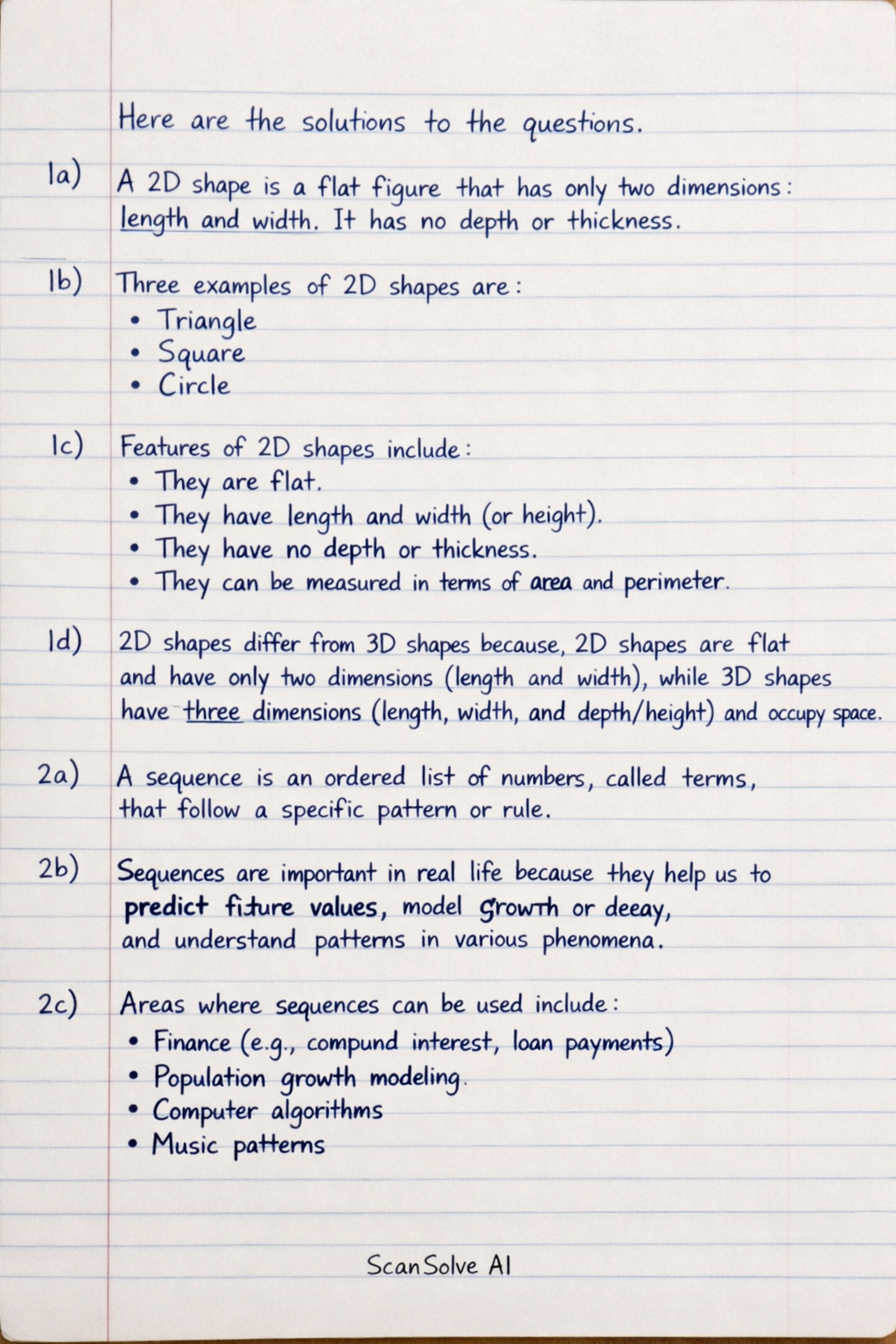
10 stepsHere are the solutions to the questions.
1a)
A 2D shape is a flat figure that has only two dimensions: length and width. It has no depth or thickness.
1b)
Three examples of 2D shapes are:
- Triangle
- Square
- Circle
1c)
Features of 2D shapes include:
- They are flat.
- They have length and width (or height).
- They have no depth or thickness.
- They can be measured in terms of area and perimeter.
1d)
2D shapes differ from 3D shapes because 2D shapes are flat and have only two dimensions (length and width), while 3D shapes have three dimensions (length, width, and depth/height) and occupy space.
2a)
A sequence is an ordered list of numbers, called terms, that follow a specific pattern or rule.
2b)
Sequences are important in real life because they help us to predict future values, model growth or decay, and understand patterns in various phenomena.
2c)
Areas where sequences can be used include:
- Finance (e.g., compound interest, loan payments)
- Population growth modeling
- Computer algorithms
- Music patterns
2d)
Part i· 2 steps
4, 9, 16, 25
Identify the pattern.
The given terms are . This is a sequence of perfect squares where the -th term is .
Calculate the next three terms.
For :
For :
For :
The next 3 terms are .
Part ii
3, 7, 11, 15
Identify the pattern.
The difference between consecutive terms is constant: , , . This is an arithmetic sequence with a first term and a common difference . The -th term is .
Calculate the next three terms.
For :
For :
For :
The next 3 terms are .3a)
Substitute the value of into the function.
Given , we need to find .
Calculate the result.
The value is .
3b)
Substitute the value of into the function.
Given , we need to find .
Calculate the result.
The value is .
3c)
Substitute the value of into the function.
Given , we need to find .
Calculate the result.
The value is .
Try one yourself
A new problem that tests the same skill.
Still stuck on this one?
Ask a follow-up, and the answer starts from this question.
More Mathematics Questions
Handwritten Step-by-Step Solution
Get this as a handwritten image on WhatsApp — like a tutor wrote it for you.
Try on WhatsApp