
We read your photo as:
3 a) Simplify (2x+14)/(2x2-98). b) Given that the third and sixth terms of a geometric progression are 3/4 and 3/32 respectively, find the i) first term and the common ratio, ii) nth term, iii) sum to infinity of the progression.
ScanSolve AI Answer
Answers
4 partsStep-by-step solution
10 stepsPart a· 3 steps
Factor out common terms from the numerator and denominator.
The numerator is . We can factor out 2: .
The denominator is . We can factor out 2: .Apply the difference of squares formula to the denominator.
The expression is in the form , where and .
So, .Substitute the factored forms back into the fraction and simplify.
Cancel out the common factors of 2 and .
The simplified expression is .
Part b(i)
First term and the common ratio
Given that the third term () of a geometric progression is and the sixth term () is .
The formula for the term of a geometric progression is , where is the first term and is the common ratio.
Write equations for and .
For : (Equation 1)
For : (Equation 2)Divide Equation 2 by Equation 1 to find the common ratio .
Solve for .
Substitute the value of into Equation 1 to find the first term .
The first term is and the common ratio is .
Part b(ii)
term
Use the formula for the term, , with and .
The term is .
Part b(iii)6
Sum to infinity of the progression
Use the formula for the sum to infinity of a geometric progression, .
This formula is valid when . Since , , so the sum to infinity exists.
Substitute and into the formula.
The sum to infinity of the progression is .
Try one yourself
A new problem that tests the same skill.
Still stuck on this one?
Ask a follow-up, and the answer starts from this question.
More Mathematics Questions
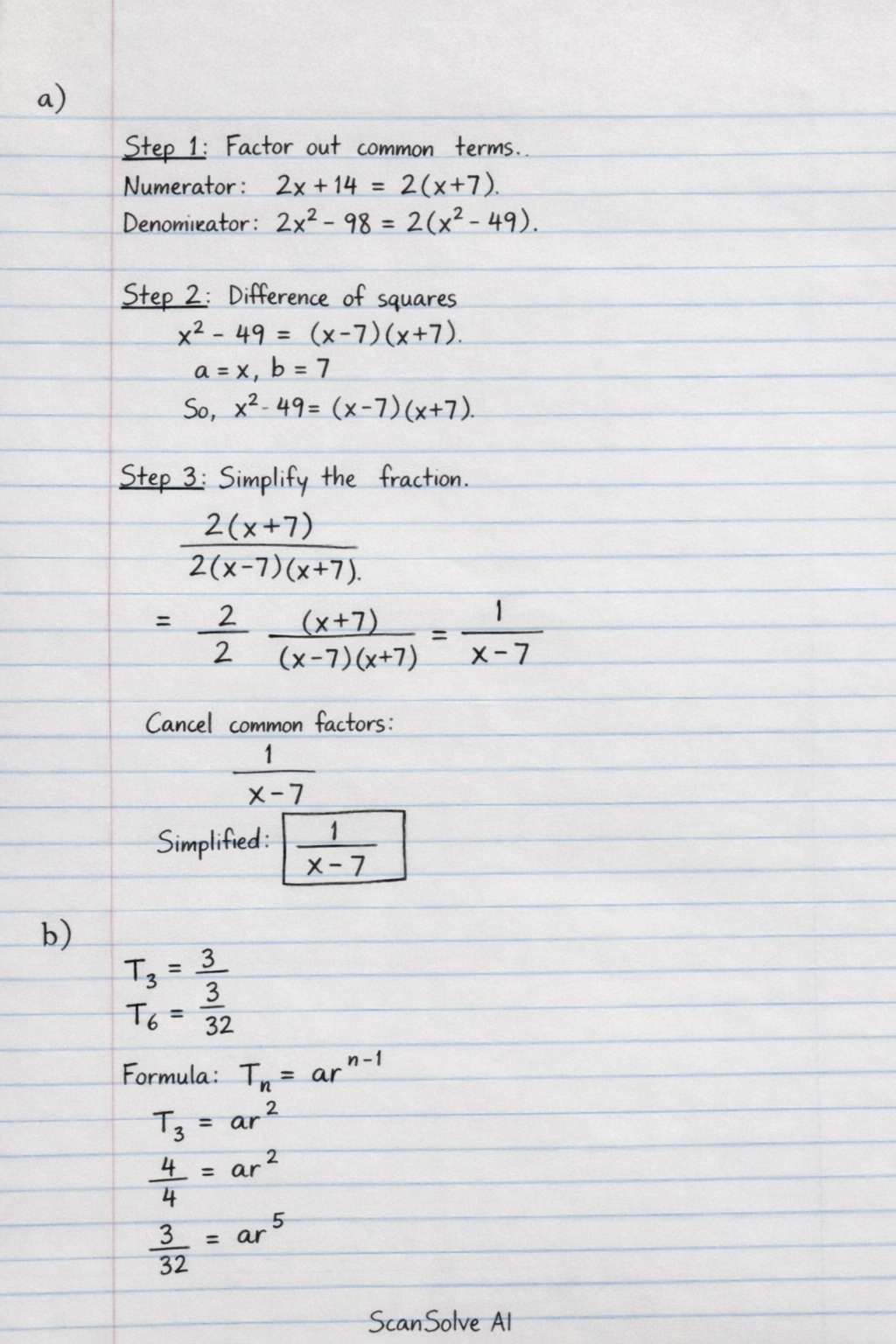
Handwritten Step-by-Step Solution
Get this as a handwritten image on WhatsApp — like a tutor wrote it for you.
Try on WhatsApp