

This mathematics problem involves applying core mathematical principles and formulas. Below you will find a complete step-by-step solution with detailed explanations for each step, helping you understand not just the answer but the method behind it.
ScanSolve AI Answer
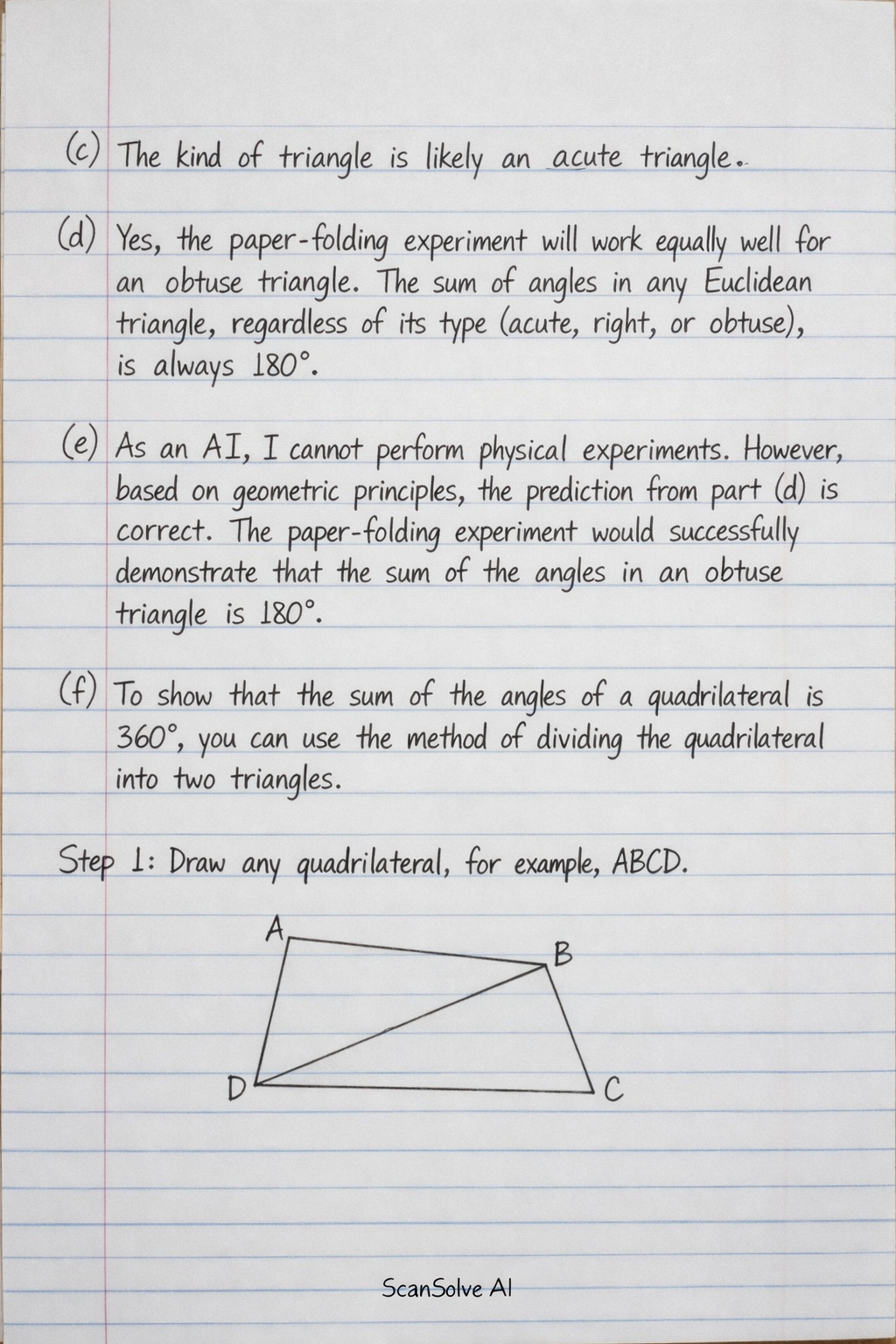
c) Without the image of the "previous page", it's common for the first practical activity demonstrating the sum of angles in a triangle to use a general acute triangle. This type of triangle helps illustrate the principle without the special properties of right or isosceles triangles. The kind of triangle is likely an acute triangle. d) Yes, the paper-folding experiment will work equally well for an obtuse triangle. The sum of angles in any Euclidean triangle, regardless of its type (acute, right, or obtuse), is always 180^. e) As an AI, I cannot perform physical experiments. However, based on geometric principles, the prediction from part (d) is correct. The paper-folding experiment would successfully demonstrate that the sum of the angles in an obtuse triangle is 180^. f) To show that the sum of the angles of a quadrilateral is 360^, you can use the method of dividing the quadrilateral into two triangles. Step 1: Draw any quadrilateral, for example, ABCD. Step 2: Draw a diagonal connecting two non-adjacent vertices, for instance, from A to C. This divides the quadrilateral into two triangles: ABC and ADC. Step 3: Recall that the sum of the angles in any triangle is 180^. For ABC: BAC + ABC + BCA = 180^. For ADC: DAC + ADC + DCA = 180^. Step 4: The sum of the angles of the quadrilateral ABCD is the sum of the angles of the two triangles. DAB + ABC + BCD + CDA This can be rewritten as: ( DAC + BAC) + ABC + ( BCA + DCA) + ADC Rearranging the terms to group the angles of each triangle: ( BAC + ABC + BCA) + ( DAC + ADC + DCA) Since each bracket sums to 180^: 180^ + 180^ = 360^ Thus, the sum of the angles of a quadrilateral is 360^. Last free one today — make it count tomorrow, or type /upgrade for unlimited.