
We read your photo as:
Use logarithms only to evaluate, correct to 4 decimal places:
Mathematics
ScanSolve AI Answer
Step-by-step solution
4 steps3. Use logarithms only to evaluate, correct to 4 decimal places:
Let .
Taking logarithms to base 10:
Find the logarithm of each term.
Using logarithm tables:
Substitute the logarithm values into the equation for .
Divide by 3.
Convert the negative logarithm to characteristic-mantissa form.
So, $\log X = \bar{1}.6
Was this helpful?
Still stuck on this one?
Ask a follow-up, and the answer starts from this question.
Got a different question?Ask your own question
More Mathematics Questions
QUse logarithms correct to 4 decimal places to evaluate sqrt((0.3698 56)/(2.548)).QExpress as a single logarithm:QUse logarithms to evaluate the expression: (453 9.814 / (4.283 (0.009478)2))^(1/2)QUse logarithm tables to evaluate 4/(75.63)QTo evaluate the expression (48.63 × 8.83)/(18.39 × 3.82) using logarithm tables, we will follow…
Browse by topic:Pre-Calculus
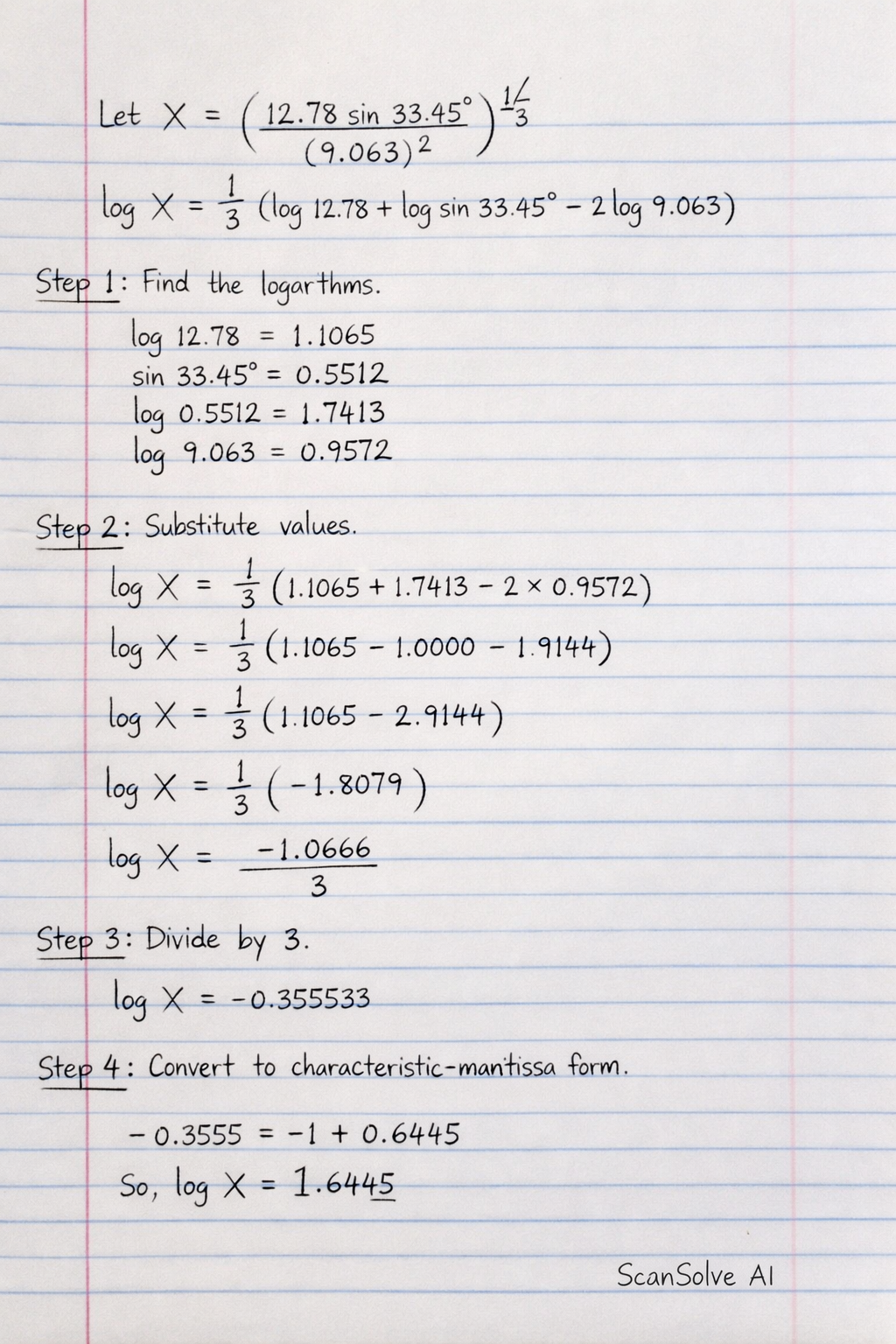
Handwritten Step-by-Step Solution
Get this as a handwritten image on WhatsApp — like a tutor wrote it for you.
Try on WhatsApp