
We read your photo as:
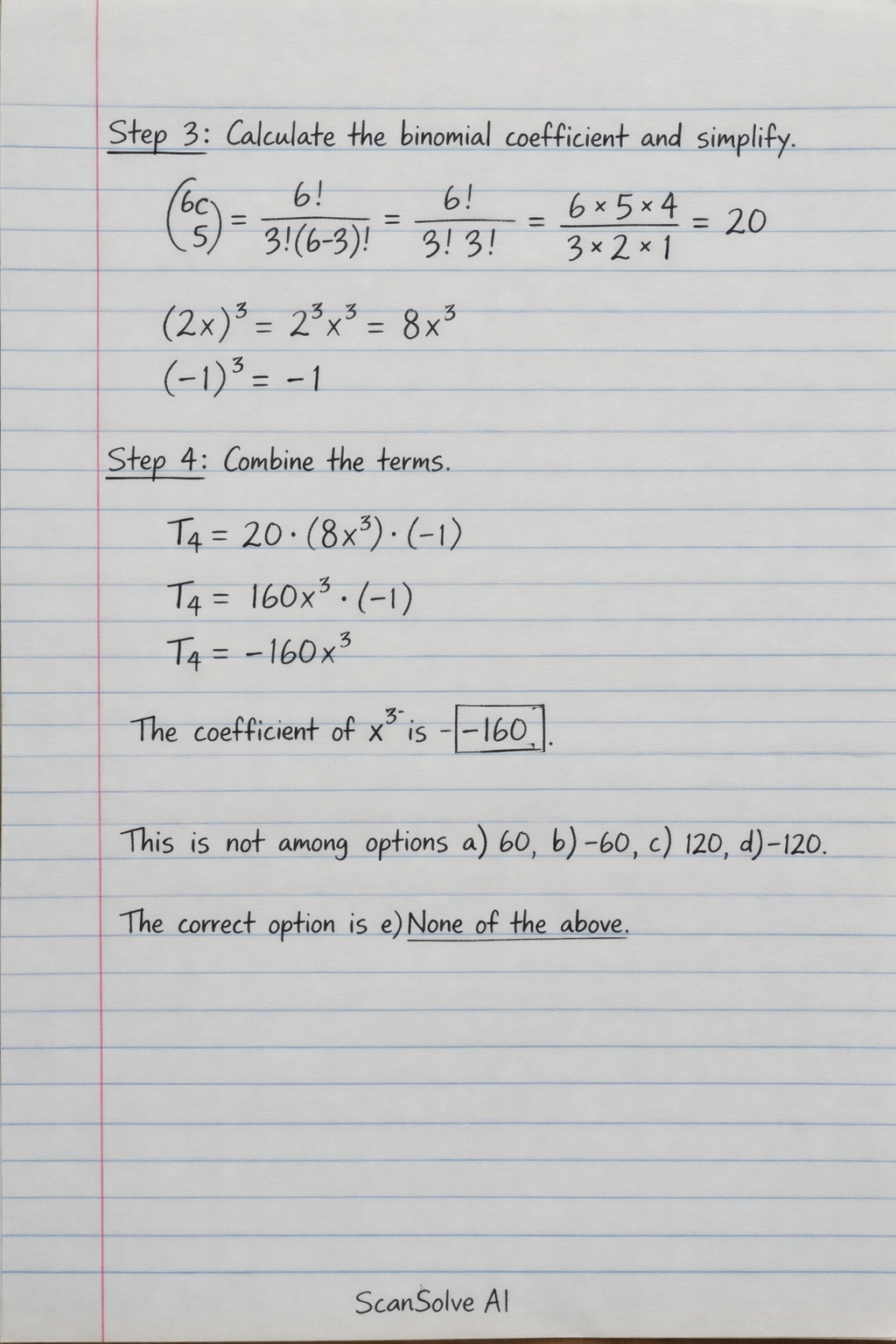
63 = (6!)/(3!(6-3)!) = (6!)/(3!3!) = (6 x 5 x 4)/(3 x 2 x 1) = 20
ScanSolve AI Answer
Answer
Step-by-step solution
11 stepsStep 3: Calculate the binomial coefficient and simplify.
Step 4: Combine the terms.
The coefficient of is .
The coefficient of is .
This is not among options a) 60, b) -60, c) 120, d) -120.
The correct option is e) None of the above.
Part 41· 3 steps
The coefficient of in the expansion of is
Use the general term formula
.
Here, , , and .
We want the coefficient of , so we set .Substitute into the formula.
Calculate the binomial coefficient and simplify.
The coefficient of is 35.
The coefficient of is .
This matches option b) 35.
Part 42· 3 steps
The term independent of in the expansion of is
Use the general term formula
.
Here, , , and .
The term independent of is the term where the power of is 0. This occurs when .Substitute into the formula.
Calculate the value.
The term independent of is 1.
The term independent of is .
This is not among options a) -50, b) 50, c) -10, d) 10.
The correct option is e) None of the above.
Part 43· 3 steps
The middle term in the expansion of is
Determine the number of terms in the expansion.
For , there are terms. Here , so there are terms.
Find the position of the middle terms.
Since there are 12 terms (an even number), there are two middle terms. Their positions are -th term and -th term.
Use the general term formula .
For , , , .
For the 6-th term, .For the 7-th term, .
The middle terms are and .
The options provided are powers of . Option b) corresponds to the variable part of one of the middle terms.The middle term (referring to the power of ) is .
This matches option b) .
Part 44· 2 steps
The determinant of the matrix is
Recall the formula for the determinant of a matrix.
For a matrix , the determinant is .
Substitute the values from the given matrix.
Here, , , , .
The determinant is .
This matches option b) 7.
Part 45
The product of a square matrix and its inverse is always
The product of a square matrix and its inverse is, by definition, the identity matrix. The identity matrix is a square matrix with ones on the main diagonal and zeros elsewhere.
The product of a square matrix and its inverse is always the .
Try one yourself
A new problem that tests the same skill.
Still stuck on this one?
Ask a follow-up, and the answer starts from this question.
More Mathematics Questions
Handwritten Step-by-Step Solution
Get this as a handwritten image on WhatsApp — like a tutor wrote it for you.
Try on WhatsApp