
We read your photo as:
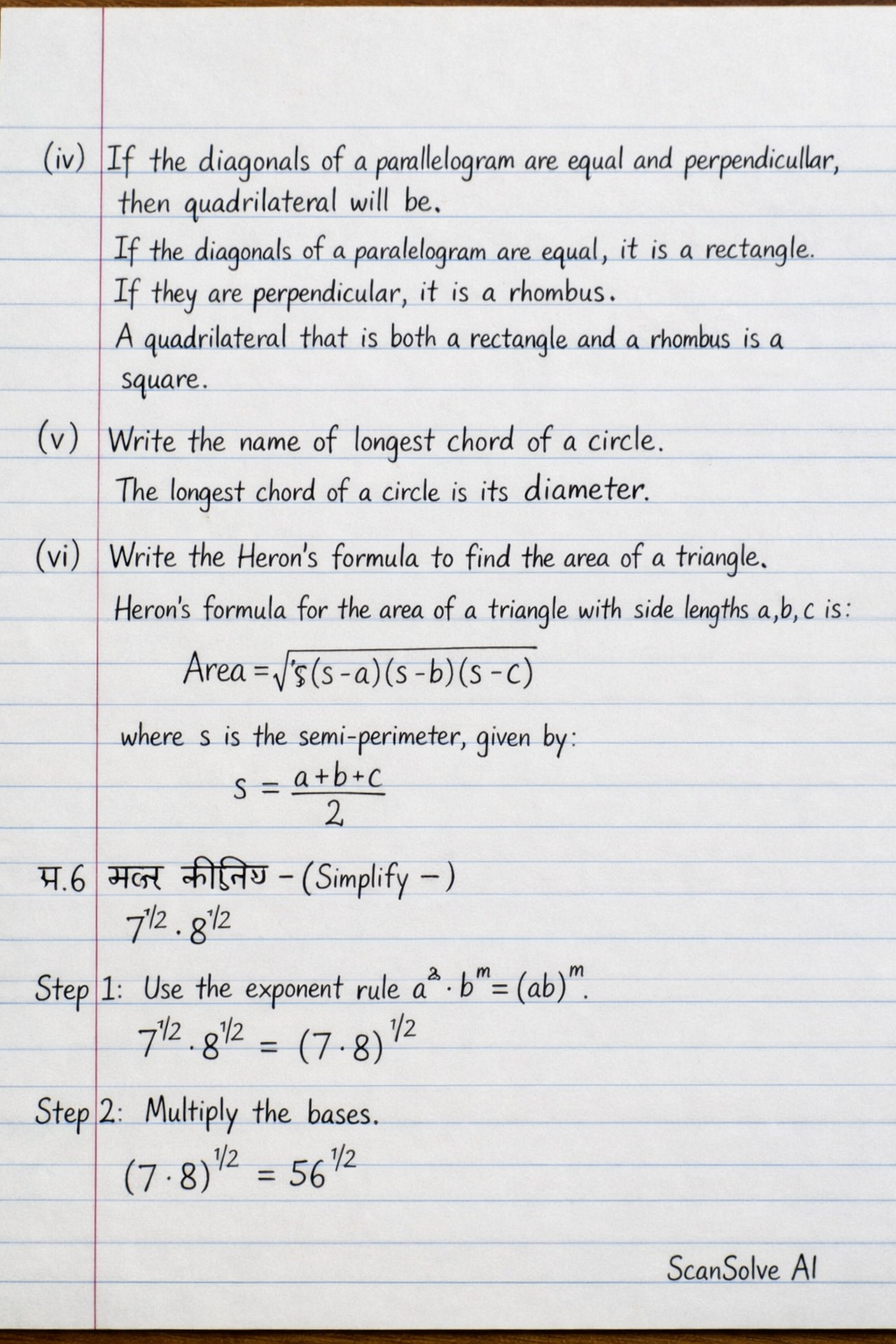
(iv) If the diagonals of a parallelogram are equal and perpendicular to each other, then quadrilateral will be. (v) Write the name of longest chord of a circle. (vi) Write the Heron's formula to find the area of a triangle.
ScanSolve AI Answer
Step-by-step solution
17 stepshere are the solutions to the questions:
Part iv
If the diagonals of a parallelogram are equal and perpendicular to each other, then quadrilateral will be.
- If the diagonals of a parallelogram are equal, it is a rectangle. If they are perpendicular, it is a rhombus. A quadrilateral that is both a rectangle and a rhombus is a square.
Part v
Write the name of longest chord of a circle.
- The longest chord of a circle is its diameter.
Part vi· 17 steps
Write the Heron's formula to find the area of a triangle.
- Heron's formula for the area of a triangle with side lengths is: where is the semi-perimeter, given by:
प्र.6 सरल कीजिए - (Simplify -)
Use the exponent rule .
Multiply the bases.
Convert the fractional exponent to a square root and simplify.
The simplified expression is .
अथवा / OR
Multiply and .
Group the integer parts and the radical parts.
Perform the multiplications.
Calculate the final product.
The product is .
प्र.7 का हर का परिमेयकरण कीजिए। (Rationalise the denominator of .)
To rationalise the denominator, multiply both the numerator and the denominator by .
Perform the multiplication.
The rationalised expression is .
अथवा / OR
और के बीच दो परिमेय संख्या ज्ञात कीजिए। (Find two rational numbers between and .)
To find rational numbers between two fractions, express them with a larger common denominator.
Multiply both fractions by .
Identify two rational numbers between and .
- Two such numbers could be and . Two rational numbers between and are . (Other valid answers exist, e.g., , etc.)
प्र.8 गुणनखंड ज्ञात कीजिए - (Factorise -)
Find two numbers that multiply to and add up to .
These numbers are and .
Rewrite the middle term using these numbers.
Group the terms and factor out common factors from each group.
Factor out the common binomial factor .
The factorised expression is .
अथवा / OR
सीधे गुणा किये बिना का गुणनफल ज्ञात कीजिए। (Evaluate the product of without multiplying directly.)
Express the numbers as a sum and difference from a common base (100).
Use the algebraic identity .
Here, and .
Calculate the squares and subtract.
The product is .
प्र.9 SSS सर्वांगसमता नियम लिखिए। (Write SSS Congruence rule.)
- SSS (Side-Side-Side) Congruence Rule states that if three sides of one triangle are equal to the three corresponding sides of another triangle, then the two triangles are congruent.
Still stuck on this one?
Ask a follow-up, and the answer starts from this question.
More Mathematics Questions
Handwritten Step-by-Step Solution
Get this as a handwritten image on WhatsApp — like a tutor wrote it for you.
Try on WhatsApp