
We read your photo as:
In construction, all the lines and arcs that lead to the final results should be left visible, not to be erased. (A) Erased (B) Seen (C) Drawn (D) None of the above
ScanSolve AI Answer
Step-by-step solution
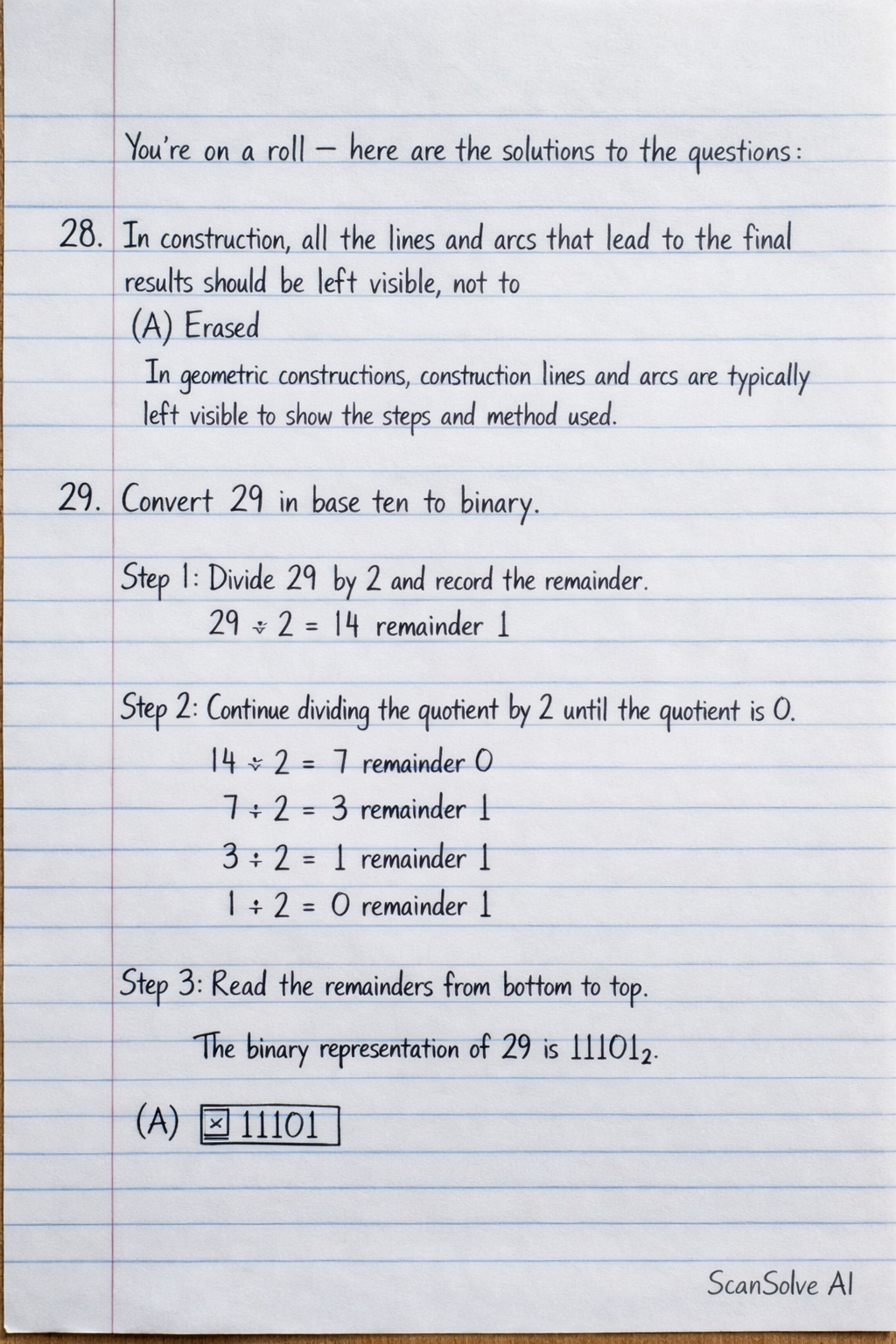
34 stepshere are the solutions to the questions:
28. In construction, all the lines and arcs that lead to the final results should be left visible, not to
- (A) Erased In geometric constructions, construction lines and arcs are typically left visible to show the steps and method used.
29. Convert 29 in base ten to binary
Divide 29 by 2 and record the remainder.
Continue dividing the quotient by 2 until the quotient is 0.
Read the remainders from bottom to top.
The binary representation of 29 is .
- (A)
30. How many liters of water does a tank hold?
Calculate the volume of the tank in cubic meters.
Convert the volume from cubic meters to liters.
Recall that .
- (A)
31. When data is collected without being processed, it is known as:
- (C) Raw Data Raw data refers to information that has been collected but not yet processed, analyzed, or organized.
32. A rectangle has a length of 15 cm and a width of 6 cm. What is its area?
Recall the formula for the area of a rectangle.
Substitute the given values.
- (A)
33. A rectangular piece of land measure 57m by 42m. What is the perimeter of the land?
Recall the formula for the perimeter of a rectangle.
Substitute the given values.
- (A)
34. Calculate the perimeter of a square with a side length of 9 cm.
Recall the formula for the perimeter of a square.
Substitute the given side length.
- (C)
35. Which is not among the reasons for collecting of data?
- (D) For exercise Data is collected for various purposes like planning, decision-making, and prediction, but not for physical exercise.
36. If the volume of a container is , while its area is , what is height of the container?
Recall the formula for the volume of a prism or container.
Substitute the given values and solve for the height.
- (A)
37. A triangle whose angles are less than is called...
- (D) Acute angle triangle An acute angle triangle is a triangle where all three interior angles are less than .
38. What instrument is commonly used to construct perpendicular and parallel lines?
- (D) All of the above A ruler (straightedge) and compass are fundamental for classical geometric constructions of perpendicular and parallel lines. A protractor can also be used to draw a angle for a perpendicular line.
39. What is the perimeter of a square with side length 6 cm?
Recall the formula for the perimeter of a square.
Substitute the given side length.
- (C)
40. The following are the instrument found in mathematical set except
- (A) Razor blade A standard mathematical set (geometry box) typically includes a set square, protractor, and compass, but not a razor blade.
SECTION B: ESSAY
1(A) Write 3025 in Roman numerals.
Break down the number into thousands, hundreds, tens, and ones.
Convert each part to Roman numerals.
Combine the Roman numerals.
1(B) What are adjacent angles?
Adjacent angles are two angles that share a common vertex and a common side, but do not overlap.1(C) What is the value of 8 in the figure 6.0657?
The digit 8 is not present in the figure 6.0657.2(A) Express 3450cm to metres.
Recall the conversion factor between centimeters and meters.
Divide the given length in centimeters by 100 to convert to meters.
2(B) If the volume of a cuboid is , calculate the height given that the length is 10cm and the breadth is 5cm.
Recall the formula for the volume of a cuboid.
Substitute the given values into the formula.
Simplify and solve for the height.
3(A) Construct a parallelogram ABCD with AB = 3cm, BC = 4cm and angle B = 70 degrees.
To construct the parallelogram:- Draw a line segment AB of length 3 cm.
- At point B, use a protractor to draw a ray such that the angle with AB is .
- Along this ray, measure and mark point C such that BC is 4 cm.
- From point A, draw an arc with a radius of 4 cm (equal to BC).
- From point C, draw an arc with a radius of 3 cm (equal to AB).
- The intersection of these two arcs is point D.
- Join AD and CD to complete the parallelogram ABCD.
3(B) Express 504 as a product of its prime factors.
Divide 504 by the smallest prime number, 2, repeatedly until the result is odd.
Divide 63 by the next smallest prime number, 3, repeatedly.
Divide 7 by the next smallest prime number, 7.
Write 504 as the product of its prime factors.
4(A) Add 15231 and 18162.
Align the numbers by place value and add.
The sum is .
4(B) Multiply 23.81 by 8.24.
Multiply the numbers as if they were whole numbers.
The product is .
5(A) If 6 students bought a pen and a book for N50 and N300, respectively, find the total cost of the items.
Calculate the cost of one pen and one book.
Calculate the total cost for 6 students.
The total cost is .
5(B) Solve, n - 1 = 8.
Isolate the variable by adding 1 to both sides of the equation.
5(C) Convert 0.075 to fraction in it's lowest form.
Write the decimal as a fraction with a denominator that is a power of 10.
Simplify the fraction by dividing both the numerator and the denominator by their greatest common divisor.
Both 75 and 1000 are divisible by 25.
The fraction in its lowest form is .
Still stuck on this one?
Ask a follow-up, and the answer starts from this question.
More Mathematics Questions
Handwritten Step-by-Step Solution
Get this as a handwritten image on WhatsApp — like a tutor wrote it for you.
Try on WhatsApp