
We read your photo as:
Sketch a solid with a uniform cross-section ABCDE and edge AP. Indicate hidden lines.
ScanSolve AI Answer
Answer
To complete the sketch of the solid with a uniform cross-section ABCDE, where AP is an edge, we need to draw the remaining edges that extend from the cross-section and the edges of the back face. Hidden edges should be represented by broken lines.
Step-by-step solution
3 stepsIdentify the corresponding vertices of the back face.
Since AP is an edge, P is the vertex corresponding to A on the back face. Similarly, we will have vertices Q, R, S, T corresponding to B, C, D, E respectively. The edges connecting the front and back faces (AP, BQ, CR, DS, ET) must be parallel to each other and of the same length.
Determine visibility of the connecting edges.
Given the perspective where AP is visible (solid line):
- BQ: This edge extends from B, parallel to AP. It is on the "top" surface of the solid and will be visible. (The wavy line in the original sketch should be a solid line).
- CR: This edge extends from C, parallel to AP. It is on the "right" surface of the solid and will be visible.
- DS: This edge extends from D, parallel to AP. Since D is an inward point of the cross-section, this edge will be obscured by the front face and other parts of the solid, making it a hidden edge.
- ET: This edge extends from E, parallel to AP. It is on the "left" surface of the solid and will be visible.
Determine visibility of the edges of the back face (PQRST).
The back face PQRST is formed by connecting the points P, Q, R, S, T in order.
- PQ: This edge connects P and Q. It is on the "top" surface of the solid and
Still stuck on this one?
Ask a follow-up, and the answer starts from this question.
More Mathematics Questions
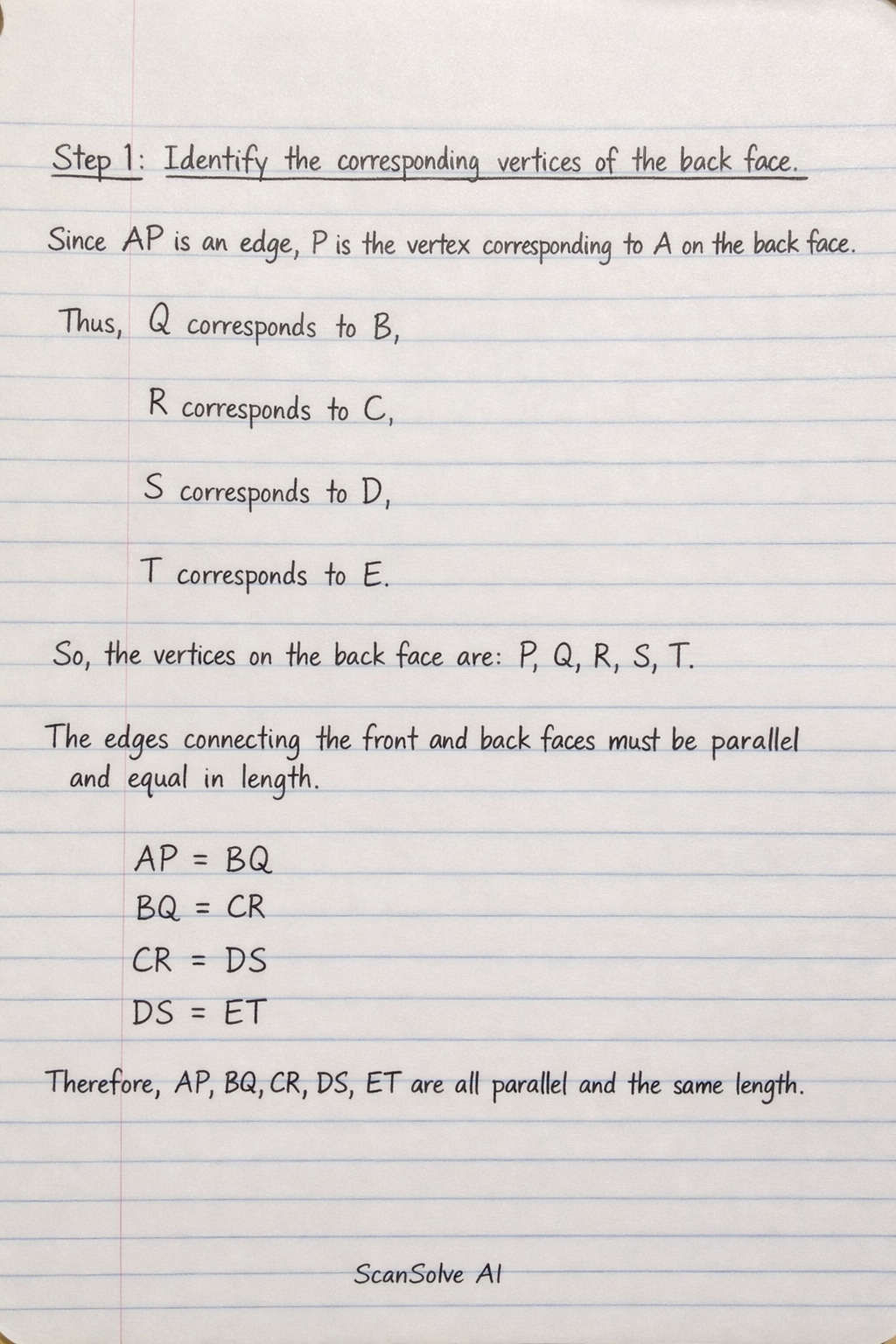
Handwritten Step-by-Step Solution
Get this as a handwritten image on WhatsApp — like a tutor wrote it for you.
Try on WhatsApp