
We read your photo as:
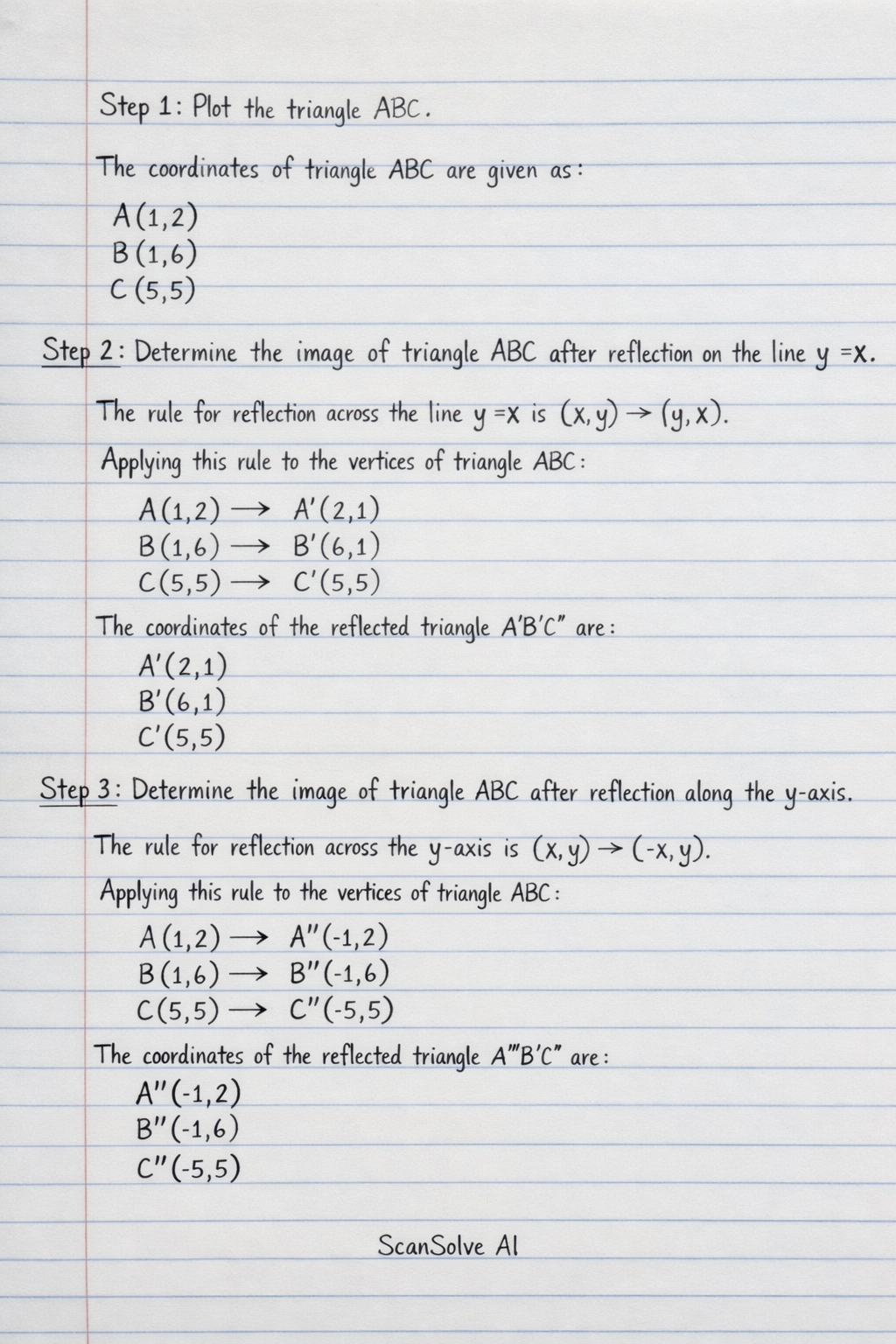
Plot the triangle ABC.
ScanSolve AI Answer
Step-by-step solution
5 stepsPlot the triangle ABC.
The coordinates of triangle ABC are given as:
A$(1,2)$
B$(1,6)$
C$(5,5)$Determine the image of triangle ABC after reflection on the line .
The rule for reflection across the line is .
Applying this rule to the vertices of triangle ABC:
A A'
B B'
C C'
The coordinates of the reflected triangle A'B'C' are:
A'
B'
C'Determine the image of triangle ABC after reflection along the y-axis.
The rule for reflection across the y-axis is .
Applying this rule to the vertices of triangle ABC:
A A''
B B''
C C''
The coordinates of the reflected triangle A''B''C'' are:
A''
B''
C''Determine the image of A'B'C' after rotation through about the origin.
The rule for rotation by (or ) about the origin is .
Applying this rule to the vertices of triangle A'B'C' (from Step 2):
A' A'''
B' B'''
C' C'''
The coordinates of the rotated triangle A'''B'''C''' are:
A'''
B'''
C'''Determine the mirror line that makes A'''B'''C''' the image of triangle ABC.
First, let's find the combined transformation from ABC to A'''B'''C'''.
The transformation from ABC to A'B'C' is reflection across : .
The transformation from A'B'C' to A'''B'''C''' is rotation by about the origin: .
Combining these, for an original point from ABC:- Reflect across :
- Rotate by about the origin: So, the overall transformation from ABC to A'''B'''C''' is .
To determine if this is a reflection and find the mirror line, we check two conditions:
- The midpoint of a point and its image must lie on the mirror line.
- The line segment connecting a point and its image must be perpendicular to the mirror line.
Let a point be and its image be .
The midpoint M is .
Consider the line . If M lies on this line, then its y-coordinate must be the negative of its x-coordinate:
This is true for all points, so the midpoint lies on the line .The slope of the line connecting and is $m_1 = \frac{-x-y}{-y-x} = \frac
Still stuck on this one?
Ask a follow-up, and the answer starts from this question.
More English Questions
Handwritten Step-by-Step Solution
Get this as a handwritten image on WhatsApp — like a tutor wrote it for you.
Try on WhatsApp