
We read your photo as:
Draw the triangle ABC.
Mathematics
ScanSolve AI Answer
Answer
Step-by-step solution
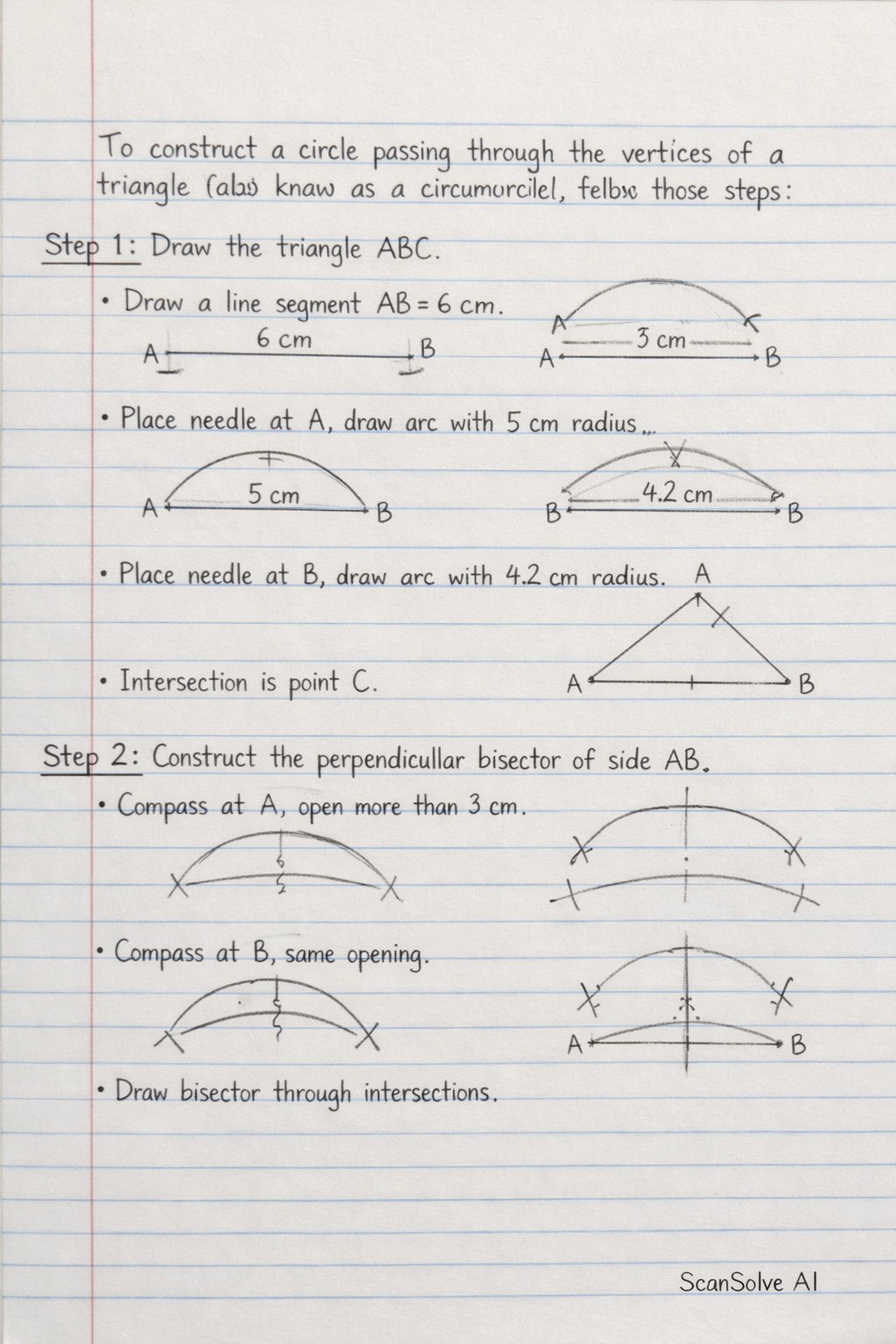
6 stepsTo construct a circle passing through the vertices of a triangle (also known as a circumcircle), follow these steps:
Draw the triangle ABC.
- Draw a line segment .
- Using a compass, place the needle at point A and draw an arc with a radius of (for side AC).
- Place the compass needle at point B and draw an arc with a radius of (for side BC).
- The intersection of these two arcs is point C. Connect A to C and B to C to form triangle ABC.
Construct the perpendicular bisector of side AB.
- With the compass needle at A, open it to more than half the length of AB. Draw arcs above and below AB.
- With the same compass opening, place the needle at B and draw arcs that intersect the previous arcs.
- Draw a straight line through the two intersection points. This is the perpendicular bisector of AB.
Construct the perpendicular bisector of side BC.
- Repeat the process from Step 2 for side BC. Place the compass needle at B, open it to more than half the length of BC, and draw arcs.
- With the same opening, place the needle at C and draw arcs intersecting the first set.
- Draw a straight line through these new intersection points. This is the perpendicular bisector of BC.
Locate the circumcenter.
- The point where the two perpendicular bisectors intersect is the circumcenter of the triangle. Label this point O.
Draw the circumcircle.
- Place the compass needle at the circumcenter O.
- Adjust the compass opening so that the pencil tip touches any one of the vertices (A, B, or C).
- Draw the circle. This circle will pass through all three vertices of the triangle.
Measure the radius.
- Use a ruler to measure the distance from the circumcenter O to any of the vertices (OA, OB, or OC). This distance is the radius of the circumcircle.
For reference, the calculated radius using the formula (where are side lengths and is the area) is approximately:
Let , , .
Semi-perimeter .
Area .
Radius .The radius of the circle should be approximately .
(Note: When performing the physical construction, measure the radius directly from your drawing.)
Was this helpful?
Try one yourself
A new problem that tests the same skill.
Still stuck on this one?
Ask a follow-up, and the answer starts from this question.
Got a different question?Ask your own question
More Mathematics Questions
QPlot the triangle ABC.QComplete the construction of triangle ABC.QDraw, labelling all the vertices clearly together with their coordinates triangle ABC with vertices…QGiven triangle ABC with vertices A(1, 4), B(2, 1), and C(5, 2).QDraw the image triangle A2, B2, and C2 of triangle ABC under an anticlockwise rotation through 90°…
Browse by topic:Geometry
Handwritten Step-by-Step Solution
Get this as a handwritten image on WhatsApp — like a tutor wrote it for you.
Try on WhatsApp