
Derived the scs equation in hydrology
ScanSolve AI Answer
Answer
Step-by-step solution
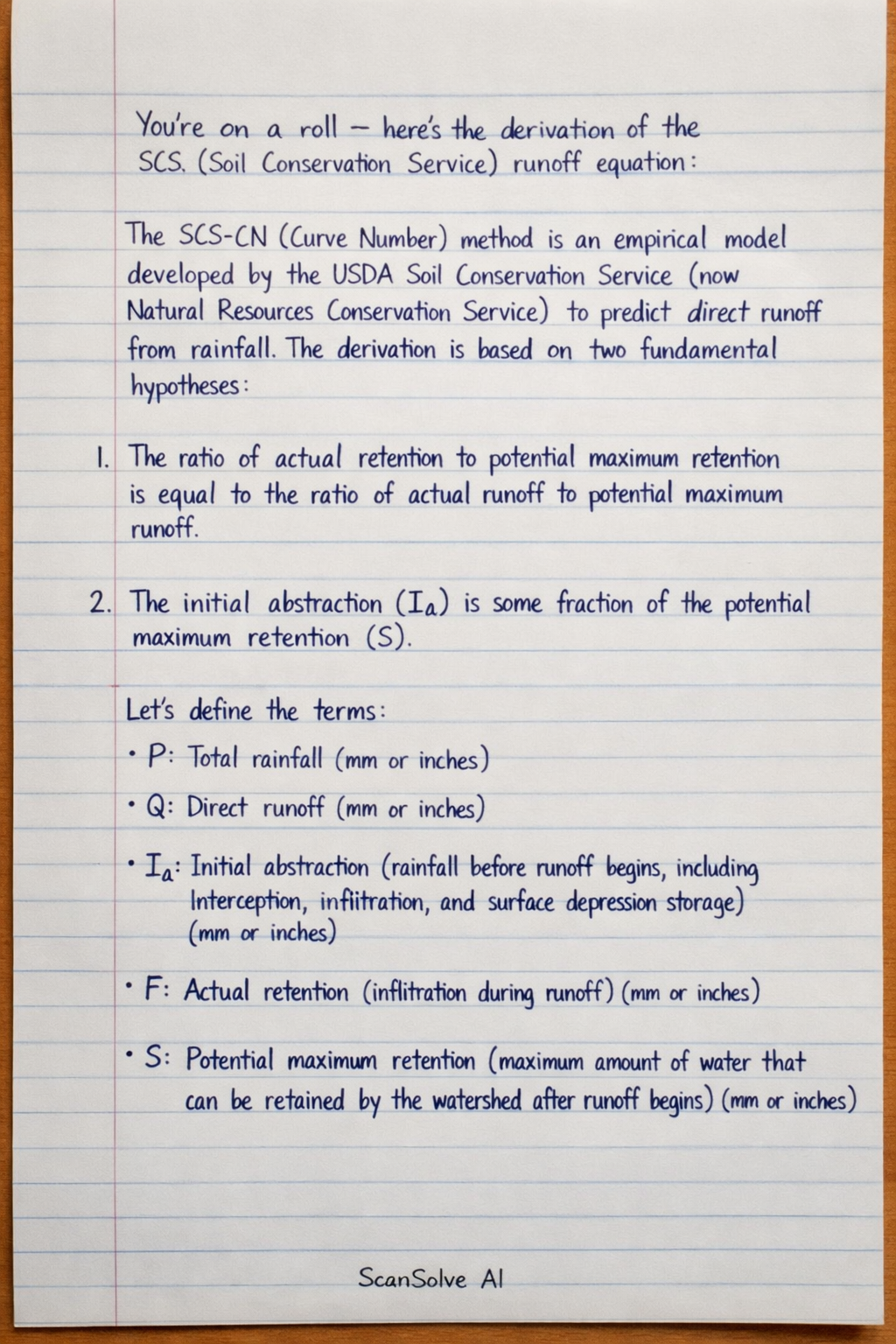
6 stepshere's the derivation of the SCS (Soil Conservation Service) runoff equation:
The SCS-CN (Curve Number) method is an empirical model developed by the USDA Soil Conservation Service (now Natural Resources Conservation Service) to predict direct runoff from rainfall. The derivation is based on two fundamental hypotheses:
- The ratio of actual retention to potential maximum retention is equal to the ratio of actual runoff to potential maximum runoff.
- The initial abstraction () is some fraction of the potential maximum retention ().
Let's define the terms:
- : Total rainfall (mm or inches)
- : Direct runoff (mm or inches)
- : Initial abstraction (rainfall before runoff begins, including interception, infiltration, and surface depression storage) (mm or inches)
- : Actual retention (infiltration during runoff) (mm or inches)
- : Potential maximum retention (maximum amount of water that can be retained by the watershed after runoff begins) (mm or inches)
Water Balance Equation
The total rainfall () is partitioned into initial abstraction (), direct runoff (), and actual retention ().
For runoff to occur, . If , then .
The rainfall available for runoff and retention is . Therefore, we can write:Proportionality Assumption
The SCS method assumes that the ratio of actual retention () to the potential maximum retention () is equal to the ratio of actual runoff () to the total rainfall available for runoff and retention ().
Empirical Relationship for Initial Abstraction
Based on empirical studies, the SCS found that the initial abstraction () can be approximated as a fraction of the potential maximum retention ().
This means that, on average, about 20% of the potential maximum retention occurs as initial abstraction before runoff begins.
Substitute and Solve for Runoff ()
From Step 2, we can express as:
Substitute this expression for and the empirical relationship for (from Step 3) into the water balance equation from Step 1 ():
Now, we need to solve for :
Rearranging to solve for :
This equation is valid only when , i.e., . If , then .
Introduce the Curve Number (CN)
To make the parameter more practical and dimensionless, the SCS introduced the Curve Number (CN). CN is an index that represents the runoff potential of a watershed and ranges from 0 to 100. The relationship between (in mm) and CN is:
If is in inches, the relationship is:
Final SCS Runoff Equation
Substituting the expression for in terms of CN into the runoff equation (using in mm):
This is the full form, but typically, the equation is used with directly calculated from CN.
The final SCS runoff equation is:
where , so:
This equation is applicable for . If , then .
The potential maximum retention is related to the Curve Number (CN) by:or
Try one yourself
A new problem that tests the same skill.
Still stuck on this one?
Ask a follow-up, and the answer starts from this question.
More Mathematics Questions
Handwritten Step-by-Step Solution
Get this as a handwritten image on WhatsApp — like a tutor wrote it for you.
Try on WhatsApp