
We read your photo as:
If a 95% confidence interval for a mean is 10 to 20, what can be inferred?
Mathematics
ScanSolve AI Answer
Here's the solution for question 64:
- If a 95% confidence interval for a mean is 10 to 20, what can be inferred?
- A. The population mean will always lie within the interval. This is incorrect. A 95% confidence interval means that if we were to repeat the sampling process many times, 95% of the intervals constructed would contain the true population mean. This implies there's a 5% chance that any given interval does not contain the true mean.
- B. The sample data is normally distributed. This is not necessarily true. While normality of the sample data or the sampling distribution of the mean is often an assumption, especially for small sample sizes, the Central Limit Theorem allows us to construct valid confidence intervals for large sample sizes even if the original data is not normally distributed. The confidence interval itself does not directly infer the distribution of the sample data.
- C. The population mean is normally distributed. This is incorrect. The population mean is a fixed parameter, not a random variable, and therefore does not have a distribution.
- D. There is a 95% probability that the population mean lies within the interval. This is the most commonly accepted interpretation in many educational contexts. It reflects the confidence level associated with the method used to construct the interval. While a strict frequentist interpretation would state "we are 95% confident that the interval contains the true population mean" (referring to the reliability of the method), this option is the closest and most practical interpretation among the choices provided. It conveys that the process of creating the interval has a 95% chance of capturing the true mean.
The final answer is
Was this helpful?
Still stuck on this one?
Ask a follow-up, and the answer starts from this question.
Got a different question?Ask your own question
More Mathematics Questions
QA normal distribution has a mean of 15 and a standard deviation of 3. What interval contains…QNormal distribution mean is 15, SD is 3 interval covers 95% of valueQA public health researcher records the number of antenatal visits for 14 women. The sample mean is…QGiven assumed mean A = 59.5.QCalculate the mode and mean for the following grouped data: Class Intervals and Frequencies (25-35…
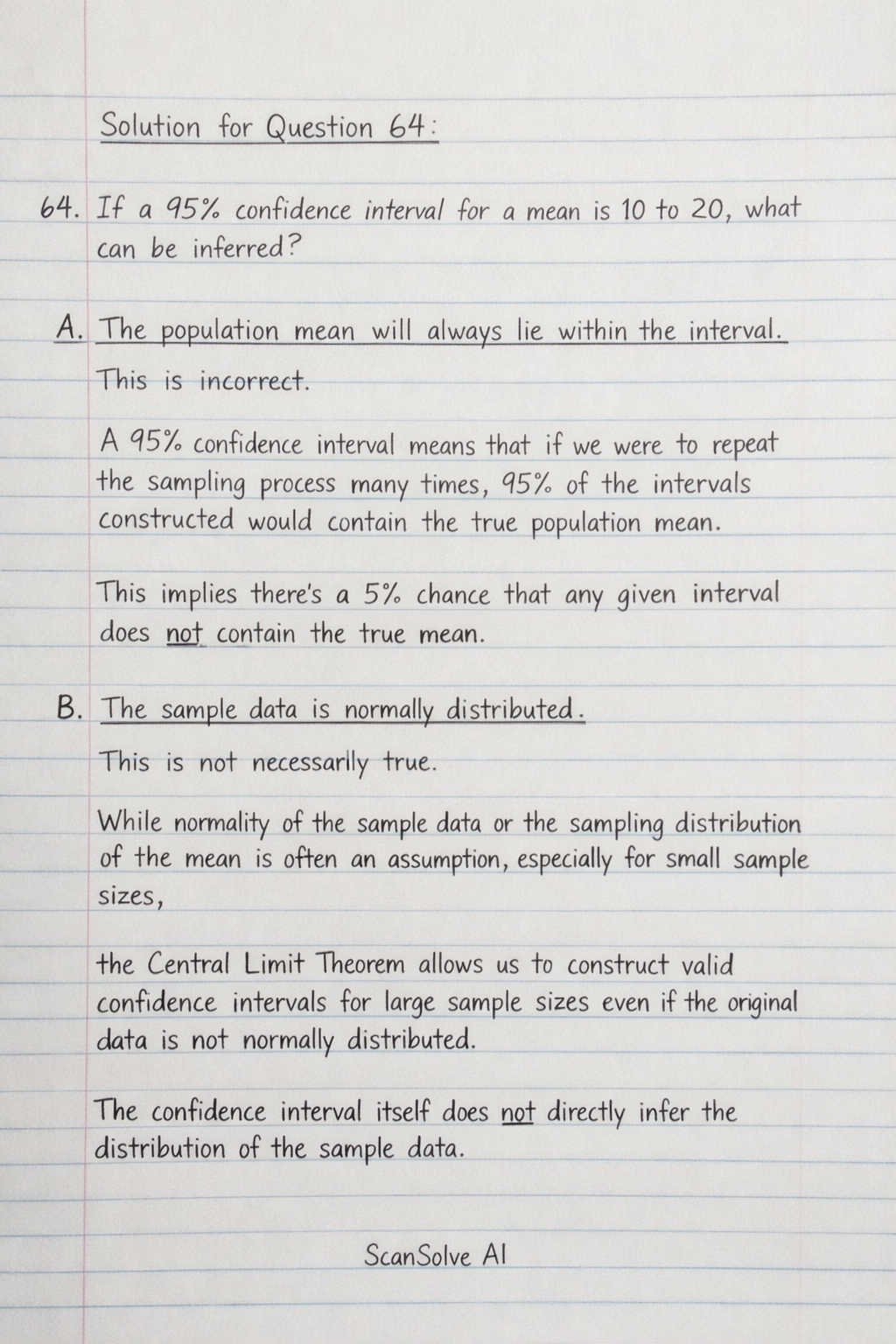
Handwritten Step-by-Step Solution
Get this as a handwritten image on WhatsApp — like a tutor wrote it for you.
Try on WhatsApp