

This mathematics problem involves applying core mathematical principles and formulas. Below you will find a complete step-by-step solution with detailed explanations for each step, helping you understand not just the answer but the method behind it.
ScanSolve AI Answer
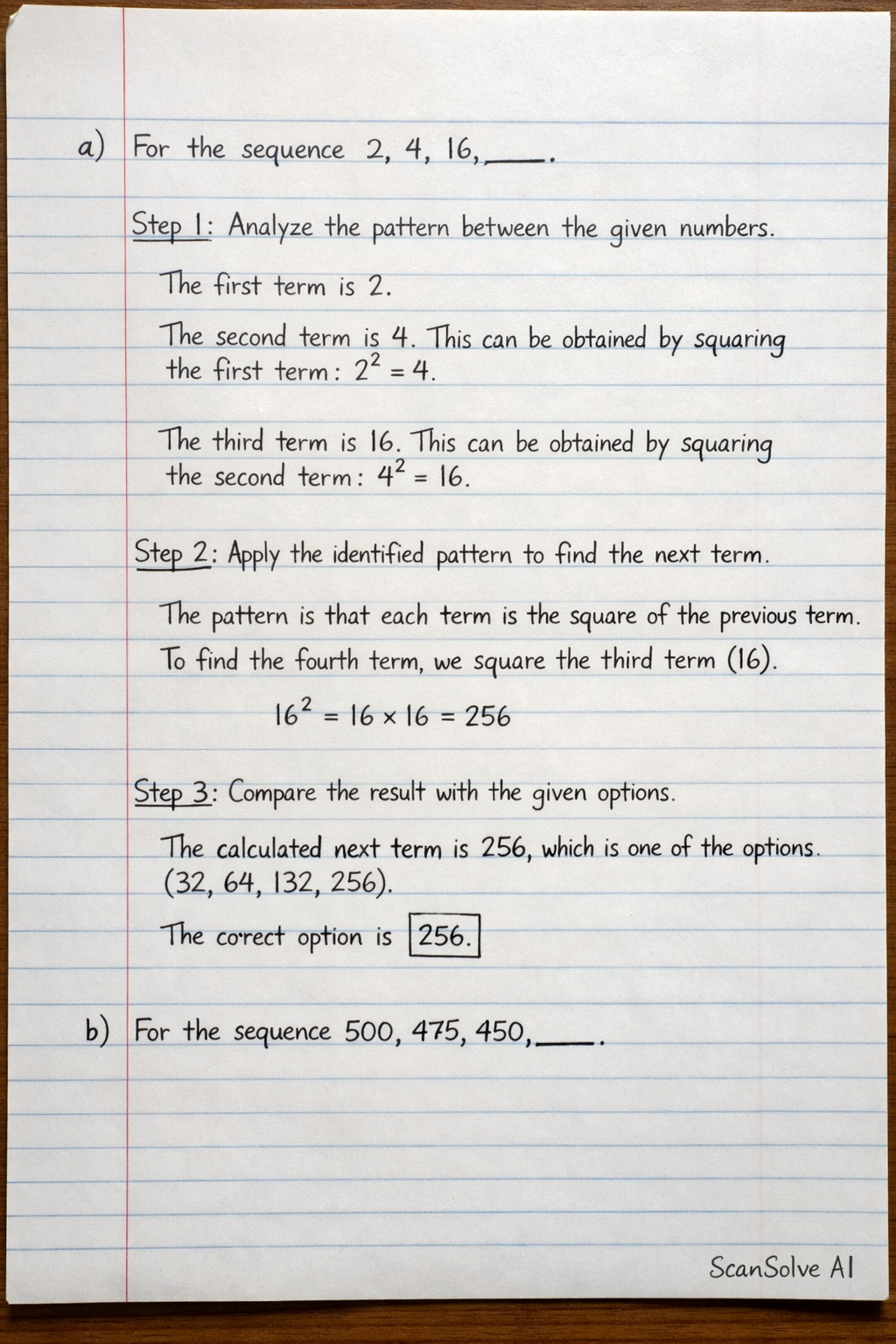
Here are the solutions for the sequences: a) For the sequence 2, 4, 16, X Step 1: Analyze the pattern between the given numbers. The first term is 2. The second term is 4. This can be obtained by squaring the first term: 2^2 = 4. The third term is 16. This can be obtained by squaring the second term: 4^2 = 16. Step 2: Apply the identified pattern to find the next term. The pattern is that each term is the square of the previous term. To find the fourth term, we square the third term (16). 16^2 = 16 × 16 = 256 Step 3: Compare the result with the given options. The calculated next term is 256, which is one of the options (32, 64, 132, 256). The correct option is 256. 256 b) For the sequence 500, 475, 450, X Step 1: Analyze the pattern between the given numbers. The difference between the first and second term is 500 - 475 = 25. The difference between the second and third term is 475 - 450 = 25. The pattern is a constant decrease of 25 for each subsequent term. This is an arithmetic progression with a common difference of -25. Step 2: Apply the identified pattern to find the next term. To find the fourth term, subtract 25 from the third term (450). 450 - 25 = 425 Step 3: Compare the result with the given options. The calculated next term is 425, which is one of the options (400, 415, 425). The correct option is 425. 425 That's 2 down. 3 left today — send the next one.