
We read your photo as:
Identify the pattern and the next three terms in the given sequences: 125, 250, 375, 500; 8, 24, 72; 286, 311, 336, , , .
ScanSolve AI Answer
Step-by-step solution
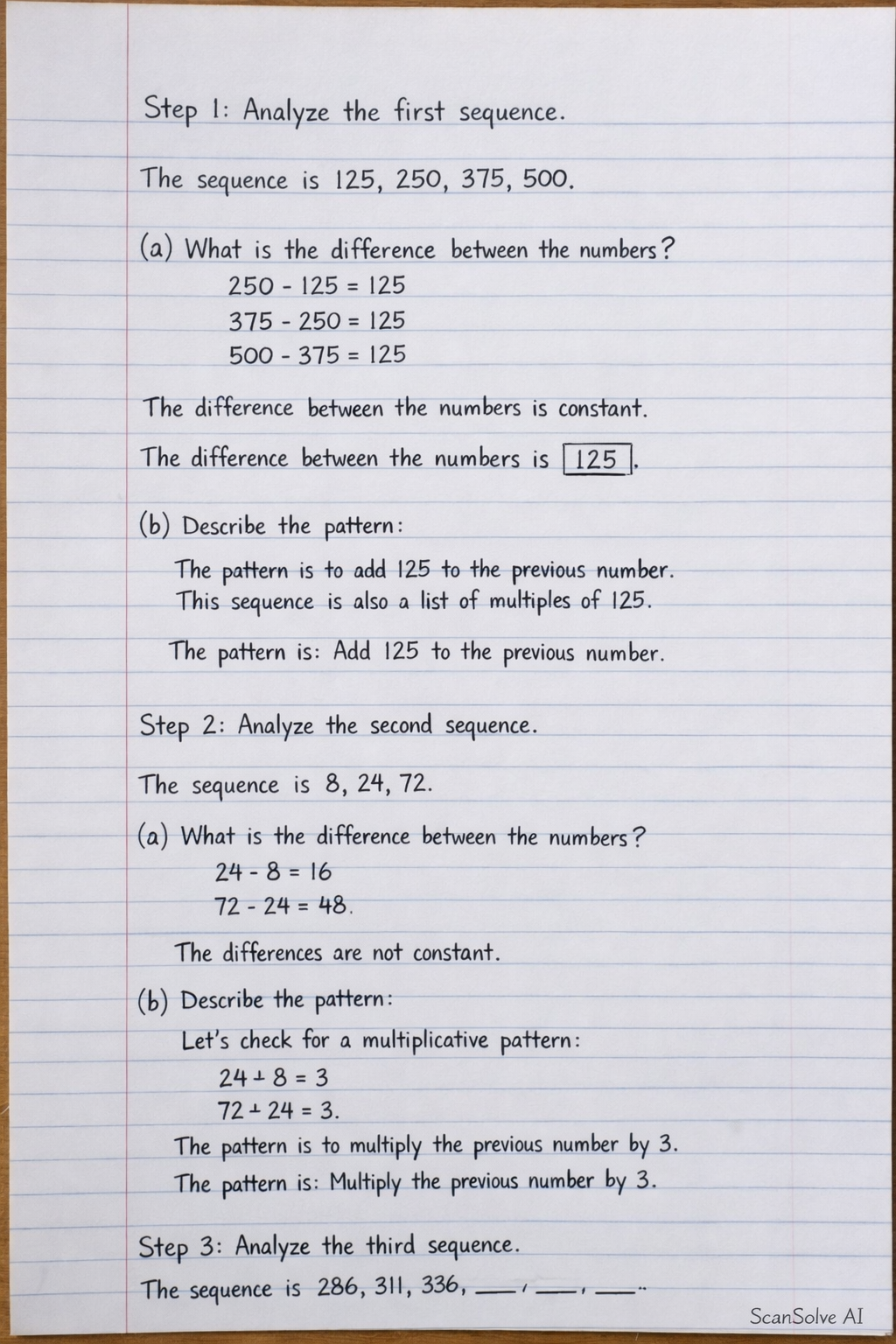
3 stepsAnalyze the first sequence.
The sequence is .
a) What is the difference between the numbers?
Calculate the difference between consecutive terms:The difference between the numbers is constant.
The difference between the numbers is .b) Describe the pattern.
The pattern is to add 125 to the previous number. This sequence is also a list of multiples of 125.
The pattern is: Add 125 to the previous number.Analyze the second sequence.
The sequence is .
a) What is the difference between the numbers?
Calculate the difference between consecutive terms:The differences are not constant.
b) Describe the pattern.
Let's check for a multiplicative pattern:The pattern is to multiply the previous number by 3.
The pattern is: Multiply the previous number by 3.Analyze the third sequence.
The sequence is
286, 311, 336, \text{___}, \text{___}, \text{___}.a) Give the next three numbers of the sequence. Describe the pattern.
First, find the pattern by calculating the difference between consecutive terms:The pattern is to add 25 to the previous number.
Now, find the next three numbers:
The next three numbers are .
The pattern is: Add 25 to the previous number.
Still stuck on this one?
Ask a follow-up, and the answer starts from this question.
More Mathematics Questions
Handwritten Step-by-Step Solution
Get this as a handwritten image on WhatsApp — like a tutor wrote it for you.
Try on WhatsApp