
We read your photo as:
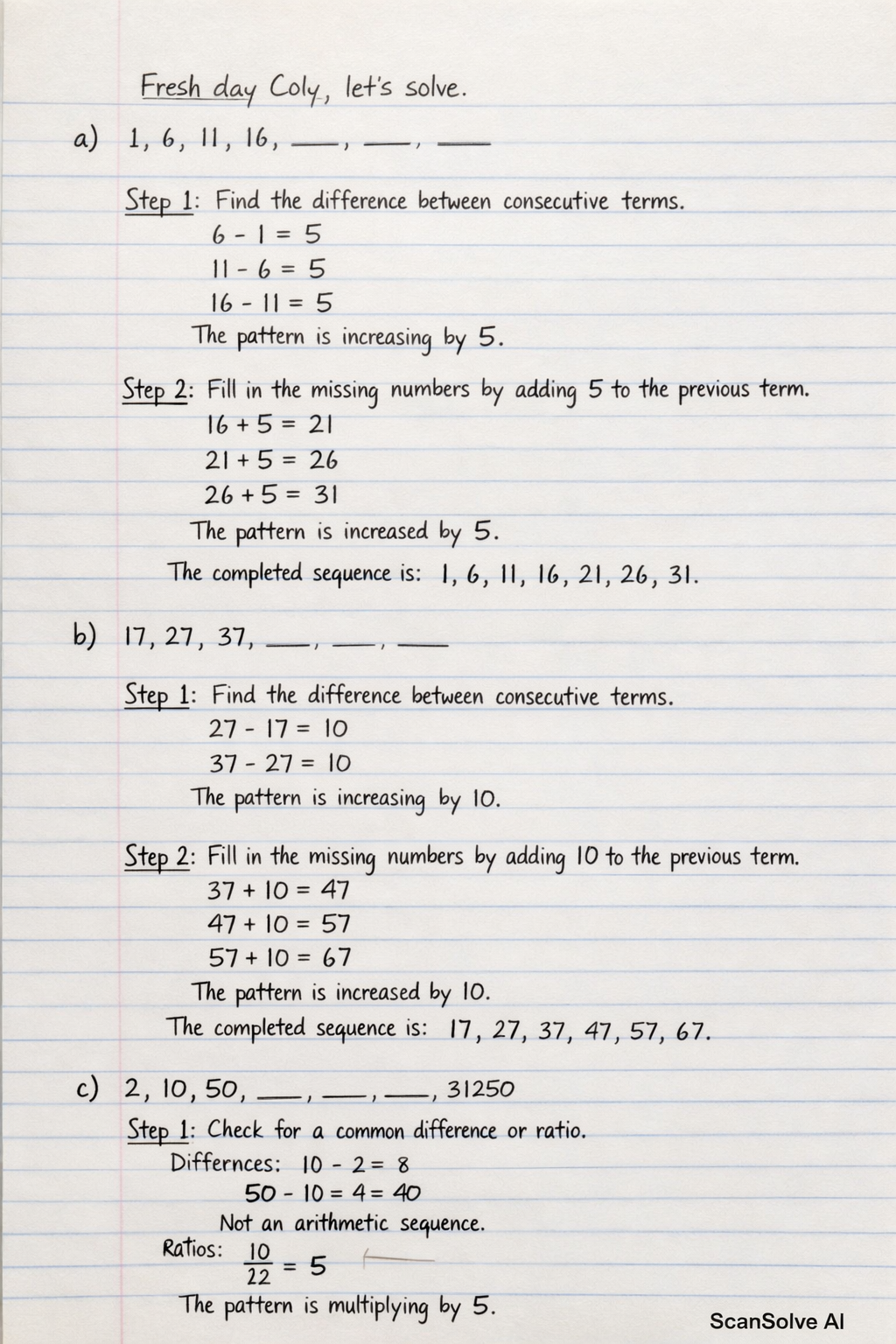
Complete the following sequences by finding the pattern and filling in the blanks: a) 1, 6, 11, 16, , , b) 17, 27, 37, , , c) 2, 10, 50, , , , 31250
Mathematics
ScanSolve AI Answer
Answers
3 partsStep-by-step solution
7 stepsPart a· 2 steps
1, 6, 11, 16, ___, ___,
Find the difference between consecutive terms.
The pattern is increasing by 5.
Fill in the missing numbers by adding 5 to the previous term.
The pattern is increased by 5.
The completed sequence is:
Part b
17, 27, 37, ___, ___,
Find the difference between consecutive terms.
The pattern is increasing by 10.
Fill in the missing numbers by adding 10 to the previous term.
The pattern is increased by 10.
The completed sequence is:
Part c
2, 10, 50, ___, ___, ___, 31250
Check for a common difference or ratio.
Differences: , . Not an arithmetic sequence.
Ratios:The pattern is multiplying by 5.
Fill in the missing numbers by multiplying the previous term by 5.
Verify the last given number.
This matches the given last term.
The pattern is multiplied by 5.
The completed sequence is:
Was this helpful?
Try one yourself
A new problem that tests the same skill.
Still stuck on this one?
Ask a follow-up, and the answer starts from this question.
Got a different question?Ask your own question
More Mathematics Questions
QComplete the following numerical patterns: a) 4, 8, 12, , , b) 30, 27, 24, , , c) 100, 95, 90…QExtend the following patterns: a) 1, 2, 3, 5, 7, 11, , , b) 1, 3, 7, 15, , , c) 100, 52, 28, , , ___QIdentify the pattern and the next three terms in the given sequences: 125, 250, 375, 500; 8, 24, 72…QComplete the following patterns: a) 373, 374, 376, ?, ?, ? b) 650, 653, 659, ?, ?, ? c) 298, 303…QWhat is the pattern in each sequence? a) 18, 25, 32, ... b) −13, −6, 1, 8, ... c) 104, 107, 110…
Handwritten Step-by-Step Solution
Get this as a handwritten image on WhatsApp — like a tutor wrote it for you.
Try on WhatsApp