
We read your photo as:
Extend the following patterns: a) 1, 2, 3, 5, 7, 11, , , b) 1, 3, 7, 15, , , c) 100, 52, 28, , , ___
ScanSolve AI Answer
Step-by-step solution
7 stepsHere are the extended patterns:
2. Extend the following pattern.
a) Pattern: 1, 2, 3, 5, 7, 11, \text{___}, \text{___}, \text{___}
The tip indicates that prime numbers are used. The pattern starts with 1, followed by the sequence of prime numbers.
Identify the prime numbers after 11.
The prime numbers are numbers greater than 1 that have no positive divisors other than 1 and themselves.
The prime numbers after 11 are 13, 17, and 19.The extended pattern is: .
b) Pattern:
1, 3, 7, 15, \text{___}, \text{___}, \text{___}
Rule: multiply by 2 and add 1.Apply the rule to the last given number, 15.
Apply the rule to the new number, 31.
Apply the rule to the next new number, 63.
The extended pattern is: .
c) Pattern:
100, 52, 28, \text{___}, \text{___}, \text{___}
Rule: divide by 2 and add 2.Apply the rule to the last given number, 28.
Apply the rule to the new number, 16.
Apply the rule to the next new number, 10.
The extended pattern is: .
3. Create two of your own number patterns and ask your friend to extend it.
a) Pattern:
5, 10, 15, 20, \text{___}, \text{___}, \text{___}
Rule: Add 5 to the previous number.b) Pattern:
1, 4, 9, 16, \text{___}, \text{___}, \text{___}
Rule: The -th term in the sequence is .
Still stuck on this one?
Ask a follow-up, and the answer starts from this question.
More Mathematics Questions
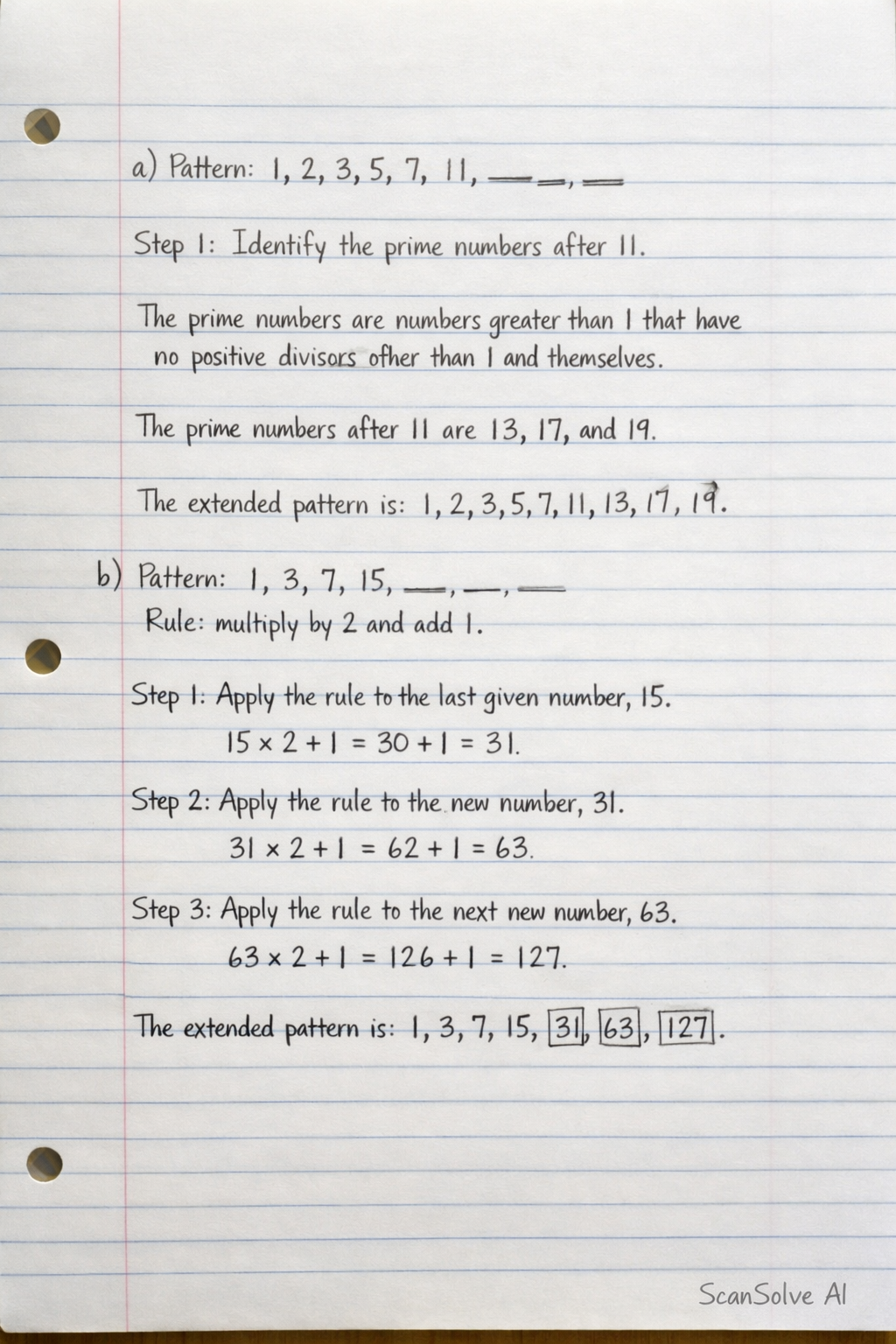
Handwritten Step-by-Step Solution
Get this as a handwritten image on WhatsApp — like a tutor wrote it for you.
Try on WhatsApp