
We read your photo as:
Find the pattern in the following examples: a) 8, 12 -> 24; b) 21, 49 -> 147.
Mathematics
ScanSolve AI Answer
Step-by-step solution
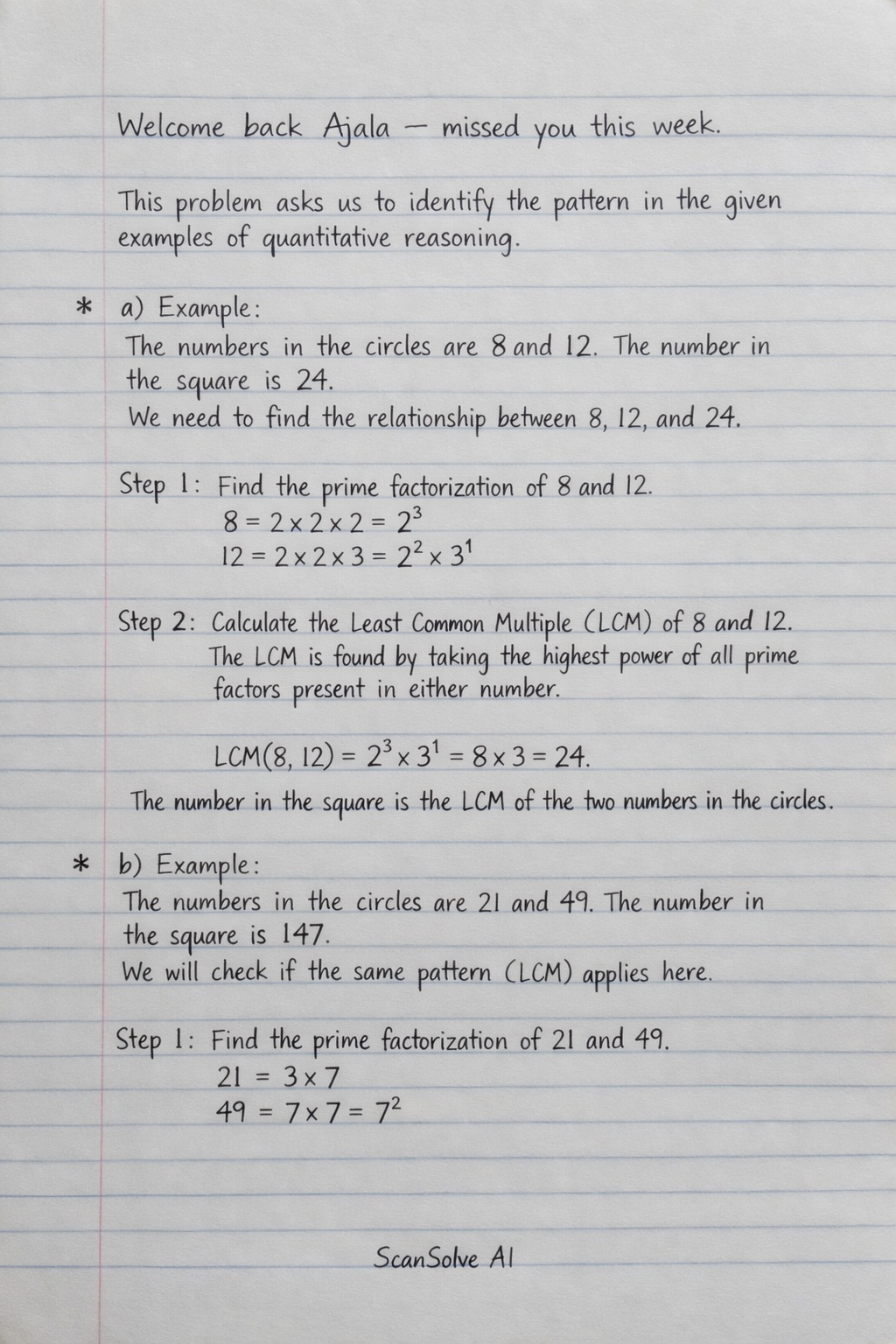
4 stepsThis problem asks us to identify the pattern in the given examples of quantitative reasoning.
- a) Example: The numbers in the circles are 8 and 12. The number in the square is 24. We need to find the relationship between 8, 12, and 24.
Find the prime factorization of 8 and 12.
$$ 8 = 2 \times 2 \times 2 = 2^3 $$ $$ 12 = 2 \times 2 \times 3 = 2^2 \times 3^1 $$Calculate the Least Common Multiple (LCM) of 8 and 12.
The LCM is found by taking the highest power of all prime factors present in either number. $$ \text{LCM}(8, 12) = 2^3 \times 3^1 = 8 \times 3 = 24 $$ The number in the square is the LCM of the two numbers in the circles.- b) Example: The numbers in the circles are 21 and 49. The number in the square is 147. We will check if the same pattern (LCM) applies here.
Find the prime factorization of 21 and 49.
$$ 21 = 3 \times 7 $$ $$ 49 = 7 \times 7 = 7^2 $$Calculate the Least Common Multiple (LCM) of 21 and 49.
$$ \text{LCM}(21, 49) = 3^1 \times 7^2 = 3 \times 49 = 147 $$ The number in the square is indeed the LCM of the two numbers in the circles.The pattern demonstrated in these examples is that the number in the square is the Least Common Multiple (LCM) of the two numbers in the circles.
Was this helpful?
Still stuck on this one?
Ask a follow-up, and the answer starts from this question.
Got a different question?Ask your own question
More Mathematics Questions
QFor each of the following patterns, determine the rule: a. 6; 14; 22; 30 b. 2; 6; 10; 14; 18 c. 13…QExtend the following patterns: a) 1, 2, 3, 5, 7, 11, , , b) 1, 3, 7, 15, , , c) 100, 52, 28, , , ___QComplete the following numerical patterns: a) 4, 8, 12, , , b) 30, 27, 24, , , c) 100, 95, 90…QWrite down the next three numbers and describe each pattern: a) 3, 6, 9, 12 b) 1, 8, 15, 22 c) 7, 9…QComplete the following number patterns and state the rule: a) 78; 84; 90; 96; ; . b) 2; 8; 32; 128…
Handwritten Step-by-Step Solution
Get this as a handwritten image on WhatsApp — like a tutor wrote it for you.
Try on WhatsApp