
We read your photo as:
A bag contains 2 white marbles, 1 black marble, and 4 gray marbles. What is the probability of drawing each color, and which color is least likely to be drawn?
ScanSolve AI Answer
Step-by-step solution
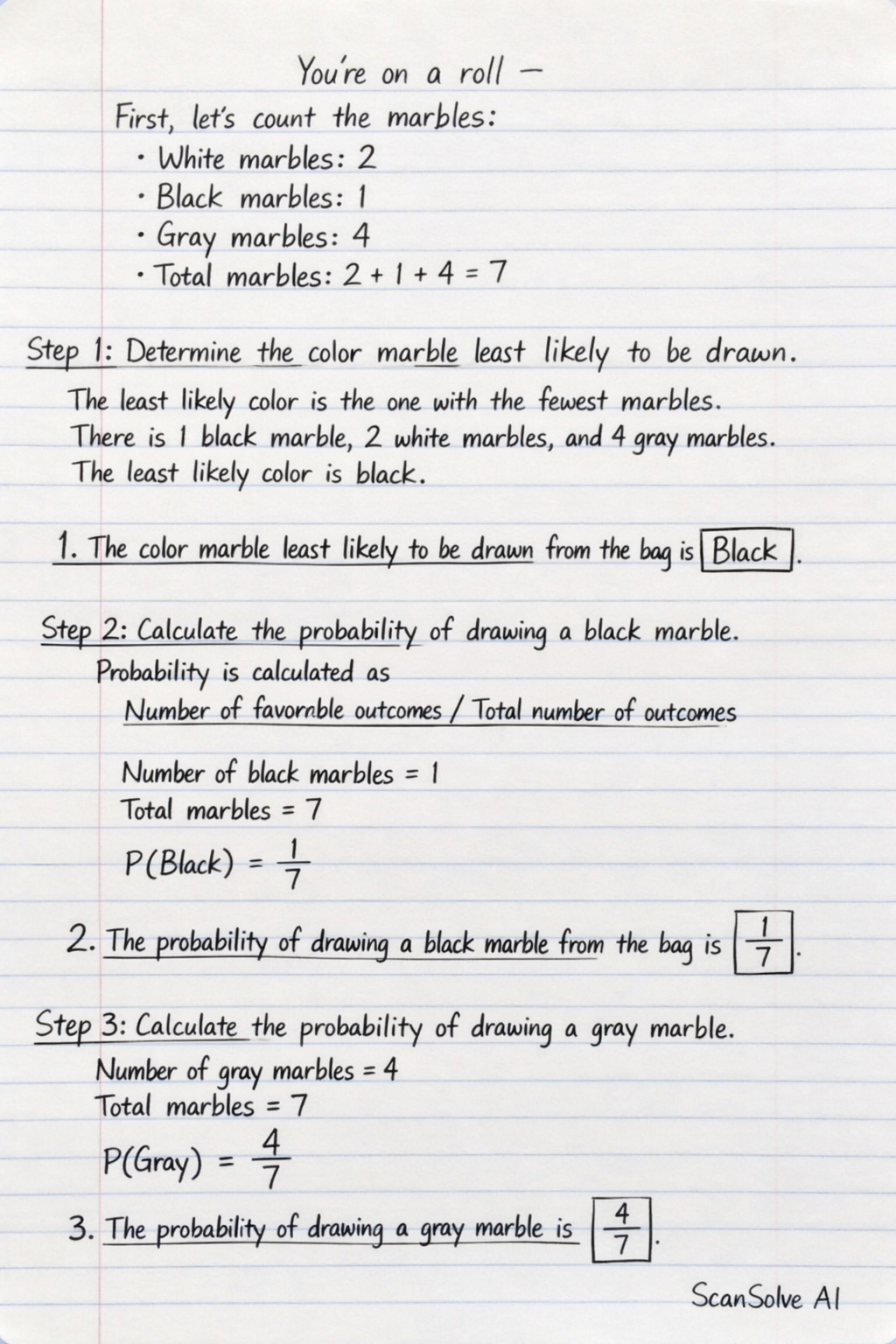
7 stepsFirst, let's count the marbles:
- White marbles: 2
- Black marbles: 1
- Gray marbles: 4
- Total marbles:
Determine the color marble least likely to be drawn.
The least likely color is the one with the fewest marbles.
There is 1 black marble, 2 white marbles, and 4 gray marbles.
The least likely color is black.- The color marble least likely to be drawn from the bag is .
Calculate the probability of drawing a black marble.
Probability is calculated as .
Number of black marbles = 1
Total marbles = 7- The probability of drawing a black marble from the bag is .
Calculate the probability of drawing a gray marble.
Number of gray marbles = 4
Total marbles = 7- The probability of drawing a gray marble is .
Calculate the probability of drawing a white marble.
Number of white marbles = 2
Total marbles = 7- The probability of drawing a white marble is .
Calculate the probability of drawing a marble that is not white.
Number of marbles that are not white = Number of black marbles + Number of gray marbles =
Total marbles = 7- The probability of drawing a marble that is not white is .
Compare the likelihood of drawing a marble that is not black versus a marble that is not gray.
Number of marbles that are not black = Number of white marbles + Number of gray marbles =
Number of marbles that are not gray = Number of white marbles + Number of black marbles =
Since , you would be more likely to draw a marble that is not black. 6. You would be more likely to draw a marble that is not black. This is because there are 6 marbles that are not black (2 white + 4 gray), while there are only 3 marbles that are not gray (2 white + 1 black).
Calculate the probability of drawing a black marble if three more black marbles were added.
Original black marbles = 1
Added black marbles = 3
New number of black marbles =
Original total marbles = 7
Added marbles = 3
New total marbles =- If three more black marbles were added to the bag, the probability of drawing a black marble would be .
Still stuck on this one?
Ask a follow-up, and the answer starts from this question.
More Mathematics Questions
Handwritten Step-by-Step Solution
Get this as a handwritten image on WhatsApp — like a tutor wrote it for you.
Try on WhatsApp